No one has to approve your Suno track before it earns money. Not a label, not a distributor's review queue, not a playlist curator, not a sync agency. Every one of those was a real gate ten years ago. Four of the five are now optional, and the fifth — sync — turns out to be the one worth walking through.
This page is not about whether you are allowed to sell AI music; that is settled and covered in is it legal to sell AI music. It is about who used to stand between a finished song and a paying listener, and which of them you can simply route around in 2026.
The five gatekeepers, and which ones still have teeth
Independent music has spent two decades dismantling its own gates, and most guides still write as if they are all standing. They are not. Here is the honest state of each.
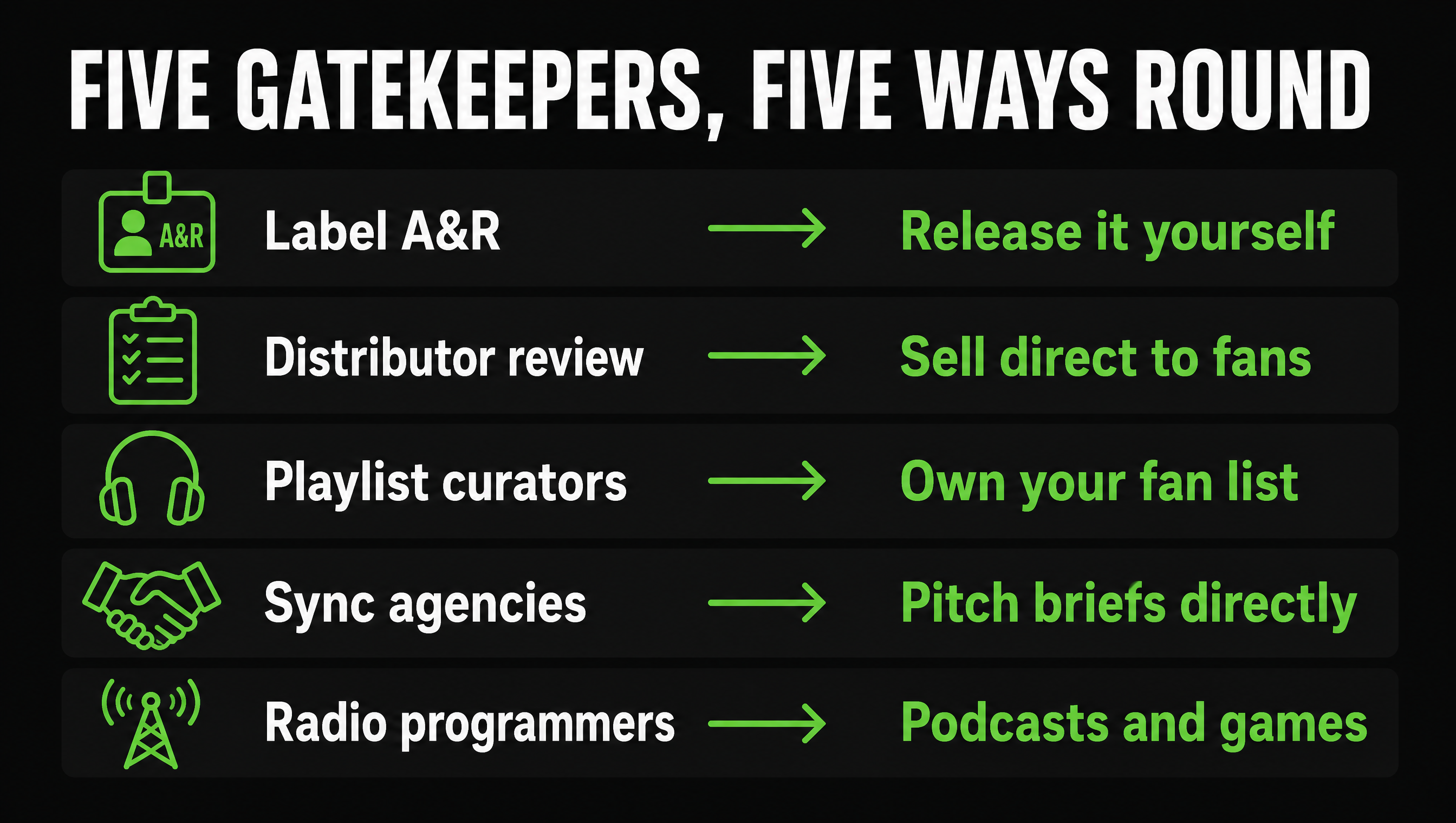
Label A&R. Gone as a requirement. You do not need a deal to put a song on sale, and taking one on a catalogue of AI-assisted tracks is unlikely to be on offer anyway.
Distributor review. Still real, and still where most AI tracks die — but only if you insist on the streaming route. Distributors run AI policies, upload classifiers and fraud rescans. That gate is covered in depth in distributing AI music without takedowns. The point for this page: it is a gate you can decline to queue for by selling directly instead.
Playlist curators. Effectively a lottery, and a bad one to build a business on. The route round is owning the relationship: an email list of people who already bought something is worth more than an editorial add you cannot repeat.
Radio programmers. Largely irrelevant to an independent AI catalogue. Podcasts, games and creator video have absorbed the discovery role radio used to hold, and none of them run a gate you have to pass.
Sync agencies and publishers. This is the interesting one, and the rest of this page is mostly about it.
First, the only gate that is genuinely non-negotiable
There is one check you cannot route around, and it happens before any of the five: do you actually hold commercial rights to the track?
Under Suno's terms (last updated 26 March 2026), paid tiers assign you Suno's right, title and interest in output generated during your paid subscription. Free and Basic output is explicitly limited to “lawful, internal, personal and non-commercial purposes” with attribution — free-tier output cannot be sold at all.
Two consequences that most guides skip:
- Assignment of rights is not the same as copyright existing. Immediately after the assignment clause, Suno states it makes no representation or warranty that any copyright will vest in the output. Combined with the US Copyright Office's human-authorship requirement, a raw one-prompt generation is generally not registrable. Your lyrics, arrangement, editing and selection can be.
- Rights attach to the plan in force when the track was generated, not the plan you hold today. Upgrading later does not retroactively clear a free-tier song. If provenance is unclear, regenerate it on a paid plan.
On the litigation everyone asks about: in GEMA v Suno (Landgericht München I, 31 July 2026) the court found works were reproducibly contained in the model and rejected a text-and-data-mining defence. The nuance almost every summary omits is the one that matters to you — liability sat with Suno as the model provider. The ruling did not address, and did not create, liability for end users who commercially exploit outputs. It is also under appeal. In the US, Warner settled with Suno in November 2025 and UMG settled with Udio in October 2025, while Sony and UMG continue litigating against Suno; reported schedules for what remains conflict, so treat any specific date you read as disputed.
Selling direct: the gate you can simply decline
The fastest way to stop worrying about distributor review is to not depend on it for revenue. Direct sales invert the economics that make streaming feel hopeless.
At a commonly reported $0.004 per Spotify stream, the arithmetic is brutal and clarifying: roughly 323 streams to equal one $1.29 sale, about 2,500 to equal a $10 album, and around 250,000 to equal a single $1,000 sync fee. Always state the rate you are assuming — the published range runs $0.003–$0.005 and an unstated midpoint quietly misleads.
That is the whole case for direct sales. One buyer who likes a song enough to pay for it replaces a number of streams you are unlikely to reach from a standing start.
On Played, a storefront lives at played.fm/s/your-handle, fans pay through your own PayPal or Wise link, and Played never touches the money — there is no commission on sales because there is no payment to take a cut of. The trade-off is worth stating plainly: because transactions happen off-platform, the platform cannot see or verify your sale prices. Any figure you see quoted is an asking price. We would rather say that than publish a revenue statistic we cannot substantiate.
Sync: the gate worth queueing for
Sync licensing — music placed in TV, film, ads, podcasts and games — is the one gate where the doorman was doing something useful, and where AI music has a genuine structural advantage.
The reason is boring and important: sync buyers need one-stop, undisputed rights. A supervisor licensing a track needs to clear both the composition and the recording, quickly, from someone who can actually grant it. A band with four writers, a publisher and an ex-manager is a week of paperwork. If you generated a track on a paid plan, wrote the lyrics and own the master outright, you are the entire rights holder. You can clear it in one email.
That is a real edge, and it is worth understanding what it does not fix, because buyers have a legitimate objection. Pure AI output generally is not copyrightable, which makes the rights weaker than a conventional recording. AI exports also carry detection markers — SynthID, C2PA, spectral fingerprints — that can flag a track downstream. A song that might be disputed or pulled mid-campaign is a liability a supervisor avoids when a clean alternative exists. Clearing the file before you pitch is covered in the AI music watermark remover guide; the fuller sync-readiness checklist is in can AI music get sync deals.
What sync actually pays
Forget the six-figure placements you read about; those are majors on network campaigns. The indie reality is smaller, more frequent and far more reachable. On Played's own briefs board the range runs $120 to $3,000, with concrete examples like a board-game trailer at $600 and a travel series at $700 per track.
Put that against streaming at $0.004 and one $3,000 placement is worth roughly 750,000 streams. That is the argument for sync in a single line.
How to pitch without an agency
The traditional route is to sign to a library or publisher, who takes a cut and controls what gets pitched. The direct route is to answer briefs yourself. On Played, Artist subscribers buy pitches as needed; Pro includes 3 pitches a month and Label 10, and Played takes 0% of any sync fee, you keep the whole thing, plus your masters and publishing.
Four things are disclosed up front, before a pitch is spent, because they are true of sync everywhere and you should plan around them:
- Reviews can take up to six months. Silence is not a rejection.
- Your subscription must stay active or the pitch is withdrawn.
- Only pitch briefs the music genuinely fits — an off-brief pitch is still spent. That is what the cap is for.
- A pitch is a submission, not a placement. Nobody can promise otherwise, and the buyer sets the fee.
What we can and cannot prove about our own board
Most platforms would stop at the pitch above. Here is the part that usually gets left out, because a page about escaping gatekeepers should not quietly become one.
The briefs board currently shows 23 open briefs. Ten of those came from buyers who approached us. The other thirteen we authored ourselves as grounded, indie-scale examples of the kind of work the board is for. They are illustrative, not inbound demand, and any total budget figure derived from all 23 should be read with that in mind.
Two further things we structurally cannot measure, and will not pretend to:
- Sale revenue. There is no orders table, because fans pay you directly. That is the flip side of taking 0% — we never see the transaction.
- Placement rate. Applications can be submitted, shortlisted or closed. There is no “placed” state, because deals close off-platform between you and the buyer. We could not compute a brief-to-placement conversion rate even if we wanted to quote one. If a competitor quotes you a placement rate, ask how it was measured.
Played is also early. A number of the storefronts you will browse are showcase profiles we built to demonstrate the format, and they are labelled as such. The full accounting, including real seller counts, is published in the Suno seller's handbook. We would rather you arrive with accurate expectations than churn in month two.
The workflow, end to end
Putting the whole thing together for a single Suno track:
- Generate on a paid plan. Free-tier output cannot be sold. Keep your project files — provenance is the thing you will be asked for if a claim ever lands.
- Finish it properly. A sync buyer needs a broadcast-quality master, and usually an instrumental and stems too. See how to master AI music.
- Clean the file before it goes anywhere. Detection markers are the single most avoidable reason a track gets rejected or quietly pulled.
- Put it on sale directly so revenue does not depend on anyone's approval queue.
- Pitch it to briefs it actually fits, and expect a long, quiet review.
- Own the fan list. It is the only asset on this page that no platform, curator or algorithm can revoke.
Who this is not for
If you want someone to tell you your music is good enough, this route will not give you that; the absence of a gatekeeper is also the absence of validation. If you are uploading one track for fun, a subscription will not pay for itself. And if your plan depends on a placement arriving in week one, the six-month review reality will be miserable.
The route works if you have a real catalogue, you would rather own the relationship than rent an algorithm's attention, and you can treat sync as a slow compounding channel rather than a lottery ticket.
Frequently asked questions
Can I sell Suno songs without a label or distributor?
Yes. Neither is required to sell music. A label is optional and a distributor is only needed if you want streaming placement specifically. Selling directly from your own storefront skips both — you set the price, the fan pays you, and no one reviews the release first. You do need commercial rights, which on Suno means generating on a paid plan.
Do I need to be on a paid Suno plan to sell my songs?
Yes. Suno's terms assign commercial rights only for output generated during a paid subscription. Free and Basic output is limited to personal, non-commercial use with attribution and cannot be sold. Rights attach to the plan in force when the track was generated, so upgrading later does not clear an earlier free-tier song — regenerate it on a paid plan if the provenance is unclear.
Can AI music actually get sync deals?
Yes, and AI music has a structural advantage: sync buyers need one-stop, undisputed rights, and a track you generated, wrote and own outright can be cleared in one email. The obstacles are that pure AI output generally is not copyrightable, and AI exports carry detection markers that can flag a track later. Clear both and an AI track pitches like any other.
How much does a sync placement pay?
For independent work, far less than the six-figure placements that make the news, and far more than streaming. Played's briefs board runs $120 to $3,000, with real examples including a board-game trailer at $600 and a travel series at $700 per track. At a commonly reported $0.004 per stream, a $3,000 placement is worth roughly 750,000 streams.
Do I need a sync agency or publisher to pitch?
No. Agencies and libraries take a cut and control what gets pitched. Answering briefs directly keeps the whole fee and the decision. On Played, Artist subscribers can buy pitches; Pro includes 3 pitches per month and Label 10. Played takes 0% platform commission on sync deals; payment provider fees may apply.
How long does a sync pitch take to hear back?
Up to six months, and silence is not a rejection. Buyers work to production schedules that have nothing to do with when you pitched. A pitch is a submission, not a placement, and the buyer sets the fee — plan for sync as a slow compounding channel rather than immediate income.
How many streams equal one direct sale?
At $0.004 per stream, roughly 323 streams equal one $1.29 sale and about 2,500 equal a $10 album. The published rate range is $0.003–$0.005, so always state the rate you are assuming — the spread is wide enough that an unstated midpoint misleads.
Does Played take a commission on sales or sync?
No, 0% on both. Fans pay through your own PayPal or Wise link so Played never touches the money, and sync fees go straight to you. Played earns from subscriptions instead. The honest trade-off is that because transactions happen off-platform, the platform cannot verify sale prices — any figure quoted is an asking price.