There are 23 open sync briefs on the Played.fm board right now, from buyers who have said what they want and what they will pay. Since the board opened, artists have sent one pitch. Not one a day — one, total.
We publish that ratio because it is the most useful number we have, and because it says something no marketing page will: the hard part of selling AI music in 2026 is not competition. It is that almost nobody finishes the boring steps. This page is the handbook for those steps. By the end of it you will know which Suno plan actually lets you sell, what to do on each of the next seven days to get one track priced and buyable, what every revenue route really pays with the arithmetic shown, and where Played.fm is the wrong answer for you.
We are the company selling the storefront, so treat every claim here as one you should check. Most of them link to the source.
Key takeaways
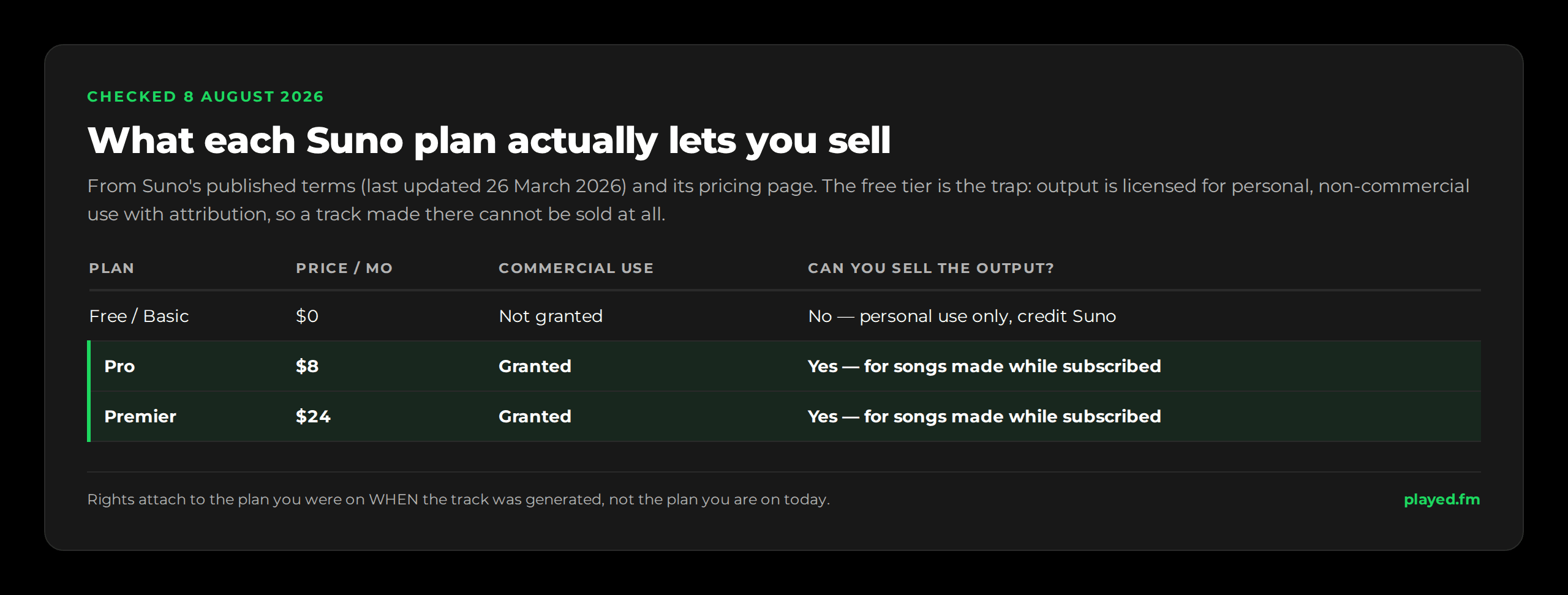
- Suno's free tier cannot be sold from. Commercial rights start on Pro at $8/month, and they attach to the plan you were on when the track was generated.
- Selling and owning are different questions. Suno assigns you its rights, then states it makes no warranty that any copyright vests in the output at all.
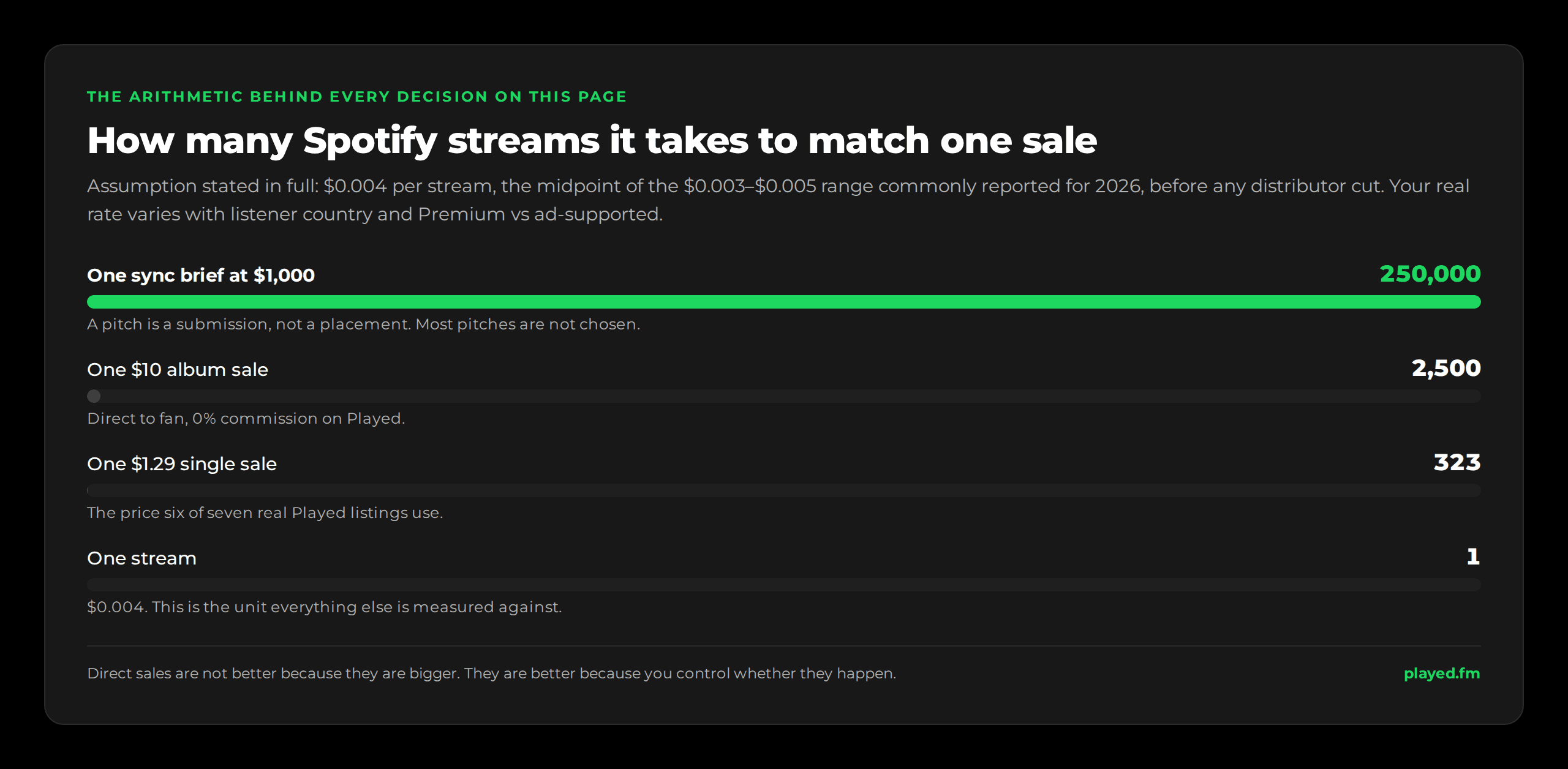
- One $1.29 sale equals 323 Spotify streams at $0.004 per stream. One $1,000 sync brief equals 250,000.
- A pitch is a submission, not a placement. Played.fm has recorded 1 pitch and 0 shortlistings, and does not track placements at all.
- 3 artists have a live listing here out of 14 real accounts, as of 8 August 2026. Six of the seven tracks are priced at $1.29.
- The 7-day trial requires a card and converts to Pro at $19.99/month unless you cancel first.
Can I sell music I made with AI?
Yes — and the question splits in two the moment you look at it properly. "May I sell this?" is answered by your generator's licence. "Do I own this?" is answered by copyright law, and it has a much less comfortable answer. Conflating them is the single most common mistake in this whole subject.
What Suno's licence actually grants
Suno's terms of service, last updated 26 March 2026, draw a hard line at the paid tier. On Pro or Premier, Suno "assigns to you all of its right, title and interest in and to any Output owned by Suno and generated from Submissions made by you" during your paid subscription. On the free tier you agree to use output "solely for your lawful, internal, personal and non-commercial purposes" with attribution to Suno.
That word non-commercial is doing a lot of work. A track generated on the free plan is not yours to sell, at any price, anywhere — not on a storefront, not to a sync buyer, not bundled into an album. And because the assignment covers songs made while subscribed, upgrading later does not retroactively clear a track you generated for free. If you are unsure which plan produced a song, regenerate it on a paid plan before you do anything else. It costs one generation and removes the only genuinely fatal problem on this list.
Owning it is a separate, weaker story
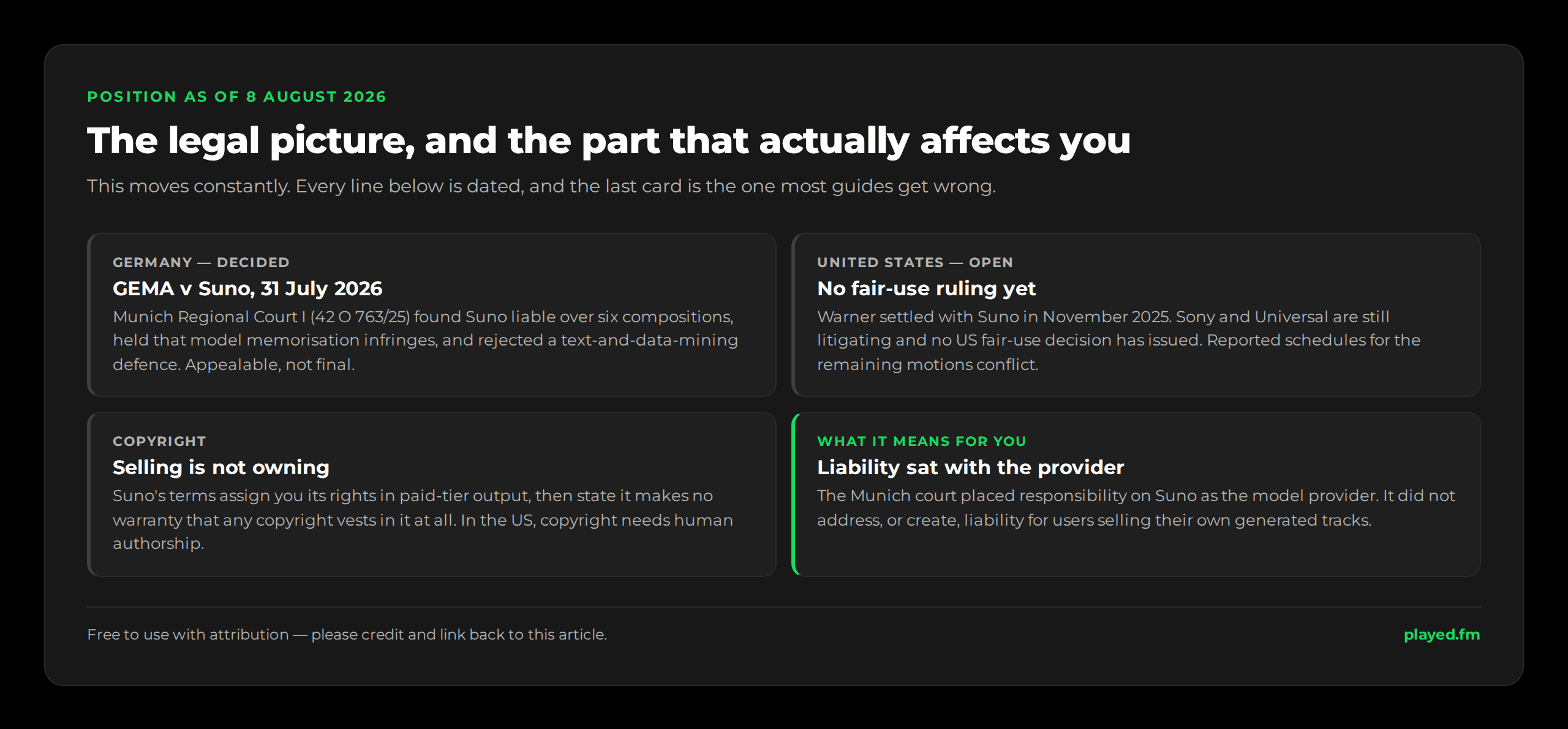
Here is the sentence most guides skip. Immediately after assigning you its rights, Suno adds that "due to the nature of machine learning, Suno makes no representation or warranty to you that any copyright will vest in any Output." Suno is handing you whatever it has, while declining to promise that what it has is a copyright at all.
That is not evasion; it reflects the law. The US Copyright Office requires human authorship, so a one-prompt generation with no meaningful human creative contribution is not registrable on its own. Your lyrics, your arrangement, your editing and selection can be protected. The raw output of a text box generally cannot.
What that means in practice: you can legally sell a track while having little or no ability to stop someone else copying it. For selling direct to fans, that trade-off is usually fine — people are buying the song and supporting you, not licensing a monopoly. For an exclusive sync deal where you sign an indemnity warranting you control the work, it matters a great deal. Our fuller treatment is in is it legal to sell AI music.
Where the litigation stands, and who it lands on
On 31 July 2026 the Munich Regional Court I ruled against Suno in GEMA v Suno (42 O 763/25), finding that six compositions were reproducibly memorised in Suno's models, rejecting a text-and-data-mining defence, and ordering disclosure and damages. It is appealable and not final. In the United States, Warner settled with Suno in November 2025 while Sony and Universal continue to litigate; no US fair-use ruling has issued, and published reports of the remaining schedule disagree with each other, so we are not going to pretend to a date.
The part that matters to you is the part the headlines omitted: the Munich court placed liability on Suno as the model provider. It did not address, and did not create, liability for an artist selling their own generated track. Nothing in that ruling makes your release unlawful. What it does do is make the provenance of your generator a live commercial question, which is worth remembering before you sign anything exclusive.
How to sell Suno songs: the seven-day version
This is the part that actually decides whether you make a sale, and it is unglamorous. Nothing below needs a label, a distributor, a following, or money beyond your Suno subscription. It needs one finished song and a few focused hours.
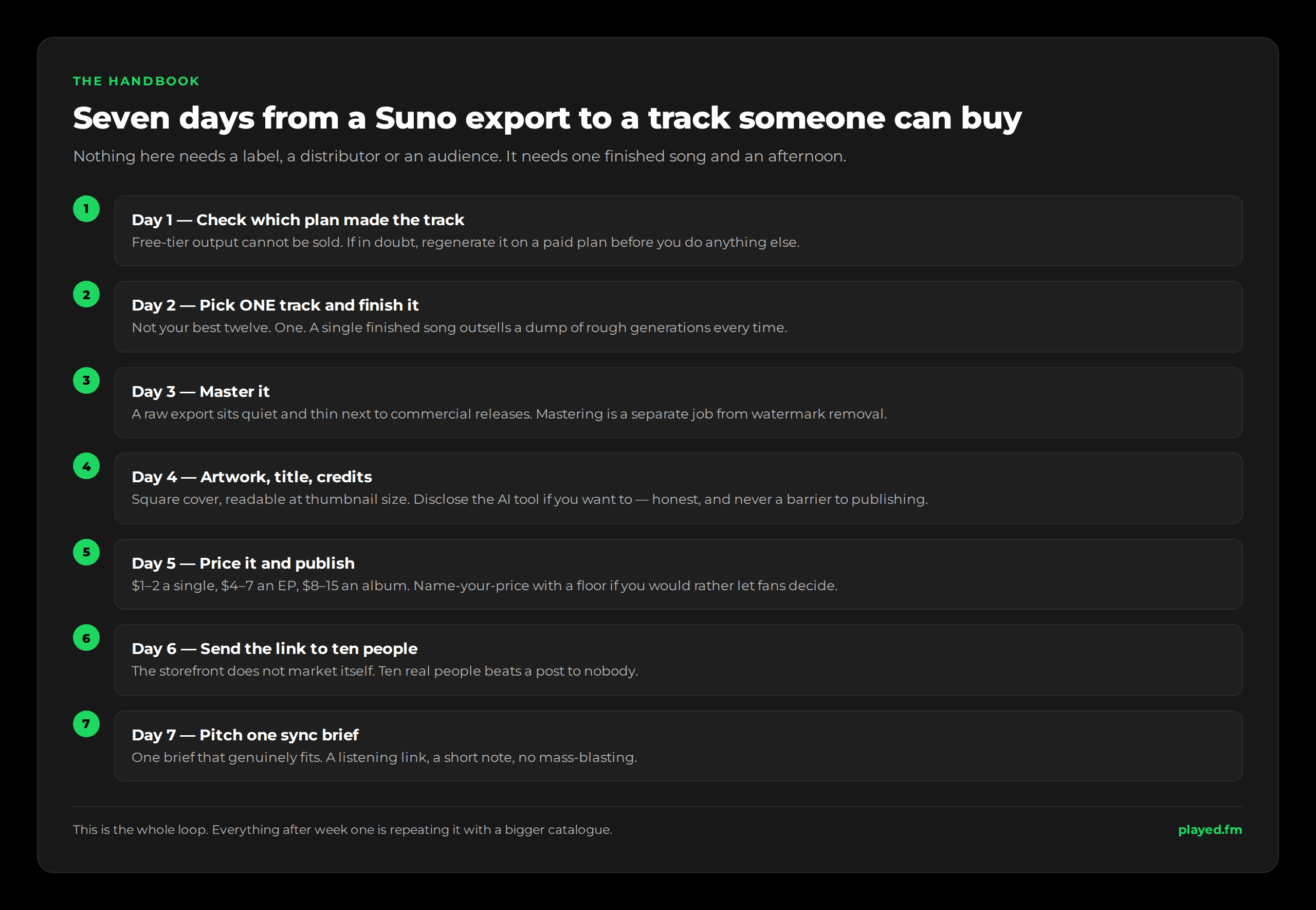
Day 1 — Confirm the plan that made it
Covered above, and first for a reason: every other step is wasted effort if the licence is wrong.
Day 2 — Choose one track and finish it
Suno's throughput is its blessing and its trap. Thirty generations at 80% is worth less than one at 100%, because a buyer hears one song and decides. Pick the one you would still defend in a month. Export the highest-quality file Suno offers and treat it as raw material, not a finished master.
Day 3 — Master it
A raw generation sits quiet, thin, and slightly wrong next to commercially released music, and listeners register that as "cheap" without knowing why. Mastering fixes loudness, tonal balance and low end. It is a different job from removing generator watermarks, which matters only if you are also sending the track to streaming — that path, and the takedown risk that comes with it, is covered in distributing AI music without takedowns. If you are selling direct, streaming AI policies do not apply to you at all. Played includes mastering on every plan; how to make AI music sound professional walks through the finishing decisions either way.
Day 4 — Artwork, title, credits
A square cover that is still readable as a thumbnail, a title that is not "Untitled (final v3)", and credits you are willing to stand behind. Disclosing which AI tool you used is optional on Played and never blocks publishing — plenty of artists do it, and it costs them nothing.
Day 5 — Price it, and do not undercharge
This is where AI creators lose the most money, discounting on the assumption that "AI-made" should be cheap. Fans buying direct are paying for a song they like and for you to make more; they are not auditing your production method. Workable anchors: $1–2 a single, $4–7 an EP, $8–15 an album. Name-your-price with a floor works well if you would rather let fans decide, and superfans routinely pay over it.
For what it is worth, six of the seven tracks currently listed by real artists on Played are priced at $1.29, and the seventh is name-your-price with an $0.80 floor. That is a very small sample and I would not read a trend into it, but it does suggest most people reach for the default rather than think about it. Bundles are the easy win Suno makes possible: a themed six-track EP at $6 is a simple yes for a fan and earns far more than the same songs sold one at a time.
Day 6 — Send the link to ten actual people
A storefront is not a marketing channel. It is a place to send people you have already reached. Ten individual messages to people who know you will outperform a broadcast post to an audience you do not have yet. This is the step most people skip, and it is the step that produces first sales.
Day 7 — Pitch exactly one sync brief
Read the open briefs, find the one your track genuinely fits, and send a listening link with a short note about why it fits. One good pitch beats ten scattergun ones, which supervisors recognise instantly. Be clear-eyed about what you are doing: a pitch is a submission. The buyer may choose someone else or nobody. More on the mechanics in how sync licensing works. If you want to see the current briefs and what they pay before committing to anything, they are listed on the seller overview.
How to make money from Suno music: every route, ranked honestly
The routes below are ordered by what they realistically return for an independent artist with a small audience. Each one includes where it is the wrong answer, because that is the part that saves you time.
1. Direct-to-fan sales — best margin, needs an audience
Highest return per listener by a wide margin, and the only channel where you set the price and keep the whole amount. On Played, fans pay through your own PayPal or Wise link, so we never touch the money and take 0% of it. Wrong answer if: you have no way to reach anyone. Direct sales convert an existing audience; they do not create one.
2. Sync licensing — biggest single cheques, lowest hit rate
One placement can pay more than a year of streaming. Briefs on our board run from $120 to $3,000. It also has the least predictable outcome of anything here, and it rewards preparation — an instrumental version, a clean master, honest metadata — more than it rewards volume. Wrong answer if: you need money this month, or you would be counting on it.
3. Streaming — reach, not revenue
Worth doing as a discovery channel, never as an income plan. At a commonly reported 2026 rate of $0.003–$0.005 per stream, the midpoint of $0.004 means 323 streams to match a single $1.29 sale and 250,000 to match a $1,000 brief. It is also the channel where AI music faces the most scrutiny, from distributor policies through to rescans months after release. Wrong answer if: you are treating stream counts as progress toward income. See what artists actually make per stream.
4. Stock and production libraries — steady, and often a trap
Libraries pay small recurring fees and can absorb a large catalogue, which suits Suno's output rate. Read the exclusivity terms with real attention: many take the track off the market entirely, and an exclusive deal on a work whose copyright status you cannot fully explain is a bad combination. Wrong answer if: you might later want to sell or license that track yourself.
5. Commissions — reliable income, not a catalogue
Making bespoke music to order — a podcast theme, a shop playlist, a wedding song — pays promptly and prices well, because you are selling your time rather than competing on catalogue. It builds no asset that earns while you sleep. Wrong answer if: you want income that compounds.
If that arithmetic has landed and you want to test the direct-sales route rather than read about it, the 7-day free trial is the cheapest way to do it: the full Pro plan, up to 3 tracks and 1 sync pitch during the week. A card is required and verified at signup but not charged. Cancel any time in one click before day 7 and you pay nothing. If you stay, it becomes Pro at $19.99/month, the limits lift to unlimited tracks and 3 pitches a month, and we email you before the charge rather than after. Your tracks remain yours and stay in your account if you cancel.
Suno monetization: what changes as you scale
The advice above works for your first track. Some of it stops working at your fiftieth, and this is the section that thin guides never write because it requires having been there.
- The 1,000-stream threshold. Spotify pays nothing on tracks below roughly 1,000 annual streams. A large catalogue of low performers earns literally zero from that channel while still costing you distribution fees.
- Catalogue dilution. Volume is Suno's obvious advantage and its subtlest danger. A storefront with 200 tracks and no curation converts worse than one with 20, because a visitor with no way to choose usually chooses nothing.
- Screening gets stricter with scale, not looser. Distributor classifiers and platform rescans react to upload patterns as much as to audio. Steady, curated releases attract less scrutiny than batch dumps — the mechanics are in can you sell AI music on Spotify.
- PRO registration turns on human authorship. Performing-rights organisations generally expect a human writer. Wholly machine-generated works with no identifiable human contribution sit awkwardly with that, while a track where you wrote the lyrics or shaped the arrangement is a far more ordinary registration.
- Models get deprecated. Rights attach to the generation, but the model that made your catalogue will not be available forever, and licensing settlements are already changing what future models are trained on. Keep your project files and highest-quality exports. You cannot re-render a deprecated model.
What Played.fm can actually prove, published in full
Every platform in this market quotes encouraging statistics. Here are ours, queried from production on 8 August 2026, with the showcase demo profiles on our own site excluded because counting them would flatter us. They are small. We opened to sellers in late June 2026, and rounding them up would be a lie.
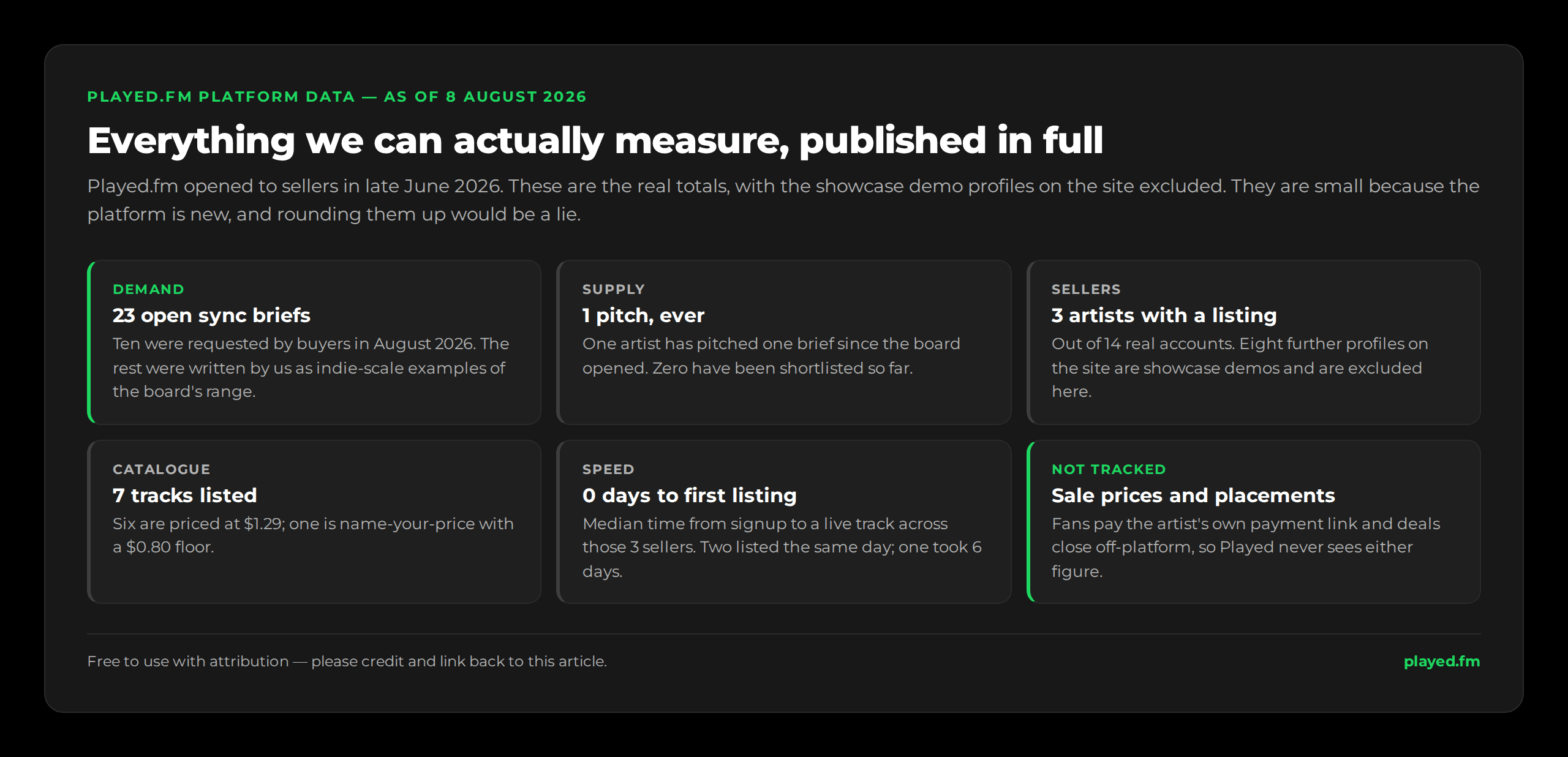
Three things in there deserve saying in words rather than in a graphic.
We cannot tell you a placement rate, and neither can anyone else who is being straight with you. Our database has no field for a placement. Deals close directly between artist and buyer, off-platform, because we are not a middleman on them. So when a competitor quotes you a success rate, the fair question is how they measured it.
We cannot tell you what tracks sell for either. Fans pay the artist's own payment link, which is the whole point of taking 0% — but it also means we never see a transaction. The prices above are asking prices, not sales.
Ten of the 23 briefs came from buyers; we wrote the rest. The other thirteen were written by us as realistic, indie-scale examples of the range the board covers. They are labelled here because a demand figure you cannot audit is worth nothing.
The honest summary is that the demand side of this board is considerably further along than the supply side. If you are reading this in August 2026 and you finish the seven days above, you are pitching into a queue of one.
Who Played.fm is not for
A page that only lists strengths is a page you should not trust. Four situations where we are genuinely the wrong choice:
- Your sales already come from Bandcamp's own discovery. If buyers find you through Bandcamp's editorial, tags and browsing rather than through links you send, moving is a downgrade. We do not have that discovery layer. Compare the trade-offs in Bandcamp alternatives and what Bandcamp takes.
- You need a built-in audience. We give you a storefront, not listeners. If your plan depends on the platform bringing people to you, no 0% commission will help — you will make more on a platform that takes a cut and sends traffic.
- You want a guaranteed placement. Nobody can sell you that. Our board is a place to submit; the buyer decides. If a service promises you a placement for a fee, that promise is the product and it is not a good one.
- You are streaming-first. If your goal is Spotify playlists and monthly-listener growth, your money is better spent on distribution and promotion than on a direct storefront.
If you are still here — you have finished tracks, you can reach a few people, and you want to keep what you earn — then what Played.fm actually does is the fastest page to check us against.
Frequently asked questions
Can I sell music I made with AI?
Yes, if your generator's licence grants commercial rights and the platform you sell on permits AI music. On Suno that means a paid plan, and the rights attach to tracks made while you were subscribed. Whether you also own an enforceable copyright is a separate and weaker question.
Can you legally sell music made with Suno?
Generally yes on Pro or Premier. Suno's terms, updated 26 March 2026, assign you its rights in paid-tier output. Free-tier output is licensed for personal, non-commercial use with attribution and cannot be sold at all.
Do you own the copyright to Suno songs?
Probably not in full. Suno assigns you its rights but explicitly makes no warranty that copyright vests in the output. In the US, copyright requires human authorship, so your lyrics, arrangement and editing can be protected while a raw one-prompt generation generally cannot.
Does the GEMA ruling mean I cannot sell my Suno tracks?
No. The Munich Regional Court's 31 July 2026 decision placed liability on Suno as the model provider over its training and outputs. It did not address liability for users selling their own generated music, and it is appealable and not yet final.
How do I sell Suno songs without a distributor?
Sell direct. Master the track, add artwork and a price, and publish it on a storefront that accepts AI music. No distributor, no approval queue, and no streaming platform's AI policy applies, because you are not sending it to streaming.
How much should I charge for a Suno track?
$1–2 for a single, $4–7 for an EP, $8–15 for an album, or name-your-price with a floor. Do not discount because it was AI-made; buyers are paying for the song. Six of seven real listings on Played currently sit at $1.29.
How much money can I make from Suno music?
It depends entirely on reach, and honest arithmetic beats a promise: one $1.29 sale equals about 323 Spotify streams, and one $1,000 sync brief equals about 250,000. Direct sales to a small real audience outperform streaming to strangers.
Why do my Suno songs get taken down from Spotify?
Usually an embedded watermark or spectral fingerprint caught by a distributor classifier or a later catalogue rescan, often weeks after the track went live. Standard exporting does not remove those signals. Direct sales are not affected.
Is Suno monetization worth it on the $8 Pro plan?
The plan is the cheapest part of this. One $10 album sale roughly covers a month of Pro. The real cost is the few hours of finishing, mastering and pricing that turn a generation into something someone will buy.
What does the Played.fm free trial actually cost?
Nothing for 7 days. A card is required and verified at signup but not charged, and you get the full Pro plan capped at 3 tracks and 1 sync pitch for the week. Cancel in one click before it ends and you pay nothing; otherwise it becomes $19.99/month and the caps lift.
The bottom line
Selling Suno music is mostly a sequencing problem. Confirm the plan that made the track, finish and master one song, price it like it has value, put it somewhere that does not gatekeep AI music, and then do the unglamorous work of telling actual people it exists. The legal picture is genuinely unsettled, but the unsettled part sits with the model providers, not with you selling your own release.
What we can offer is a storefront that takes 0% of your sales, a sync board with more open briefs than pitches, and the numbers above published without flattering ourselves. What we cannot offer is an audience or a guaranteed placement, and anyone offering you those is worth less trust than we are asking for. If that trade sounds right, start the 7-day trial — card verified, not charged, $19.99/month after only if you decide to stay.