Sync licensing is the one part of the music business where a single yes still pays like a real job. Streaming pays about $0.004 a play; one placement of your track under a scene, a trailer, a podcast intro or a game menu pays a fee upfront, in one payment, and usually leaves you free to license it again.
It is also the part of the business that most independent artists never seriously attempt, because the route in looks gated. It is much less gated than it looks, and the reason is structural: if you wrote and recorded your own music, you are the easiest possible person for a music supervisor to say yes to.
This is the full picture: what a sync licence actually is, what placements really pay (including real numbers from live briefs), the four routes in and what each takes from you, and how to get a catalogue ready to pitch this week.
What sync licensing actually is
A synchronisation licence grants someone the right to pair your music with moving images. Every placement needs permission for two separate rights:
- The composition — the song as written: melody, chords, lyrics. Owned by the songwriters and any publisher.
- The master — your specific recording of it. Owned by whoever paid for and made the recording.
A supervisor needs a yes from both sides. On a major-label release that means chasing a label, a publisher, and sometimes several co-writers with split shares, on a deadline measured in days. It is the single biggest reason good songs get dropped from a scene.
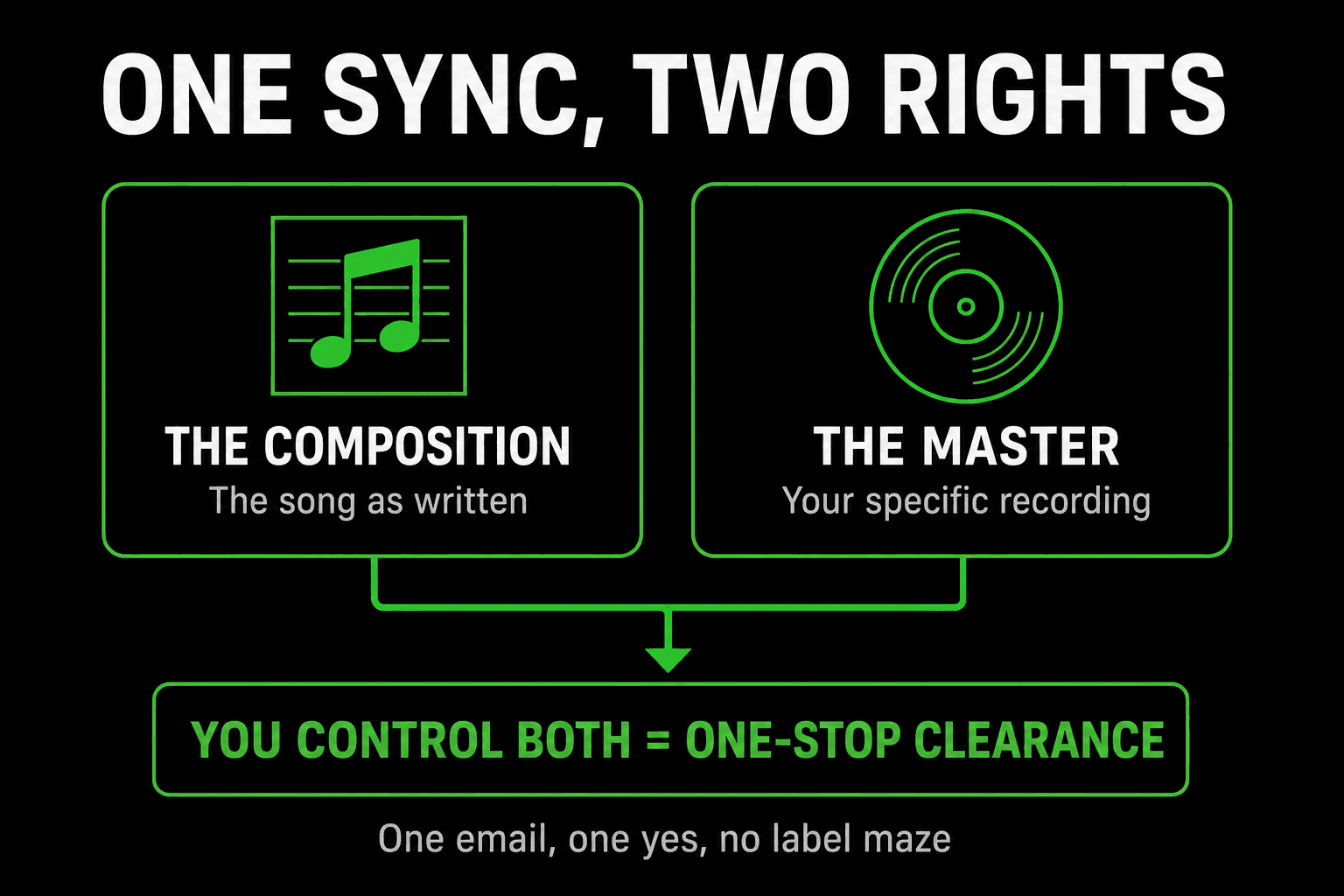
If you wrote and recorded your own track, you control both rights yourself. The industry calls that a one-stop, and it is a genuine competitive advantage over artists with better-known names. One email, one yes, no clearance maze. Say it explicitly in every pitch. If you are unclear on how the two copyrights work more broadly, we set that out in how music royalties work.
What placements actually pay
Published sync rates vary wildly, and most articles quote suspiciously precise figures without saying where they came from. The honest position is that fees depend on production budget, how prominently the music is used, territory, licence term and exclusivity, and the spread is enormous: a podcast placement might be a few hundred dollars while a national TV campaign for a well-known song can run into six figures.
Rather than repeat unsourced ranges, here is something verifiable. These are real budgets from briefs open on Played's sync board in July 2026:
- $120 / track — fitness YouTuber (60k subs), workout playlist
- $300–400 / track — wellness app focus playlist; indie roguelike game loops
- $350 — weekly interview podcast, intro and outro theme
- $750 — narrative adventure game, key-scene themes
- $900 / track — DTC skincare brand, TikTok ad series
- $1,000 — specialty coffee brand social reels; sleep podcast ambient beds (4)
- $1,500 — top-100 true-crime podcast, theme and stingers
- $1,500–3,000 — indie feature film, end-credits song
- $2,500 — festival short film, original score
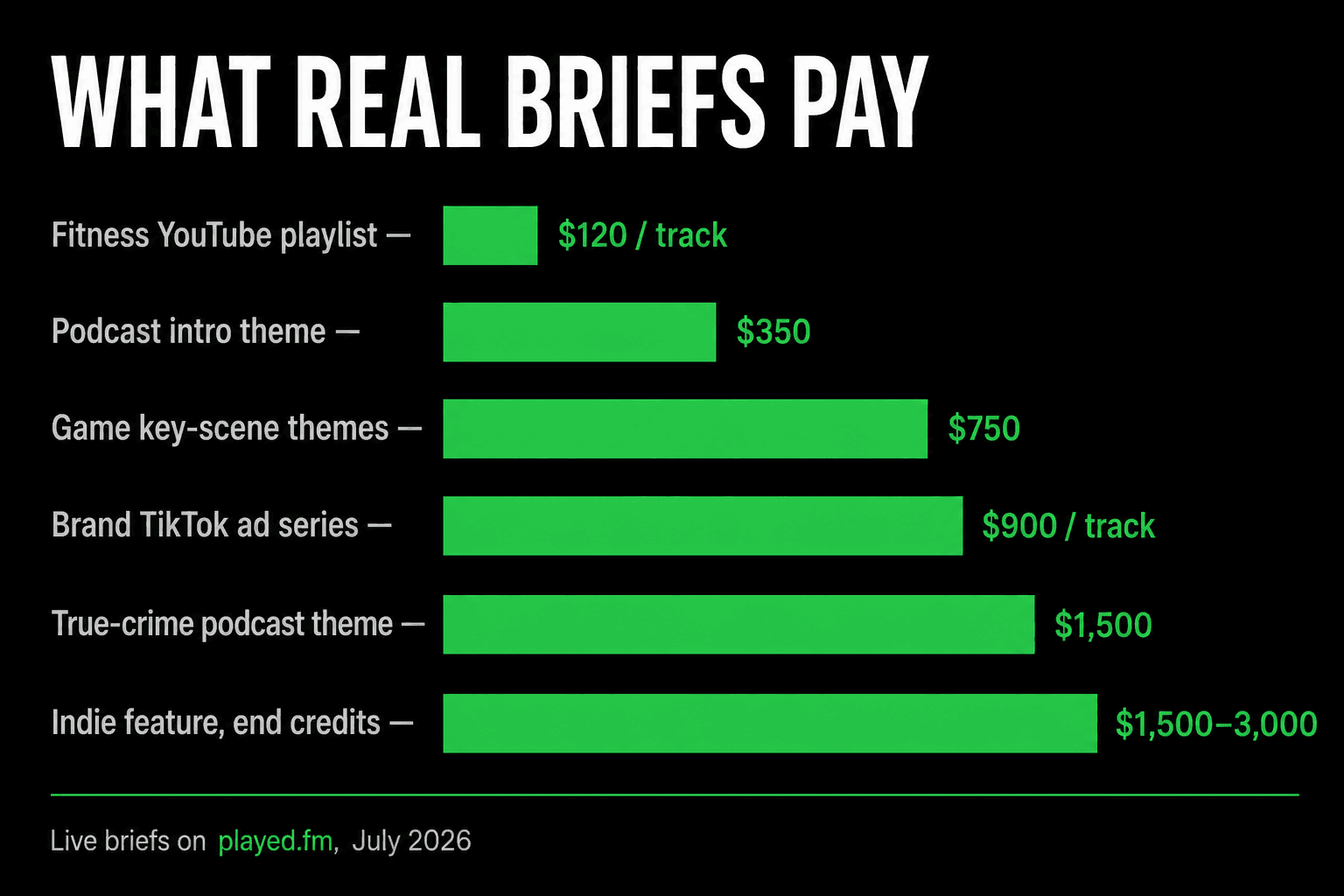
That is the realistic entry band for an independent artist without an agent: roughly $120 to $3,000 per placement. Not the $50,000 network-TV numbers that get quoted to sell sync courses, but real money arriving in one payment, from a catalogue you already own, with no cut taken.
Two things compound on top of the fee. TV and radio placements generate performance royalties every time the episode airs, collected by your PRO, which can eventually exceed the original fee. And a placement is a credit: supervisors hire from people who have already delivered.
For scale, at typical streaming rates a $750 game placement is worth roughly 190,000 streams. The full per-stream arithmetic is in how much artists make per stream.
The four routes in, and what each one takes
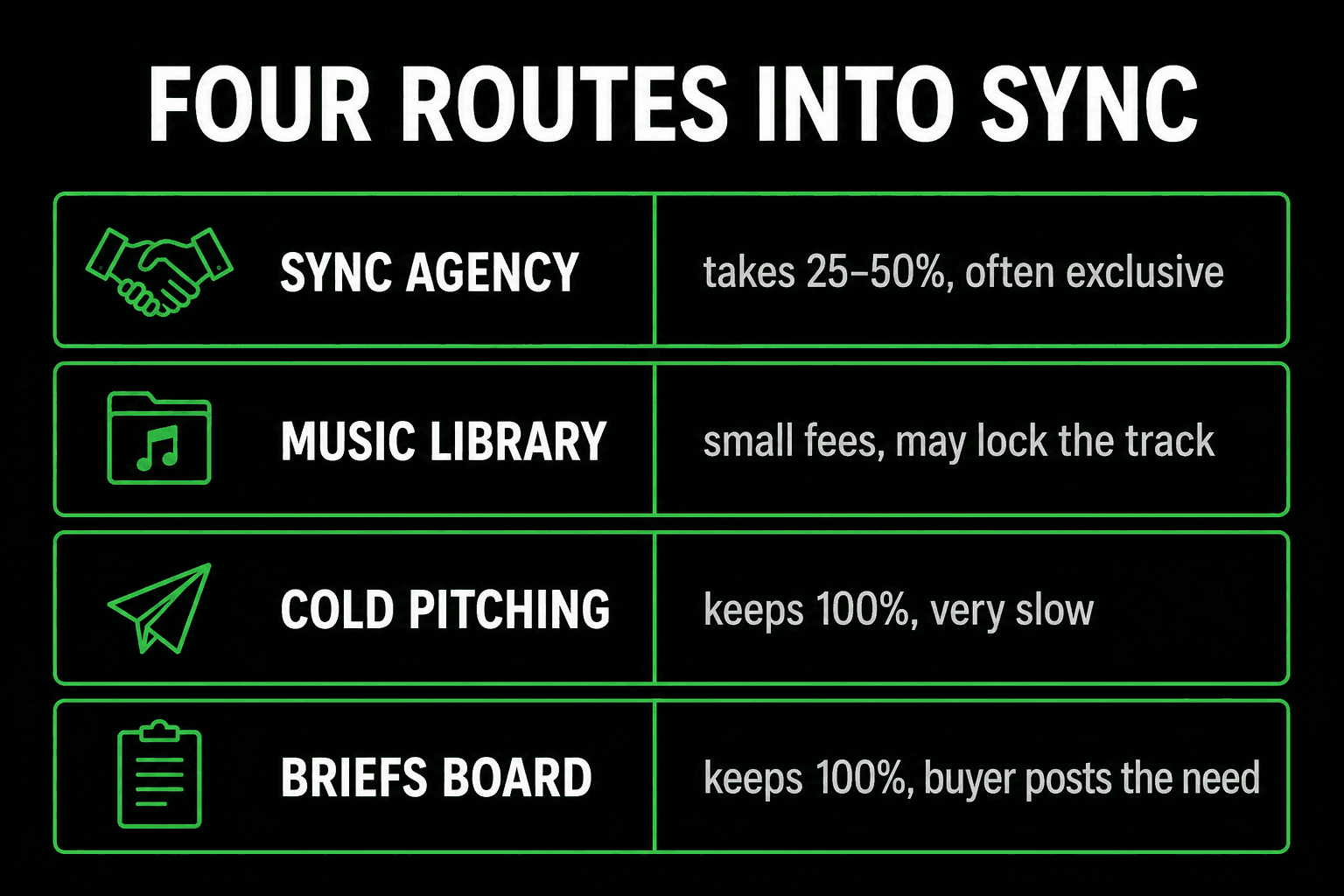
Every route to a placement charges you in a different currency. Pick deliberately.
1. Sync agencies and publishers
They pitch on your behalf using relationships you do not have. In exchange they take 25–50% of every fee, frequently with exclusivity that ties your catalogue up for years, sometimes including tracks they never place. Genuinely valuable at the top end where the relationships are the whole game, and a bad deal for a small catalogue that would place itself.
2. Music libraries and production libraries
You upload, they license at volume. The axis that matters here is not the split, it is exclusivity, and it is the thing artists most often fail to check before signing:
- Non-exclusive libraries let the same track sit in several places and be pitched directly by you. More total reach, less pitching effort spent on your behalf.
- Exclusive libraries require that the track is licensed only through them. Some pay an upfront fee for accepted tracks, which is guaranteed money whether or not it places, but that track is then out of play everywhere else.
Musicbed and Songtradr are generally non-exclusive; Artlist and Epidemic Sound operate models that take tracks off the market in exchange for upfront payment. Terms change, so read the current agreement rather than a blog post, this one included, and be specific about whether exclusivity is per-track or catalogue-wide.
3. Cold pitching supervisors
Costs 0% and works, but it is a numbers game with a long lead time. What actually gets replies: research the specific show or brand, one short personal email, one streamable link (never an attachment), a single sentence confirming you control 100%, and no follow-up chasing. Supervisors are not gatekeeping out of malice; they are on deadlines and drowning in unsolicited mail.
4. Briefs boards
These invert the model. Instead of guessing what a buyer wants, the buyer posts the requirement — budget, genre, mood, deadline — and you pitch a track that fits. You are answering a stated need rather than interrupting someone, which is why the reply rate is fundamentally different.
Where Played fits: pitch for real briefs, keep 100%
This is what we built played.fm to do, and it is the part of the platform we would point an artist at first.
Played runs a sync briefs board where buyers post real, budgeted requirements: indie games, podcasts, short films, wellness apps, DTC brands, YouTube channels. You browse the open briefs, pick one of your tracks, write a short pitch, and submit. Every brief listed in the fee table above was live on the board when this was written.
What matters about the terms:
- Played takes 0% of the placement. No agency cut, no publisher share. You license direct with the buyer and keep the whole fee.
- No exclusivity, ever. Pitching a track here does not remove it from anywhere else, and does not stop you licensing it directly yourself.
- You keep your masters and your publishing. There is nothing to sign away.
- Pro includes three pitches a month, extra pitches are available as credits, and Label includes ten with priority review. See pricing.
The honest framing: a briefs board is not a magic wand, it is a shorter queue. You still have to have the right track, master it properly and answer quickly. What it removes is the two hardest parts of sync for an independent artist, which are finding out that an opportunity exists at all, and getting a human to open your email.
What music supervisors actually want
Nearly every avoidable rejection comes down to one of these five.
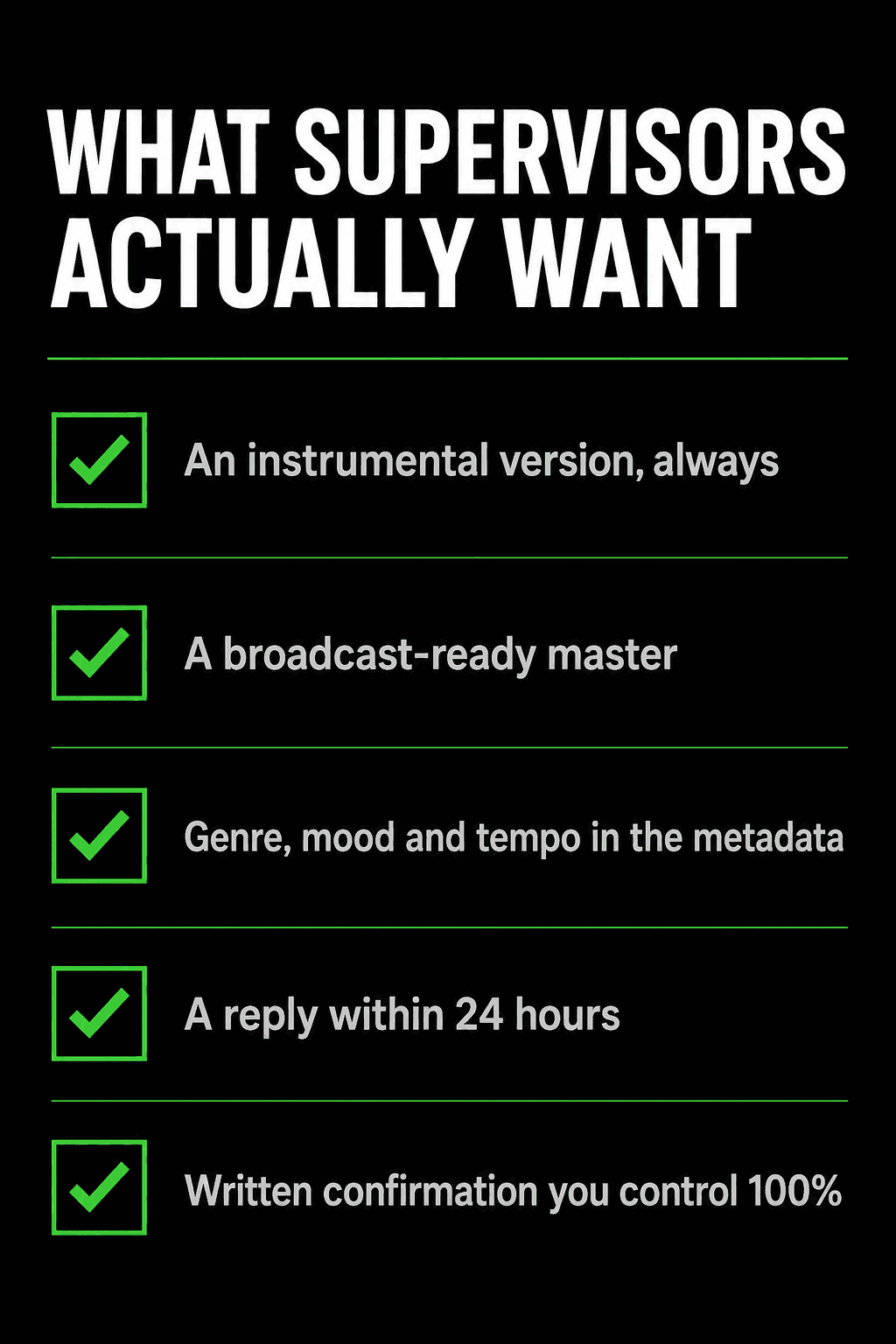
- An instrumental version. Roughly half of briefs need the vocal out of the way so dialogue can sit on top. Export one for every track, always. This alone disqualifies more artists than taste does.
- A broadcast-ready master. Consistent, clean, properly finished. Played includes mastering in every plan, and how to make AI music sound professional covers the finishing process if you are working with generated material.
- Metadata that matches how supervisors search. They search by feeling, not genre taxonomy: "tense synthwave build", "warm folk morning", "triumphant but restrained". Write one honest mood line per track. Get your ISRCs right too, because that is how a placement is tracked and paid.
- A reply inside 24 hours. Deadlines are measured in days. Slow answers lose placements that were already won.
- Written confirmation you control 100%. One sentence. It moves you to the top of the pile.
Getting your catalogue pitch-ready this week
- Pick your five strongest tracks. Not your favourites, the five most usable: clear mood, no lyrical specifics that fight a scene, no abrupt ending.
- Export instrumentals of all five. Also export a 30-second edit; short-form briefs are increasingly common.
- Master to a consistent loudness so a supervisor auditioning ten tracks does not have to ride the fader.
- Write the mood line and tag the metadata — genre, mood, tempo, and working contact details in the file itself.
- Put the catalogue somewhere fully streamable. Not 30-second previews. A supervisor needs to hear the section they care about. Your own storefront doubles as a sync portfolio.
- Pitch weekly. Sync rewards consistency far more than brilliance. One good pitch a week beats twenty in January and none after.
A note if your music is AI-generated
Sync is one of the more welcoming corners of the business for AI-assisted music, because supervisors are buying a feeling that fits a scene, not an artist story. Two practical points: confirm your generator's terms grant commercial rights, since free Suno and Udio tiers typically do not (see is it legal to sell AI music), and disclose AI involvement when asked, because a licence built on a misrepresentation is worthless to both sides. If you are also distributing to streaming, the detection question is separate and covered in distributing AI music without takedowns.
The mindset shift
Sync is not a lottery ticket. It is a second sales channel for a catalogue you already own, and it does not compete with the first one. The same track can sell direct to fans this month and license to a game studio next year, and neither use diminishes the other.
That is the whole argument for owning your catalogue outright rather than trading it away for reach. Sell direct on Played and keep 100%; pitch the same tracks for sync and keep 100% of that too. Set your catalogue up, then go and look at what is open.
Frequently asked questions
What does sync licensing mean?
A sync (synchronisation) licence is permission to pair a piece of music with moving images — TV, film, games, adverts, social video. It requires clearing two separate rights: the composition (the song as written) and the master (the specific recording). An artist who wrote and recorded their own track controls both and can clear it alone.
How much do you make from sync licensing?
It depends entirely on budget, prominence, territory and term, and the spread is very wide. For independent artists pitching without an agent, roughly $120 to $3,000 per placement is realistic — that is the actual range of live briefs on Played's board in July 2026. TV and radio placements also generate performance royalties through your PRO on top of the upfront fee.
What is the best sync licensing company?
There is no single best one, and the question to ask is not the split but the exclusivity. Non-exclusive routes (including briefs boards and libraries like Musicbed or Songtradr) let a track stay available everywhere. Exclusive libraries may pay upfront but take the track off the market. Agencies take 25–50% and are worth it mainly when their relationships are the thing you are buying.
How do I get my music licensed for film and TV?
Prepare the catalogue first: instrumental versions, broadcast-ready masters, honest mood and tempo metadata, and full streamable links. Then pick a route — agency, library, cold pitching, or a briefs board where buyers post budgeted requirements. Confirm in writing that you control 100% of both rights, and reply within a day.
Do I need a publisher or sync agent to get placements?
No. Controlling both the composition and the master makes you easier to clear than a signed artist, which is precisely what supervisors want on a deadline. An agent buys relationships and costs 25–50% of every fee, often with exclusivity. That trade makes sense at the top end and rarely for a small catalogue.
Does sync licensing stop me selling or streaming the same track?
Not unless you signed an exclusive deal. Most sync licences are non-exclusive for a defined use, territory and term, so the same track can keep selling on your storefront and stay on streaming. Always check whether a library or agency is asking for exclusivity per-track or across your catalogue.
The bottom line
Sync pays in one payment what streaming pays over years, and being unsigned is an advantage rather than an obstacle, because you can clear both rights yourself. Realistic independent placements run about $120 to $3,000. Get five tracks instrumental-ready and properly mastered, write metadata the way supervisors actually search, answer within a day, and pitch every week.
Then pitch somewhere that does not take a cut. Played's sync briefs board puts budgeted requirements from games, podcasts, film and brands in front of you, takes 0% of the placement, and asks for no exclusivity. Open your storefront and start pitching.