An ISRC code is the serial number for a recording. It is how streaming platforms, radio monitors, chart compilers and collection societies all agree that the track playing is your track, and it is the reason royalties find their way to you rather than accruing somewhere unclaimed.
Most artists never think about ISRCs because their distributor quietly assigns them. That works fine until it doesn't: you re-release a song and split its stream history in two, or you remaster a track and reuse the old code, and suddenly the reporting is wrong in ways that are tedious to unpick. This covers what an ISRC is, how to get one, and the handful of rules worth knowing.
What an ISRC actually is
ISRC stands for International Standard Recording Code. It identifies one specific recording, permanently and globally.
The key word is recording, not song. A song can have any number of ISRCs, one for each distinct recording of it: the studio version, the acoustic version, the live take, the radio edit, the remix. Each is a separate recording and each gets its own code.
The code travels with the audio for the rest of its life. Change distributor, move label, re-release on a compilation ten years later: the ISRC stays the same, and everything reported against it stays connected.
The 12 characters, decoded
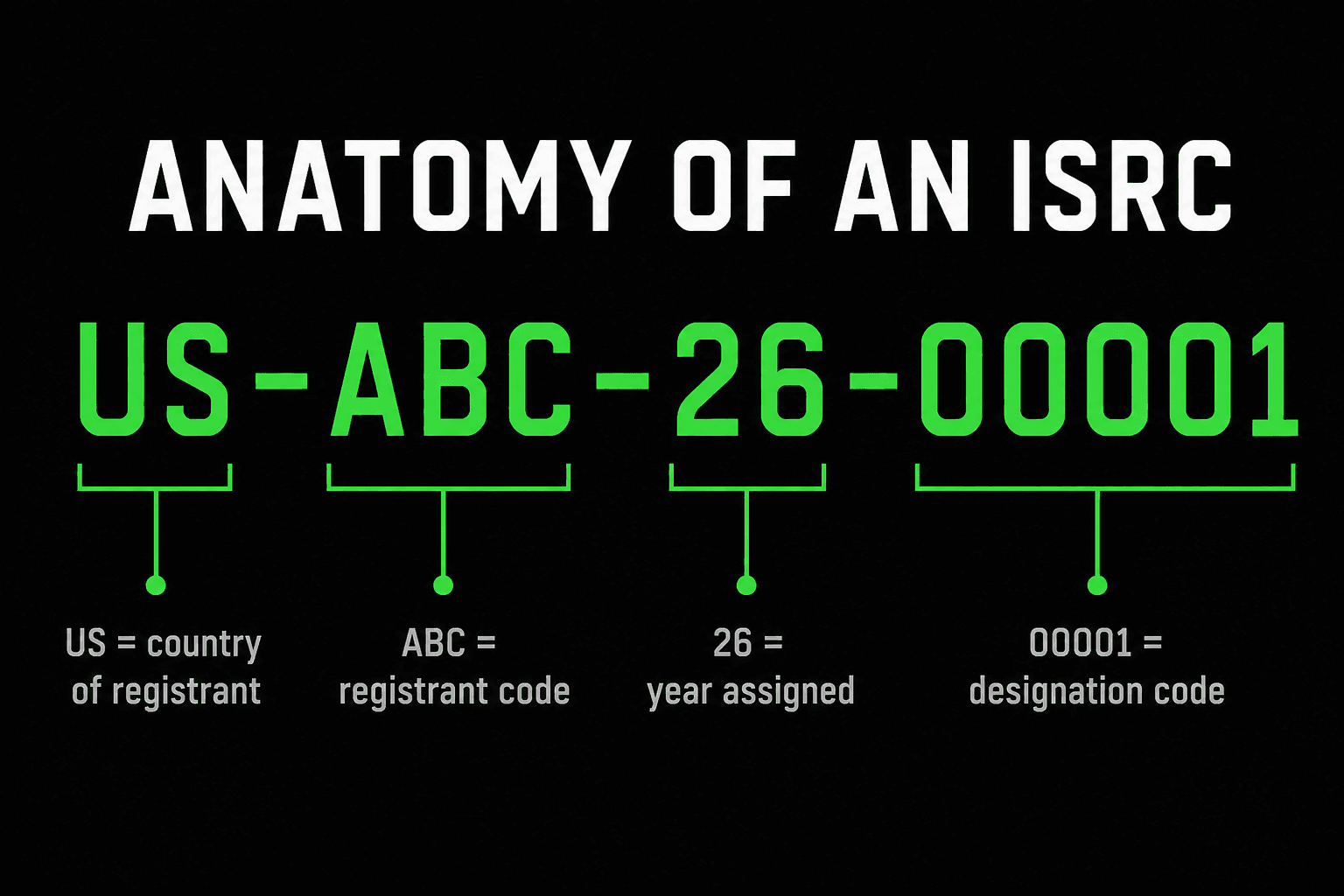
An ISRC is always 12 alphanumeric characters, usually written with hyphens for readability (the hyphens are cosmetic and are not part of the code). Take US-ABC-26-00001:
- US — two-character country code of the registrant, not where the recording was made.
- ABC — three-character registrant code, unique to whoever allocated it. This is the bit that identifies you, your label, or your distributor.
- 26 — two-digit year of reference, the year the ISRC was assigned.
- 00001 — five-digit designation code, which the registrant increments per recording. Five digits means up to 100,000 recordings per registrant per year.
The system is administered internationally by the IFPI, through national agencies.
ISRC vs UPC: not the same thing
These get mixed up constantly, and getting them wrong breaks reporting:
- ISRC identifies a recording, one track. A ten-track album needs ten ISRCs.
- UPC (or EAN) identifies a release, the product as a whole. That same album needs one UPC.
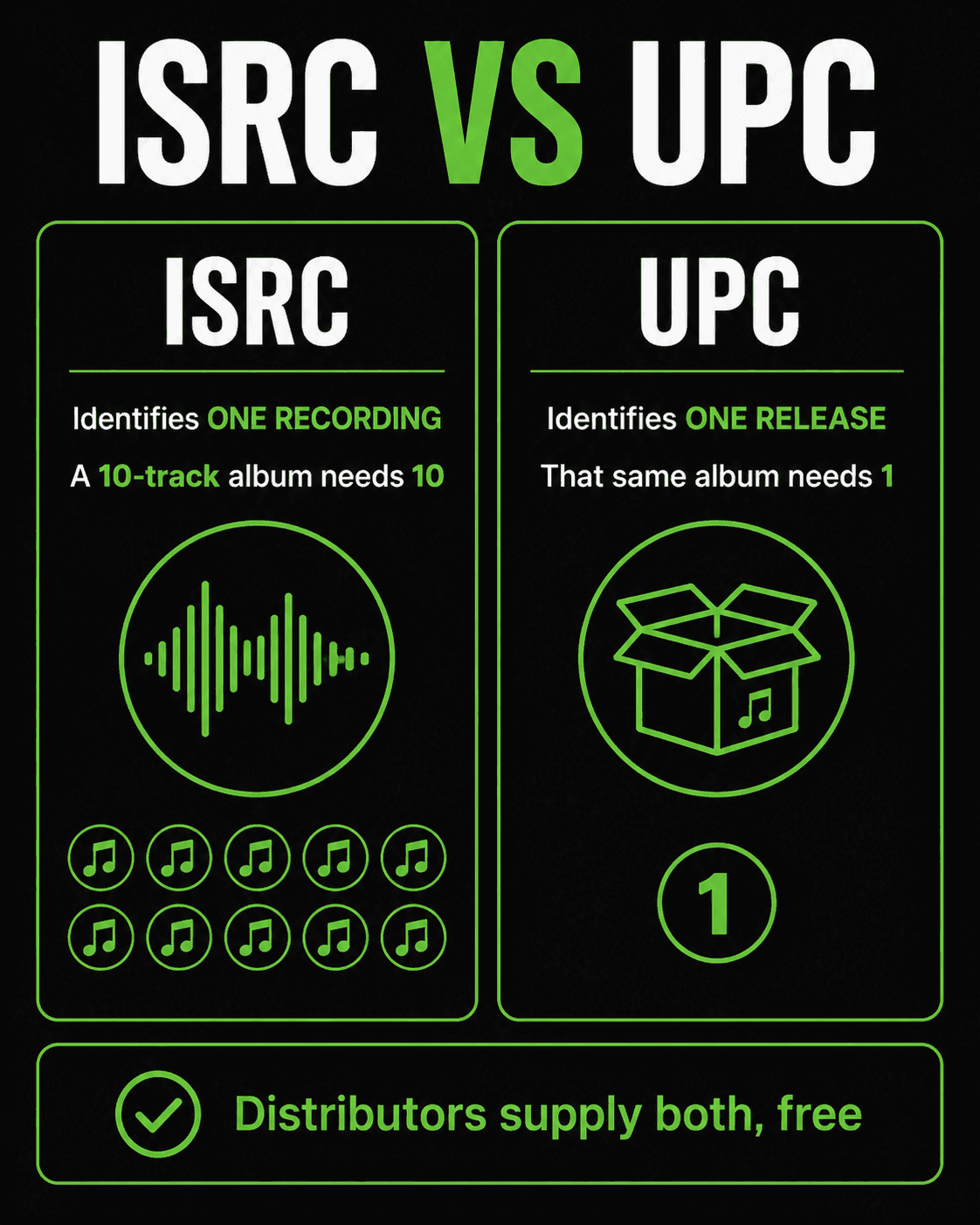
Release a single and you need one ISRC and one UPC. Put that same recording on an album later, and it keeps its original ISRC while the album gets a new UPC of its own. Distributors normally supply both at no charge.
How to get ISRC codes
Three routes, and for most people the first is correct.
1. Free from your distributor (recommended)
DistroKid, TuneCore, CD Baby, RouteNote, UnitedMasters and Amuse all assign ISRCs automatically at upload, at no extra cost. They are valid, permanent, internationally recognised codes, and using them is not a compromise.
The one consequence: the registrant portion of the code belongs to the distributor, not you. That does not affect your ownership of the recording, your royalties, or your ability to change distributor later. The code just carries their prefix.
2. Direct from the national agency (~$95 one-time in the US)
If you want your own registrant prefix, apply to your national ISRC agency. In the US that is the US ISRC Agency, operated by the RIAA, which charges a one-time $95 administrative fee for a rights-owner prefix. Its own FAQ is explicit that once you have the prefix there are no further costs, and you then assign your own codes.
Worth it if you release a lot, run a label, or want consistent codes across every release regardless of who distributes. Unnecessary for most solo artists.
3. Resellers (usually skip)
Various sites sell ISRCs individually. They are legitimate but you are paying for something your distributor gives away, or paying repeatedly for what a single $95 prefix would cover permanently.
When a recording needs a new ISRC
The rules that actually cause problems when broken.
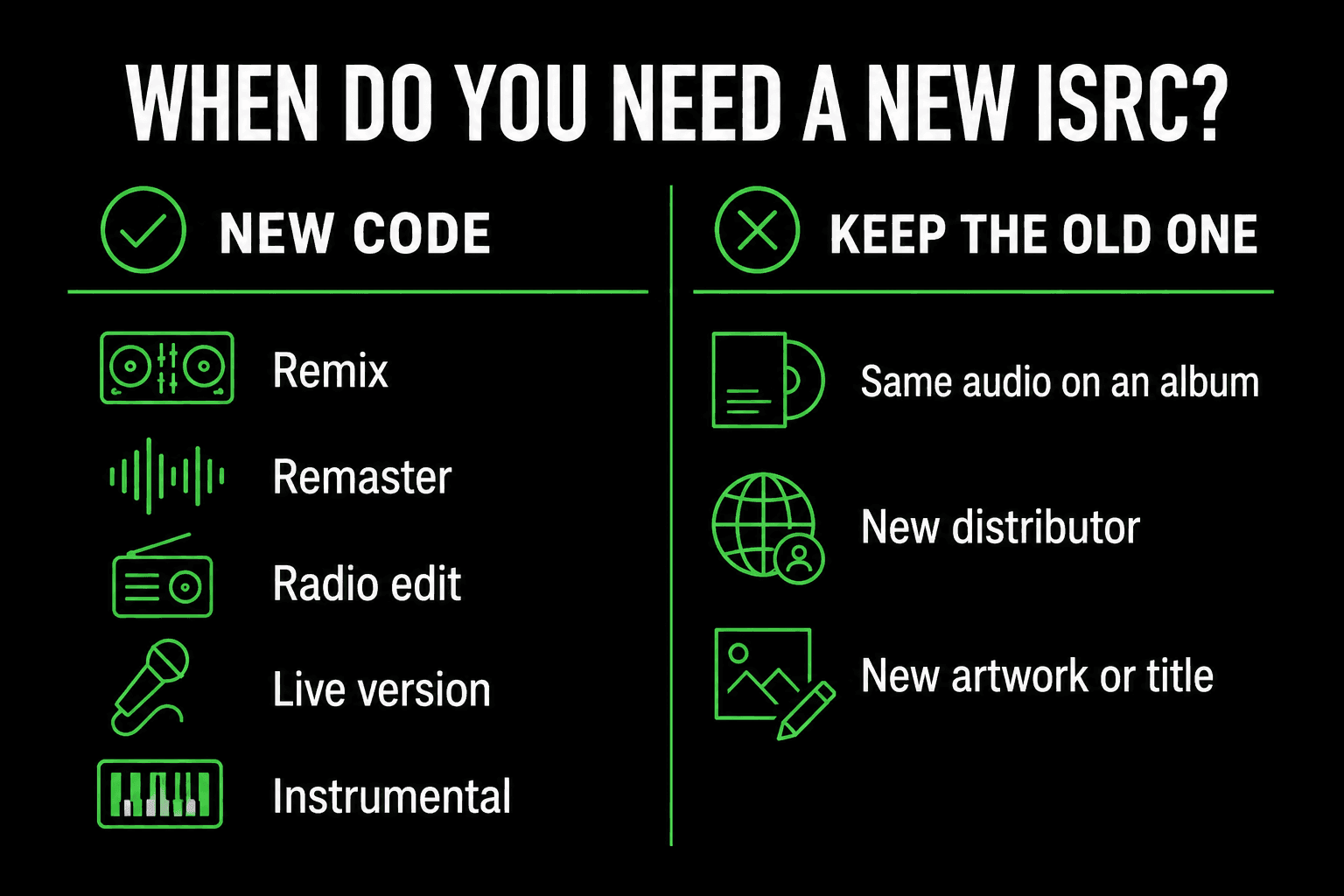
Assign a new ISRC when the audio is materially different:
- A remix or a different mix
- A remaster
- An edit of different length, a radio edit, or a clean version
- A live recording, an acoustic version, or a re-recording
- An instrumental or a cappella version
Keep the existing ISRC when the recording is unchanged:
- Re-releasing the same audio on an album, compilation or deluxe edition
- Moving to a new distributor with the same master
- Changing artwork, title or metadata without touching the audio
And never reuse an ISRC for a different recording. The two big failure modes are mirror images of each other: assign a new code to unchanged audio and you split its play history and chart position across two identities; reuse an old code on new audio and you merge two recordings' earnings into one, which is far harder to unwind.
This matters most when moving distributors. If you take music down and re-upload it, supply the original ISRCs rather than letting the new distributor mint fresh ones, or you will orphan every stream the track has ever earned.
What breaks without a correct ISRC
- Royalties go unmatched. SoundExchange, PROs and The MLC all reconcile against identifiers. Wrong ISRC, unmatched money. See how music royalties work.
- Radio and streaming plays go uncredited, because airplay monitoring keys on the ISRC.
- Chart eligibility suffers, since chart compilers aggregate by ISRC. Split codes split your numbers.
- Content ID gets confused, producing bad claims or none.
- Analytics fragment, so the same song appears as two unrelated tracks.
Switching distributors without losing your history
This is where ISRC mistakes cost real money, so it is worth doing deliberately.
- Export your ISRCs before you cancel anything. Once an account lapses you may lose dashboard access, and with it the record of which code belongs to which recording. Save them to a spreadsheet alongside titles, release dates and UPCs.
- Set up the new distributor and enter the existing ISRCs manually. Every major distributor lets you supply your own ISRC per track rather than generating one. Use it.
- Deliver to stores before taking the old release down, or accept a gap. Overlapping briefly is usually safer than a window where the track is nowhere.
- Check the track merged rather than duplicated. If Spotify shows two entries for the same recording, the ISRC did not carry across, and it needs fixing before the histories drift further apart.
Skip step two and the new upload becomes, as far as every reporting system is concerned, a brand new recording that happens to sound identical. Your play counts, playlist history, chart data and royalty history stay attached to the old code.
Common ISRC mistakes
- Letting a new distributor mint fresh codes for existing recordings. The single most expensive mistake, and the easiest to avoid.
- Reusing a code on a remaster. A remaster is a different recording and needs its own ISRC, even though the performance is the same.
- Assigning one ISRC to a whole album. That is what the UPC is for. Every track needs its own.
- Assuming the country code describes the recording. It identifies the registrant. A track recorded in Berlin distributed by a US company carries US.
- Typing hyphens into a metadata field. The code is 12 alphanumeric characters; the hyphens are for human readability only, and some systems reject them.
- Losing the codes entirely, then guessing at re-upload. Keep the spreadsheet.
How to find a track's existing ISRC
If you have lost yours, or want to check what was assigned:
- Your distributor's dashboard lists the ISRC for every release. This is the authoritative place for your own music.
- Spotify for Artists and Apple Music for Artists both expose it per track.
- Public lookup tools and the IFPI ISRC search can find codes for released recordings.
- The audio file itself often carries it in the metadata for WAV and FLAC exports.
A note if you release AI music
One consequence of permanence is worth knowing. Because an ISRC follows a recording for life, whatever happens to that recording stays attached to it. If a release is pulled for AI detection, that history belongs to the identifier, not just to the upload.
The practical upshot is to get the file right before it is ever assigned a code and distributed, rather than re-uploading a cleaned version afterwards under a new ISRC and fragmenting the track's history. Master it, then, if it is AI-generated, run it through a purpose-built processor such as Undetectr so automated scanners do not misread music you legitimately own, and distribute once. The reasoning is in distributing AI music without takedowns.
Frequently asked questions
How do I get ISRC codes for my songs?
The simplest route is your distributor: DistroKid, TuneCore, CD Baby, RouteNote, UnitedMasters and Amuse all assign ISRCs automatically and free when you upload. Alternatively, apply to your national ISRC agency for your own registrant prefix and assign codes yourself.
How much does an ISRC cost?
Nothing if your distributor assigns it, which is the normal case. If you want your own registrant prefix, the US ISRC Agency operated by the RIAA charges a one-time $95 administrative fee, with no further costs after that.
How do I get an ISRC for free?
Upload through any major distributor. They all include ISRC assignment at no extra charge, and the codes are fully valid and permanent. The only difference from buying your own prefix is that the registrant portion of the code belongs to the distributor, which does not affect your rights or royalties.
Do I need a new ISRC for every version of a song?
Yes, whenever the audio is materially different: remixes, remasters, radio edits, live versions, instrumentals and re-recordings each need their own ISRC. Keep the original code when the recording itself is unchanged, such as putting an existing single on an album.
What is the difference between an ISRC and a UPC?
An ISRC identifies one recording, so a ten-track album needs ten of them. A UPC identifies the release as a product, so that album needs one. You generally need both, and distributors supply both free.
Do I need an ISRC for every track?
Yes. Every commercially released recording needs its own ISRC so plays and royalties can be attributed to it. Without one, streaming reports, airplay monitoring and royalty matching have nothing reliable to key on.
The bottom line
An ISRC is the permanent serial number for one recording, twelve characters identifying country, registrant, year and sequence. Let your distributor assign them free unless you release enough to justify a $95 registrant prefix of your own. Assign a new code whenever the audio materially changes, keep the old one whenever it does not, and never reuse a code for a different recording.
Getting identifiers right is what makes royalty collection possible at all. It just is not what makes royalty collection lucrative, because streaming pays fractions of a cent however cleanly it is tracked. Sell to your fans directly as well: open your storefront on Played and keep 100% of every sale.