For about a decade, getting your music onto Spotify cost nothing. A handful of distributors ran genuinely free tiers, and "free music distribution" was the default advice for any artist releasing their first track. That era largely ended between 2025 and 2026. Several of the biggest free plans were withdrawn, two distributors shut down entirely, and most of the listicles still ranking for this search were written before any of it happened.
This guide is the current picture: what is genuinely still free, what "free" actually costs you in each model, the break-even math on commission versus upfront pricing, and the extra step you need if your tracks are AI-generated. Pricing in this space changes often, so treat every figure here as accurate at the time of writing and confirm on the distributor's own pricing page before you commit.
Free distribution shrank a lot in 2025 and 2026
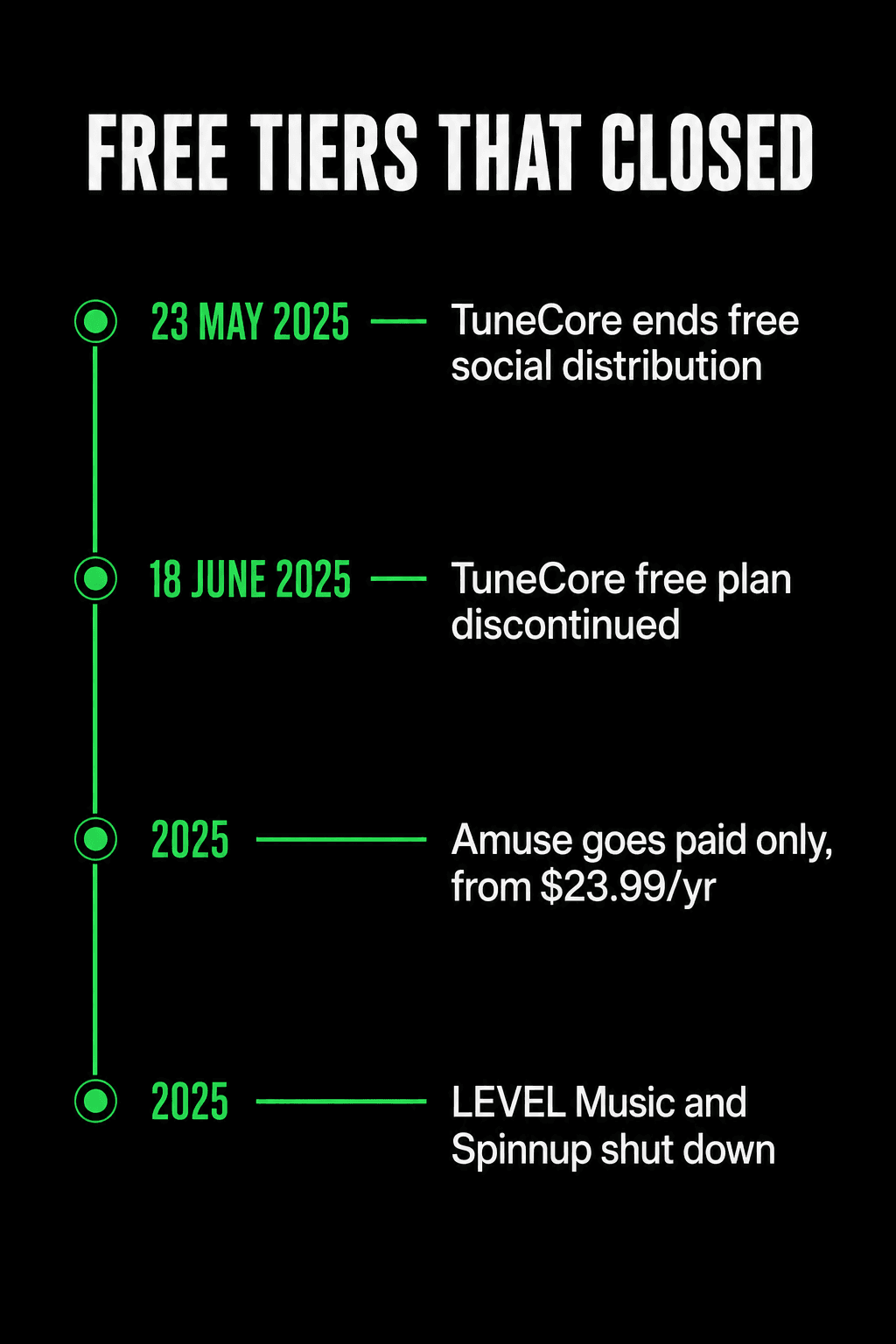
If you last looked at this two years ago, the map has changed. The notable closures:
- TuneCore ended free social-platform distribution on 23 May 2025, then discontinued its free New Artist plan on 18 June 2025. Per TuneCore's own support documentation, artists who did not upgrade had their releases taken down from stores and could not upload anything new until they subscribed. TuneCore is now a paid platform, roughly $24.99 to $49.99 a year.
- Amuse no longer runs a free tier. Its published plans start at $23.99 a year for Artist, $39.99 for Artist Plus, and $59.99 for Professional.
- UnitedMasters retired the free DEBUT distribution tier. The entry paid plan is DEBUT+ at $19.99 a year (unlimited releases to 150+ services, keep 100% of royalties), with SELECT at $59.99.
- LEVEL Music and Spinnup both shut down during 2025.
This matters more than it sounds. A large share of the "best free music distribution" articles currently ranking still list TuneCore, Amuse and UnitedMasters as free options. Some list distributors that no longer exist. Before you pick anything on the strength of a listicle, including this one, open the distributor's pricing page and read it yourself.
"Free" means one of two very different things
No distributor works for nothing. They charge you in one of two ways, and the difference matters far more than the word "free" on the homepage:
- The commission model. Nothing upfront. The distributor keeps a percentage of your royalties, typically 10 to 15 percent, for as long as the release stays live. This is what most people mean by free distribution.
- The upfront model. You pay per release or per year and keep 100 percent of royalties. Cheaper in the long run for anything that earns, more expensive for tracks that never find an audience.
The commission model is not a discount, it is a deferred payment with no ceiling. The upfront model is a bet that your music will earn. Which one is right depends entirely on numbers you can actually work out, and we do that below.
What is genuinely still free in 2026
These are the services still offering distribution with no upfront cost at the time of writing:
- RouteNote is the most established free option. Its free tier pays you 85% of net revenue and RouteNote keeps 15%, with unlimited uploads and no annual fee. RouteNote's own support hub lists the Premium alternative at $10 for a single, $20 for an EP (2 to 6 tracks), $30 for an album (7 to 18), and $45 for an extended album (19+), then a $9.99 per-release annual renewal, with 0% commission. The main free-tier complaint is speed: free releases sit in the review queue longer.
- FreshTunes is free and lets you keep 100% of streaming royalties, but takes roughly 20% of Content ID, songwriter and UGC royalties, which is where a lot of modern income actually lands. One artist per account, and reports of inactivity suspensions with a reactivation fee.
- ONErpm runs a free tier at around 85% to the artist, with a larger and better-established network than most free options.
- Indiefy, Freecords and Boost Collective all advertise free distribution at or near 100% royalties. They are smaller and newer, with shorter track records, narrower store networks (Boost Collective reaches roughly 32 stores against 150+ for the majors) and, in some cases, artist reports of slow payouts.
- SoundOn offers 100% royalties in year one, with less clarity about the terms after that.
The honest summary: RouteNote is the only free tier with both real scale and a long operating history. Everything else is either newer, smaller, or free in a narrower sense than the marketing suggests. If you are weighing these against the paid options, we put every distributor's real cost side by side in best music distribution services.
The break-even math nobody shows you
Here is the calculation that actually answers "should I pay?", using RouteNote because both models are published.
The free tier costs you 15% of everything the release earns. Premium costs $10 upfront for a single, then $9.99 a year, and takes nothing. So the free tier is cheaper only until 15% of your revenue exceeds the fee:
- Year one break-even: 15% of revenue = $10, so revenue of roughly $67.
- Every year after: 15% of revenue = $9.99, so again roughly $67 a year.
- In streams: at the widely-reported $0.003 to $0.005 per stream, $67 is somewhere between 13,000 and 22,000 streams. We break down the real payout rates in how much artists make per stream.
So the rule of thumb is simple. If a release will not clear roughly 15,000 streams in a year, the free tier is genuinely the cheaper choice. If it will, you are paying a permanent tax to avoid a $10 charge.
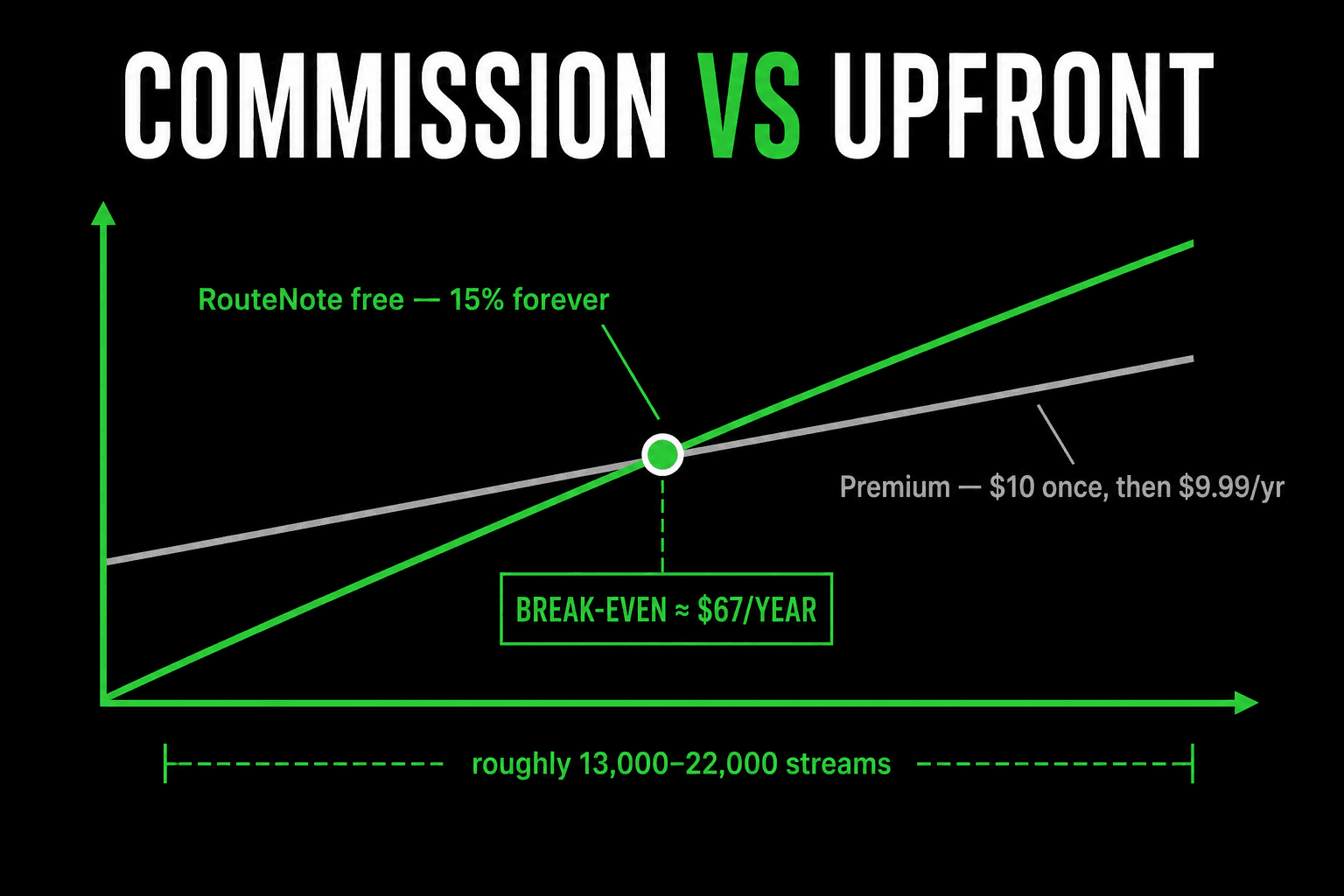
And "permanent" is the word that catches people out. A commission is not a one-off cost, it applies for as long as the track is live. A song that earns for ten years pays the commission for ten years. Upfront pricing has a ceiling; commission does not.
The costs that do not show up as money
Even where the commission math favours free, the free tier usually costs you something else:
- Speed. Free releases go to the back of the review queue. If you are working to a release date, a multi-week wait is a real cost.
- Payout friction. Minimum withdrawal thresholds and withdrawal fees mean small earnings can sit unclaimed for a long time.
- Account risk. Some free tiers suspend inactive accounts and charge to reopen them. FreshTunes has been reported at around $50 to restore a suspended account.
- Feature lockouts. Detailed analytics, Content ID, pre-save links, and help claiming your Spotify for Artists profile are commonly reserved for paid tiers.
- Reach. A 32-store network is not a 150-store network. Most of your income will come from a handful of platforms, but the long tail is free money you simply will not collect.
- Platform risk. 2025 proved that a free tier can be withdrawn, and that releases can be pulled from stores when it happens. Anything you build on someone else's free plan is a tenancy, not an asset.
If you are releasing AI music, the free lane is narrower
AI-generated tracks face a second filter on top of price, and it is the part most guides skip.
Distributor policies diverge sharply. RouteNote is the notable free option that accepts AI-generated music from Suno, Udio, ElevenLabs and similar tools, provided you hold commercial rights and disclose the AI involvement at upload. TuneCore rejects tracks created primarily with Suno, Udio or equivalents. CD Baby rejects fully AI-generated music, though it does distinguish between AI used as a production tool alongside meaningful human authorship and AI as the primary author.
Before any of that, check your generator's terms. Free tiers of Suno and Udio typically grant personal use only; you need a paid plan that explicitly grants commercial rights before you distribute anywhere. We cover the rights question properly in is it legal to sell AI music.
Getting past the distributor is also only half the job, because the platforms run their own scanning. In September 2025 Spotify tightened its AI policy considerably: it had removed more than 75 million spammy tracks in the preceding twelve months, and introduced a spam filter targeting mass uploads, duplicate and near-duplicate audio and SEO-stuffed titles, an impersonation policy covering unauthorised voice clones, and AI disclosure in credits built on the DDEX standard.
This is why AI releases that clear a distributor still get pulled weeks later. Raw exports from AI generators carry machine-readable signals, SynthID watermarks, C2PA credentials and spectral fingerprints, and re-exporting the file does not remove them. A workable sequence looks like this:
- Confirm commercial rights on the generator plan you used.
- Finish and master the track properly, so you are processing a final master rather than a rough generation. See how to make AI music sound professional.
- Clean the file with a tool built for it. Standard exporting and mastering do not touch embedded watermarks; purpose-built processors such as Undetectr target SynthID, C2PA and spectral fingerprints in one pass so an automated scanner does not misread a track you legitimately own. Our guides on distributing AI music without takedowns and AI music watermark removers go into the detail.
- Disclose honestly where the distributor or platform asks. Disclosure and clean audio are not in conflict: one is a truthful credit, the other stops a scanner flagging your own work as spam.
- Distribute, and sell direct in parallel.
What free distribution still does not solve
Even a perfect free distribution setup only solves one problem: getting your music onto shelves. It does nothing about the fact that those shelves pay fractions of a cent.
At typical rates, 1,000 streams returns somewhere around $3 to $5. A single $10 direct sale is worth roughly 2,000 to 3,000 streams. Distribution is a reach channel and a credibility signal. It is very rarely an income strategy on its own, and no amount of optimising your distributor choice changes that arithmetic.
The income side comes from selling direct to the people who already like your music. That is what Played is for: 0% platform commission on music sales, permanently. Fans pay you through your own payout link, so Played is never in the money flow and never takes a cut; you pay a Played subscription plus your own payment processor's standard fee. Every genre is welcome, including AI music, and you keep the customer relationship rather than renting it. Use free distribution for reach and your own storefront for income. For the wider picture, see how to sell your music online and Bandcamp alternatives.
How to choose, in about a minute
- First release, no audience yet? Use a commission-based free tier. RouteNote is the safest pick. You will not clear the break-even, so the 15% costs you less than the fee.
- Track already earning, or a catalogue you believe in? Pay upfront. Break-even is around 15,000 streams a year, and commission never stops.
- Releasing often? An unlimited annual plan (DEBUT+ at $19.99, or similar) beats per-release pricing quickly.
- Releasing AI music? Check the AI policy before the price. Confirm commercial rights, clean the file, disclose where asked.
- Whichever you choose, sell direct alongside it. Distribution is reach; direct sales are income.
Frequently asked questions
Is music distribution actually free?
Not really. Free tiers charge a commission instead of a fee, typically 10 to 15 percent of royalties for as long as the release stays live. Paid tiers charge upfront and take nothing. You are choosing which way to pay, not whether to pay.
What is the best free music distribution service in 2026?
RouteNote, for most artists. It is the only remaining free tier that combines real scale, a long operating history, unlimited uploads and an 85% royalty share, and it is also the main free option that accepts AI-generated music. Smaller services like FreshTunes, Indiefy, Freecords and Boost Collective are free too, but with narrower networks and shorter track records.
Can I upload music to Spotify for free?
Not directly. Spotify does not accept uploads from artists; you have to go through a distributor. Using a free distributor such as RouteNote gets you onto Spotify with no upfront cost, in exchange for a share of royalties.
Why did TuneCore, Amuse and UnitedMasters drop their free plans?
All three moved to subscription-only models between 2025 and 2026, in a market flooded with uploads and increasing platform pressure on spam. TuneCore discontinued its free New Artist plan on 18 June 2025 and took down the releases of artists who did not upgrade. Amuse now starts at $23.99 a year, and UnitedMasters at $19.99.
Do free distributors accept AI music?
Some do, some do not. RouteNote accepts AI-generated music if you hold commercial rights and disclose the AI involvement. TuneCore rejects tracks made primarily with Suno or Udio, and CD Baby rejects fully AI-generated music while allowing AI used as a production tool. Always check the current policy before you upload.
Is it better to pay for distribution or use a free tier?
Work out the break-even. On RouteNote, 15% commission equals the $10 single fee at roughly $67 of revenue, or somewhere around 13,000 to 22,000 streams a year. Below that, free is cheaper. Above it, upfront pricing wins, and it keeps winning every year because commission never expires.
The bottom line
Free music distribution still exists in 2026, but there is far less of it than the search results suggest, and what remains charges you in royalties rather than cash. RouteNote at 85% is the sensible default for a first release; once a track clears roughly 15,000 streams a year, upfront pricing costs you less. If your music is AI-generated, the policy check matters more than the price, and the file needs cleaning before it meets platform-side scanning.
Whichever distributor you land on, remember what it is for. Distribution buys you reach on platforms that pay fractions of a cent. The money is in selling to the fans you already have. Open your storefront on Played and keep 100% of every sale.