In 2026 a stream pays an independent artist somewhere between $0.0007 and $0.108, and which end of that you land on has almost nothing to do with your music. It is decided by which service the play happened on, whether the listener was paying, and which country they were in.
Across the paid services alone the spread is roughly 15x. Include free ad-supported plays and it is more than 150x. That is the single most useful fact on this page: there is no such thing as "the streaming rate", and any figure quoted without a platform attached is close to meaningless.
Below are the current rates platform by platform, the number of streams each one needs to produce $1,000, what actually reaches your bank account after the splits, and the two revenue lines that pay per transaction instead of per play.
Per-stream payout rates by platform, 2026
These are blended industry averages for the recording side, before your distributor's cut. Your own statements will differ by market and listener mix, but the ranking is stable and has been for years.
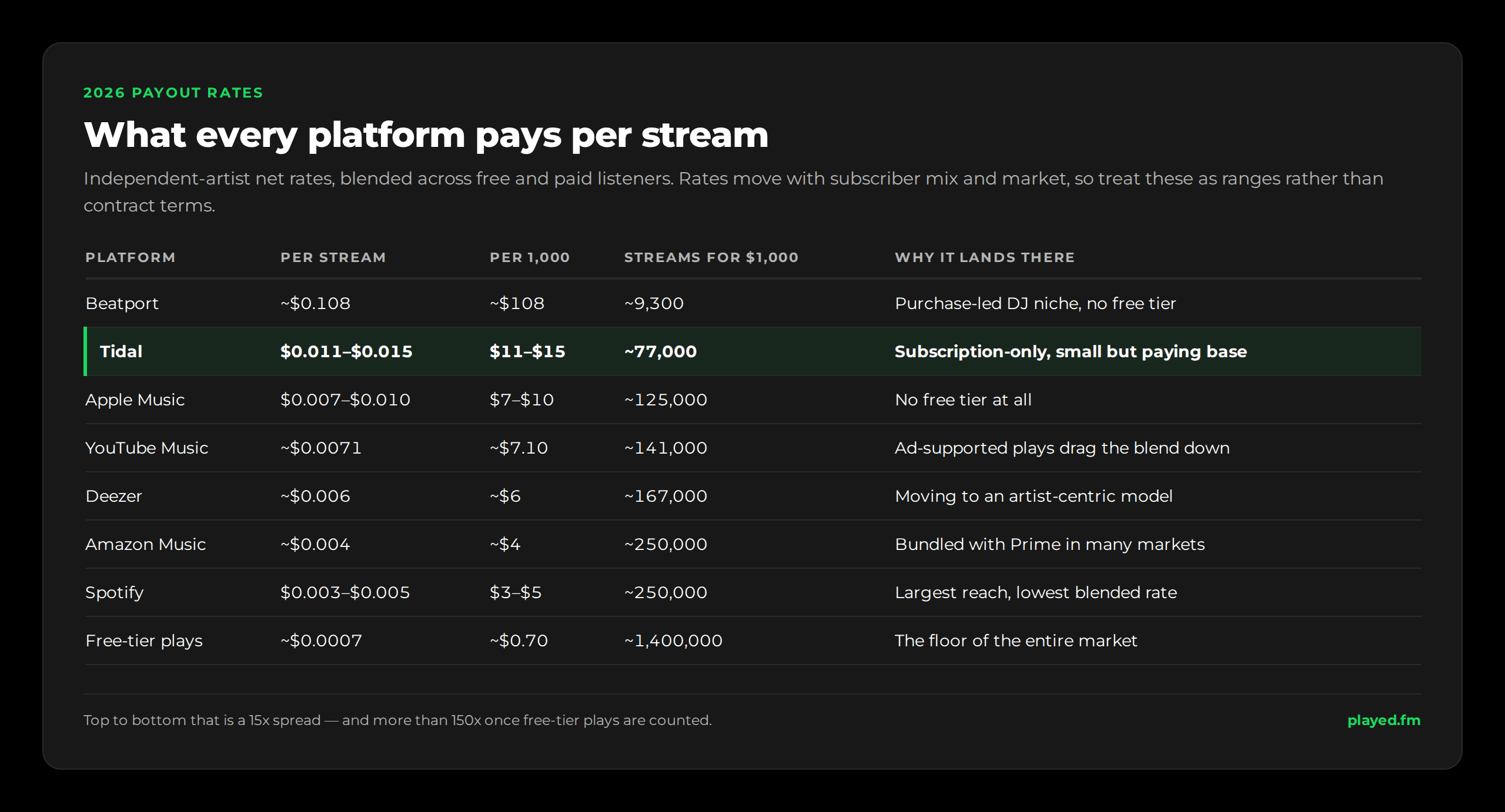
| Platform | Per stream | Per 1,000 streams | Streams for $1,000 |
|---|---|---|---|
| Beatport | ~$0.108 | ~$108 | ~9,300 |
| Tidal | $0.011–$0.015 | $11–$15 | ~77,000 |
| Apple Music | $0.007–$0.010 | $7–$10 | ~125,000 |
| YouTube Music | ~$0.0071 | ~$7.10 | ~141,000 |
| Deezer | ~$0.006 | ~$6 | ~167,000 |
| Amazon Music | ~$0.004 | ~$4 | ~250,000 |
| Spotify | $0.003–$0.005 | $3–$5 | ~250,000 |
| Free ad-supported plays | ~$0.0007 | ~$0.70 | ~1,400,000 |
Beatport is the outlier that proves the rule. At around $0.108 per stream it pays roughly 25 times what Spotify does, because it is a paid DJ platform with no free tier, no casual listening, and a subscriber base that pays specifically for professional access to dance music. It is not a general consumer service, and for most artists it is not a realistic destination. It belongs on the table because it shows exactly what a per-stream rate looks like when every listener is paying and nobody is browsing for free.
Tidal and Apple Music lead the mainstream services for the same structural reason: neither operates a free ad-supported tier, so every play is funded by a subscription. Spotify sits at the bottom of the paid group precisely because a large share of its plays come from listeners who pay nothing.
The YouTube Music figure of about $0.0071 needs one caveat. That is the blended rate on the Music subscription product. Plays of your track inside ordinary ad-supported YouTube videos pay far less, often in the same territory as that $0.0007 free-tier number, which is why YouTube payout figures quoted elsewhere vary so wildly. Both numbers are true; they describe different products.
Note the trade-off running down the table. The services paying best per play have the smallest audiences, and the service with the deepest reach pays close to the least. No platform gives you both.
Why the per-stream rate is an average, not a price
Every number above is a division result. Nobody at Spotify set a price of $0.004 and nobody is contractually obliged to pay it.
Here is the mechanism. A service collects subscription and advertising revenue for the month, keeps its share, and puts the rest into a royalty pool. That pool is then divided across every stream that happened on the service that month, and rightsholders are paid according to their share of the total. This is called pro-rata allocation, and it has four consequences worth understanding:
- Your rate falls when other people stream more. If total streams on a platform grow faster than its revenue, the value of every individual play drops, including yours, even if your own numbers are identical to last month.
- Subscriber mix decides almost everything. A paying subscriber contributes roughly ten to fifteen times what an ad-supported listener does to the pool. That is the whole reason Tidal and Apple Music sit at the top of the table.
- Territory changes the number dramatically. A stream from a listener on a $12 US or UK subscription is worth many times a stream from a market where the same tier costs $2. Two artists with identical stream counts and different audience geographies will see different payouts.
- Free-tier plays drag the blended average down. At roughly $0.0007, an ad-supported play is worth about a fifth of a paid Spotify play and about a hundred and fifty times less than a Beatport one.
Deezer and Tidal have both moved toward artist-centric or user-centric variants, where a subscriber's fee is allocated to the artists that specific person actually listened to rather than thrown into a common pool. It is a fairer model for artists with small, devoted audiences, and it is one reason those two services sit above Spotify in the table.
The practical takeaway: stop treating your per-stream rate as a fixed input. If it moved this quarter, the likely explanations are a shift in listener countries, a shift in free-versus-paid mix, or currency conversion, not something you did wrong.
How many streams it takes to earn $1,000
Rates in fractions of a cent are hard to feel. Inverting them is not.
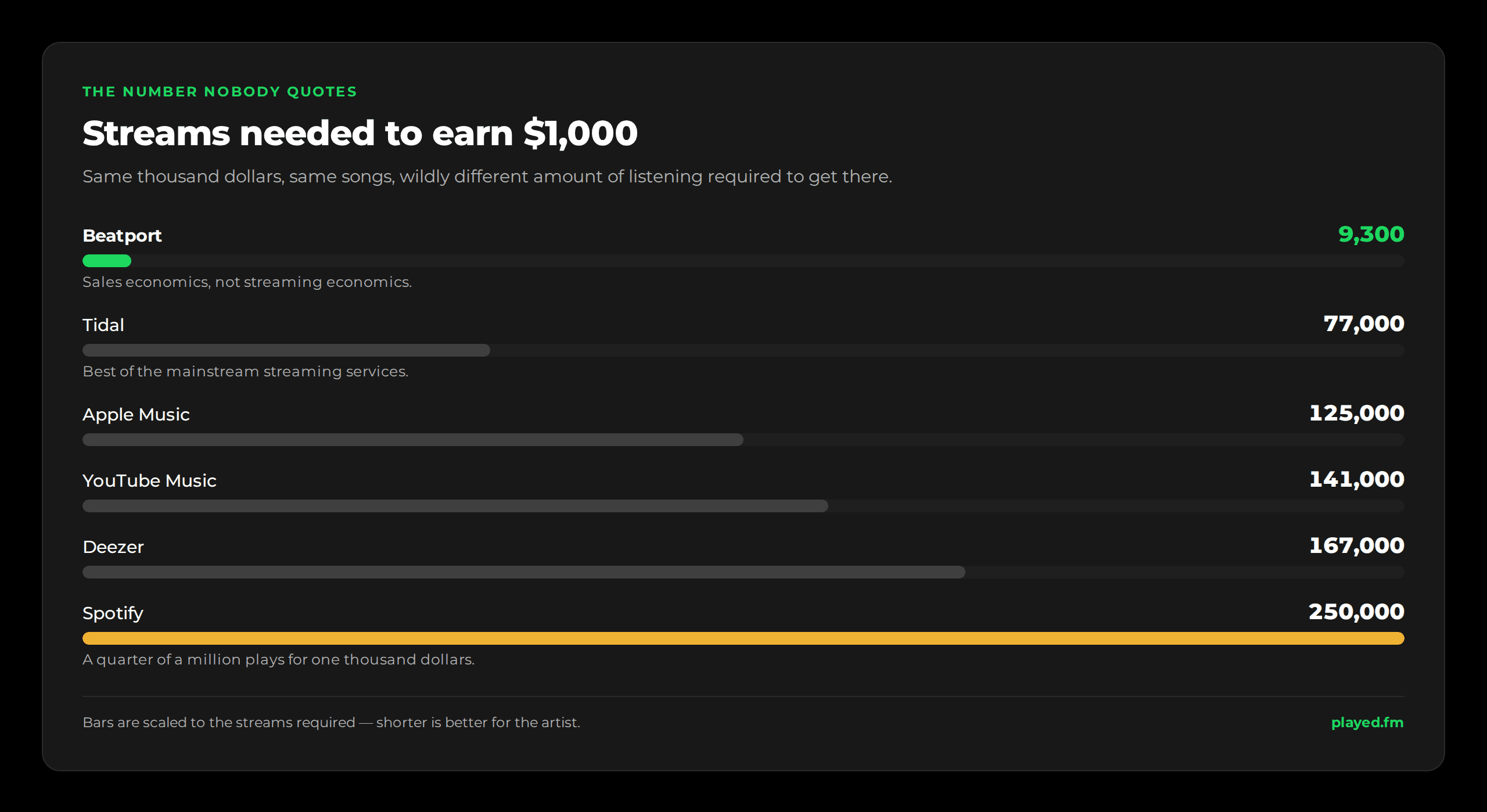
Read that against what a release actually does. The median independent single does not clear four figures of lifetime streams, let alone 250,000. A quarter of a million Spotify streams is a genuinely successful independent release, and it pays about $1,000 before anyone takes a cut.
The bottom row is the one to sit with. If your audience is largely on the free tier, the number of plays required for $1,000 is 1.4 million. Same music, same fans, roughly 150 times the work.
Streaming royalties: what the per-stream figure does and does not cover
This is where most per-stream articles quietly mislead. Every rate on this page is the recording royalty only. It is the money paid for the use of your master, and it flows to whoever delivered the track to the platform, which for an independent artist means your distributor.
Streaming also generates royalties on the composition — the song as written, rather than the specific recording. Those are paid separately, to songwriters and publishers, through different organisations entirely, and they do not appear anywhere in your distributor dashboard. If you write your own material you are owed both, and most self-releasing artists collect only the first. We cover which body collects what, and how to register, in how music royalties work. It is free to fix and it is the most common money left on the table.
Three more things the headline rate does not include:
- Non-interactive plays. Pandora, SiriusXM and internet radio pay on a different basis entirely and are collected by a different body. They are not in these averages.
- User-generated content. When creators use your track in their videos, that pays against the recording through Content ID, separately from streaming.
- Payment timing. Streaming royalties land two to three months after the plays happen, converted from local currencies, and most distributors hold a minimum balance before they will pay out at all.
So when someone tells you a million streams pays $4,000, they mean $4,000 of recording royalty, gross. The composition money is extra, the collection is on you, and the net is lower. We will do that arithmetic properly below.
Spotify pays nothing at all below 1,000 streams
A policy change that rewrote the maths for small catalogues, and one plenty of artists still have not heard about.
Since April 2024, per Spotify's own documentation, a track must reach at least 1,000 streams in the previous 12 months to be included in the recorded-music royalty pool. There is also an undisclosed minimum number of unique listeners, deliberately unpublished so it cannot be gamed.
Below that line a track earns zero. Not a reduced rate. Nothing. The money that would have gone to it is redistributed to tracks above the threshold.
For a catalogue of ten tracks where three clear 1,000 annual plays and seven do not, seventy per cent of your catalogue is generating no Spotify revenue whatsoever, regardless of how many plays those seven accumulated between them. A release that gets 900 streams a year is a release that earned nothing, and it stays at nothing until it crosses the line.
This matters most for exactly the artists who can least afford it: new releases, deep album cuts, instrumental versions, and anyone with a wide catalogue and a modest audience. If you are releasing high volume and spreading thin listening across many tracks, the threshold works directly against you.
What you actually receive after the splits
Every rate on this page is what the platform pays out. It is not what arrives in your account.
Between the platform and you there are up to four deductions:
- Distributor commission. Subscription distributors such as DistroKid and TuneCore take 0% and charge a flat annual fee instead. CD Baby takes 9%. RouteNote's free tier takes 15%. A percentage cut costs you nothing when you earn nothing and a great deal when a track takes off. We compared the terms in best music distribution services.
- Label share. On a traditional record deal, the artist royalty on the master is typically 15% to 25% of net receipts, paid only after the advance recoups. A $4,000 gross becomes $600 to $1,000, and often $0 while you are unrecouped. Newer indie deals run 50/50 profit shares, also post-recoupment.
- Producer points. Commonly 2% to 5% of the master, carved out of your share, not the label's.
- Co-writer and featured artist splits. These reduce the composition side and, where a feature has a royalty, the master side too.
The gap between the headline number and the deposit is the part nobody screenshots. An unsigned artist on a flat-fee distributor keeps close to all of the recording royalty. A signed artist on a standard deal keeps a fifth of it and sees none until recoupment.
One track, three platforms, three stream counts
Same recording, same year, gross recording royalty before any commission. Spotify at $0.004, Apple Music at $0.008, Tidal at $0.013 — the midpoints of the ranges above.
| Streams | Spotify ($0.004) | Apple Music ($0.008) | Tidal ($0.013) |
|---|---|---|---|
| 10,000 | $40 | $80 | $130 |
| 100,000 | $400 | $800 | $1,300 |
| 1,000,000 | $4,000 | $8,000 | $13,000 |
Now apply the deductions to the million-stream row on Spotify. On a flat-fee distributor you keep the full $4,000. On CD Baby at 9% you keep $3,640. On a 20% label deal you keep $800, and nothing at all until the advance is recouped. Add a 3% producer point and the unsigned figure drops to about $3,880.
A million streams is a milestone the large majority of independent artists never reach. It is worth, at best, a few thousand dollars, once, spread across a year.
Compare the same money the other way round. One hundred fans buying a $10 album from a storefront you own earns the same $1,000 that 250,000 Spotify streams does. A single $10 sale is worth about 2,500 Spotify plays. Follow one devoted listener through both models and it is starker still: fifty plays of your album across a year earns you roughly 20 cents; that same person buying it once earns you $10, and leaves you their email address.
Do playlists and viral spikes change the arithmetic?
Less than you would hope. A large editorial playlist can add tens of thousands of streams in a burst, which at $0.004 a play is a few hundred dollars, real but temporary. Once the playlist rotates you out you are back to baseline.
Virality has the same shape: a spike, then a return to normal. Neither builds durable income, because streams are rented attention rather than an owned relationship. The artists who convert a viral moment into a career are the ones who route that attention somewhere they control — a storefront and an email list — so the spike becomes buyers instead of a number that fades.
Does any of this differ for AI music?
The per-stream rate is identical. The risk profile is not.
AI-generated releases face additional screening at distribution and on-platform, and the failure mode is not a lower rate but a frozen one: a track goes live, accrues earnings for weeks, and is then pulled with everything it earned withheld. Spotify removed more than 75 million spam tracks in the year to September 2025 and added DDEX-based AI disclosure to credits.
If your track has already been rejected by a distributor over AI detection, the practical fix is to master it properly and clean the file first: raw exports carry watermarks and spectral fingerprints that survive re-encoding, and a purpose-built processor such as Undetectr (€39 one-time, unlimited tracks, browser-based) removes those layers so scanners do not misread music you legitimately own. Disclose AI use wherever a form asks for it — that is a separate obligation and not something to work around. The full workflow is in distributing AI music without takedowns.
The revenue lines that pay per transaction, not per play
Everything above is per-play income, and per-play income only works at a scale almost no independent artist reaches. The two revenue lines that do not behave that way are direct sales and sync licensing, because both pay a fixed amount per transaction rather than a fraction of a cent per listen.
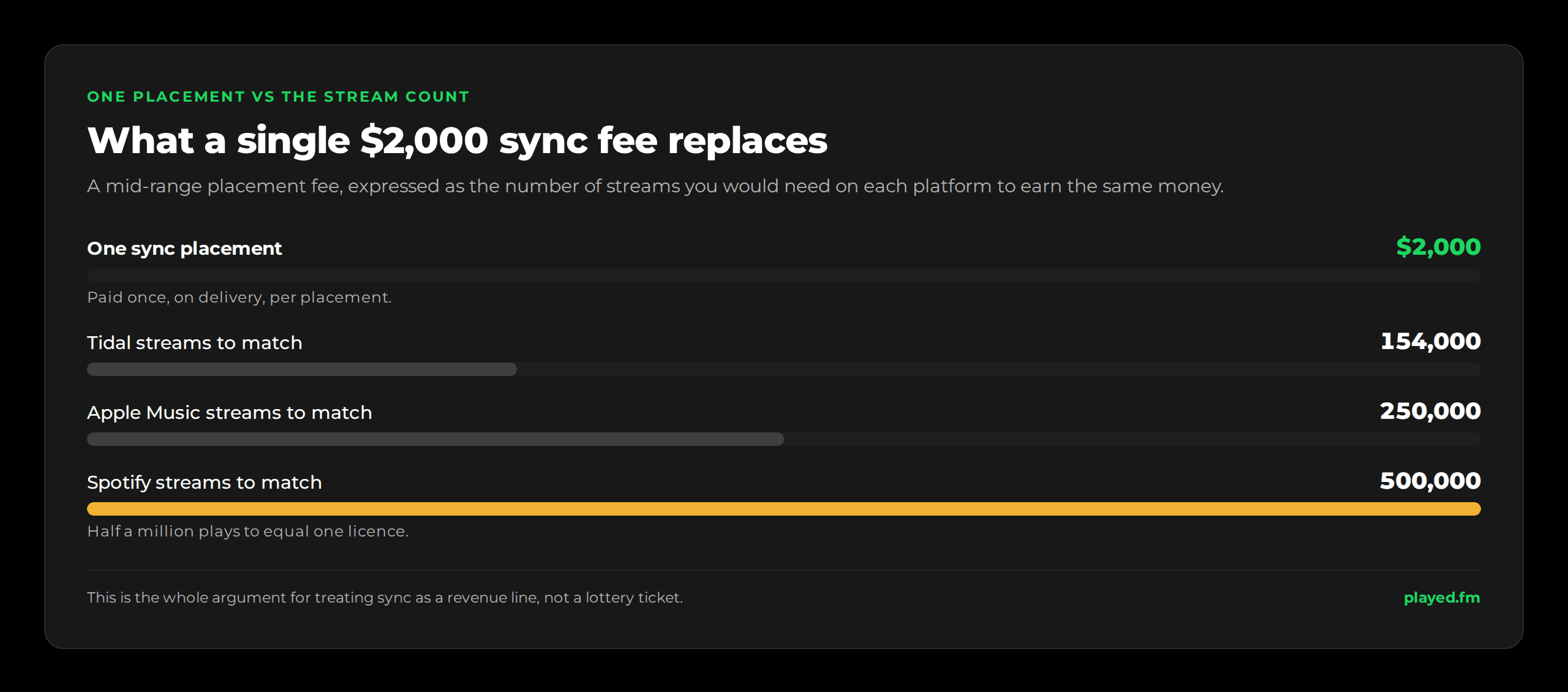
A $2,000 placement in a show, advert or game is worth about 154,000 Tidal streams, about 250,000 Apple Music streams, or about 500,000 Spotify streams. It is paid once, up front, on signature, and it does not depend on a pool, a subscriber mix or a threshold. Sync fees and how they are structured are covered in how much sync licensing pays, and the process of getting placed in music sync licensing.
Direct sales work the same way at smaller unit sizes. There is no revenue pool, no country weighting and no 1,000-stream threshold. A fan pays a price you set, and the transaction settles.
That is what Played is built for. Your storefront takes 0% platform cut; fan money goes straight to your own payout account, so Played is never in the flow of a sale; you set your own prices, and you keep the customer emails rather than renting an anonymous audience from an algorithm. The sync brief board carries live placement briefs paying $120 to $3,000. Every genre is welcome, AI-assisted or not, with no gatekeeping. It is a $12.99 a month artist subscription and nothing else.
None of this means abandoning streaming. It means using streaming for what it is genuinely good at, which is discovery, and earning where the arithmetic works. The full playbook is in how to sell your music online.
Frequently asked questions
How much does Spotify pay per stream in 2026?
Roughly $0.003 to $0.005 per stream, or $3 to $5 per 1,000 plays, on the recording side. It is a blended average from a revenue pool rather than a fixed rate, so the number moves with listener country, free-versus-premium mix and total platform streaming volume.
Which streaming service pays the most per stream?
Among mainstream services, Tidal at $0.011 to $0.015 and Apple Music at $0.007 to $0.010, both because they have no free ad-supported tier. Beatport pays far more at around $0.108, but it is a specialist paid DJ platform rather than a general consumer service. Higher rates come with much smaller audiences, so they do not automatically mean more total income.
How many streams do I need to make $1,000?
About 250,000 on Spotify, 125,000 on Apple Music, 77,000 on Tidal and 9,300 on Beatport. If your plays are largely on a free ad-supported tier at roughly $0.0007 each, it takes around 1.4 million. All of those figures are before your distributor's commission and any label or producer splits.
Why does my per-stream rate keep changing?
Because it was never a set price. Platforms divide a monthly revenue pool across every stream that happened, so your effective rate moves when the mix of paying and free listeners shifts, when your audience geography changes, or when total streaming grows faster than platform revenue. Currency conversion and payout timing add further noise.
Does Spotify pay for tracks under 1,000 streams?
No. Since April 2024 a track must reach at least 1,000 streams in the previous 12 months, plus an undisclosed minimum of unique listeners, before it earns anything from Spotify. Below that it earns zero rather than a reduced amount, and the money is redistributed to tracks above the threshold. For artists with wide catalogues and modest audiences this can zero out most of the catalogue.
How much do artists actually keep from streaming royalties?
An unsigned artist using a flat-fee distributor keeps effectively all of the recording royalty. On a percentage distributor it is 85% to 91%. On a traditional label deal the artist share is typically 15% to 25% of net receipts, and nothing is paid until the advance recoups. Producer points and co-writer splits come out on top of that.
Is a sync placement really worth more than streaming?
For most independent artists, yes. A $2,000 placement equals about 500,000 Spotify streams, 250,000 Apple Music streams or 154,000 Tidal streams, and it is paid once on signature rather than accruing fractions of a cent over years. It also carries no threshold, no pool and no country weighting.
Do AI-generated tracks earn the same per stream?
The rate is exactly the same. The difference is risk: AI releases face extra screening, and the common failure is earnings being frozen or a track being removed rather than paid at a lower rate. Clean and master files properly before distribution, disclose AI use where a platform asks, and keep a direct sales channel that does not depend on a platform's tolerance.
The bottom line
Per-stream payouts in 2026 run from about $0.0007 to $0.108 depending on where the play happened, a spread of more than 150x, and the rate is a division result rather than a price. Spotify sits near the bottom of the paid services at $0.003 to $0.005 and pays nothing at all on tracks below 1,000 annual streams. A quarter of a million Spotify plays is $1,000 gross, and less than that after everyone in the chain has taken their share.
Collect every streaming royalty you are owed, on both the recording and the composition. Then build the income that does not run through a pool: open your storefront on Played, keep 100% of every sale, and treat streaming as the discovery channel it actually is.