Music royalties confuse people because everyone explains them as a list. The list is not the hard part. The hard part is that every song is two separate pieces of property, each earning its own royalties, collected by different organisations, and you have to register with all of them separately or the money simply sits there.
Once that clicks, the rest is bookkeeping. This walks through both copyrights, every stream of income attached to them, the actual 2026 rates, and the specific places independent artists leave money uncollected.
The two copyrights in every song
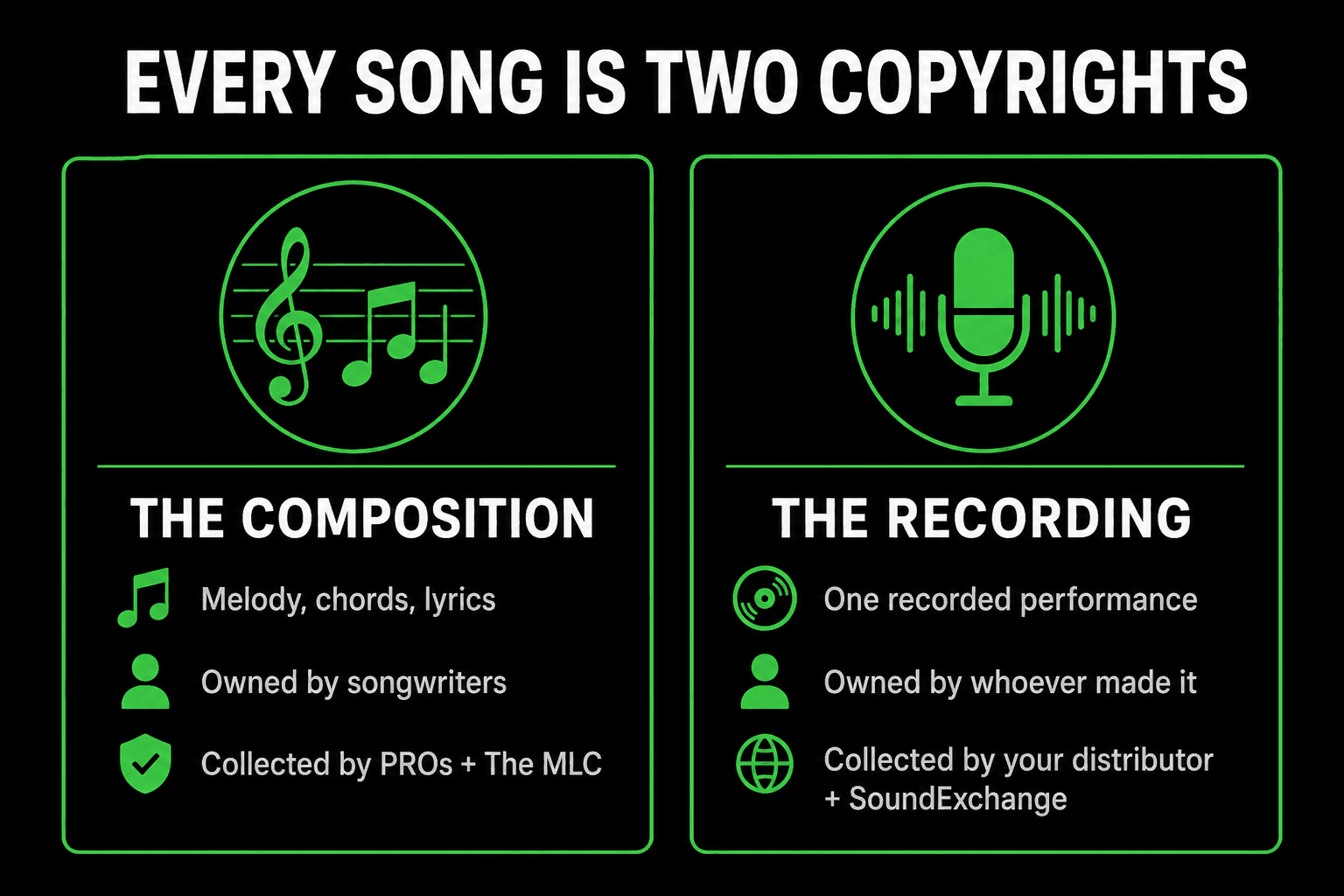
Get this and everything else follows:
- The composition (also called the song, or the publishing side). The melody, chords and lyrics as written. Owned by the songwriters and their publishers.
- The sound recording (also called the master). One specific recorded performance of that composition. Owned by whoever paid for and made the recording, which for an independent artist is usually you.
A cover version is a new sound recording of someone else's composition. That is why the two rights have to be tracked separately, and why a single Spotify stream triggers payments on both sides at once.
If you write and record your own material, you own both, and you are entitled to every royalty below. Most artists collect only two or three of them.
Recording royalties (the master side)
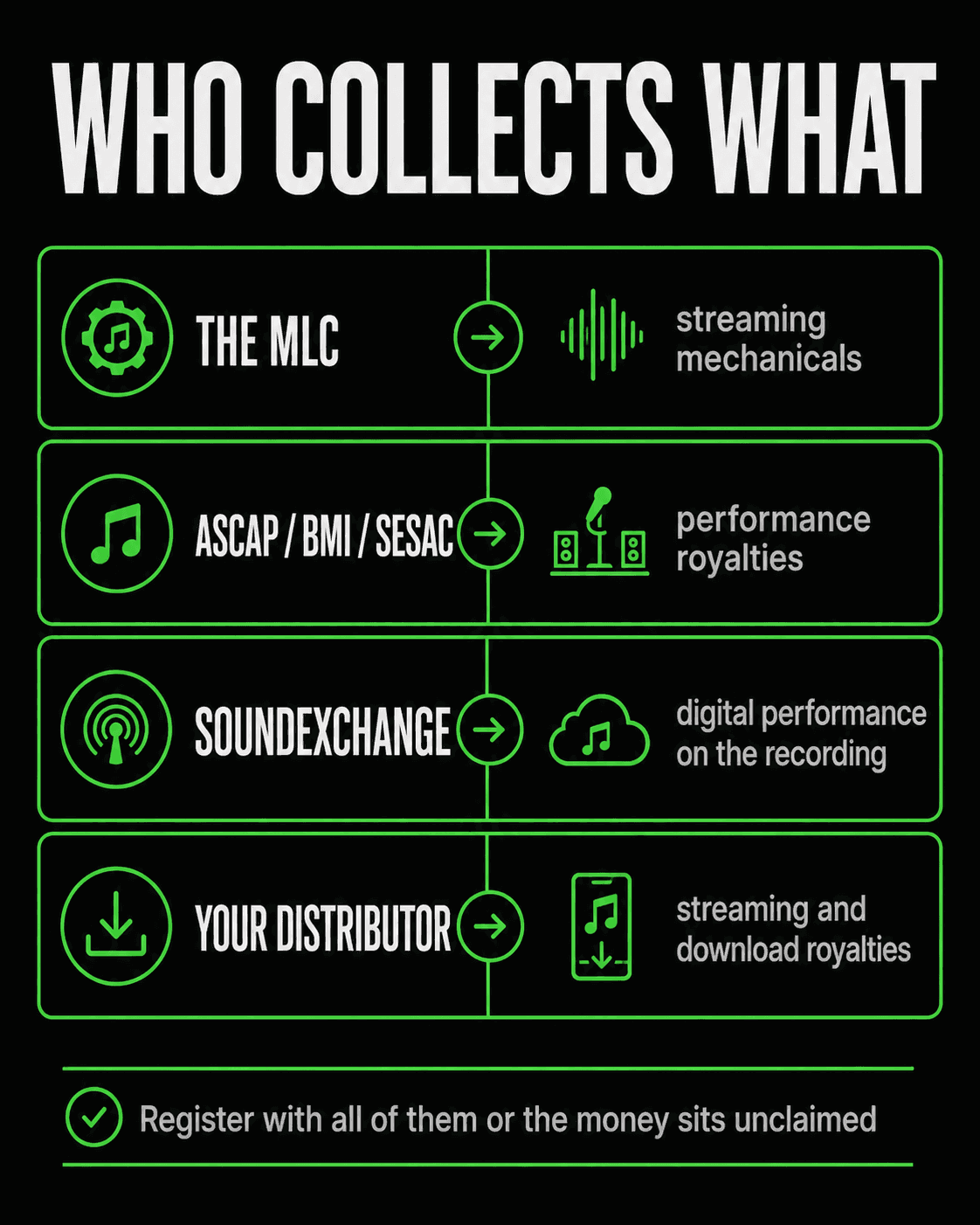
The money from streams and downloads of your actual recording. Spotify, Apple Music and the rest pay this to whoever delivered the track, which means your distributor, who passes it to you minus their commission (0% on most subscription plans, 9% on CD Baby, 15% on RouteNote's free tier). We compared those in best music distribution services.
This is the royalty every artist knows about, and it arrives without you doing anything beyond distributing. It is also usually the smallest per-unit and the easiest to overestimate.
Mechanical royalties (composition, reproduction)
Owed whenever your composition is reproduced: physical copies, permanent downloads, and on-demand streams.
The 2026 numbers, which changed in January:
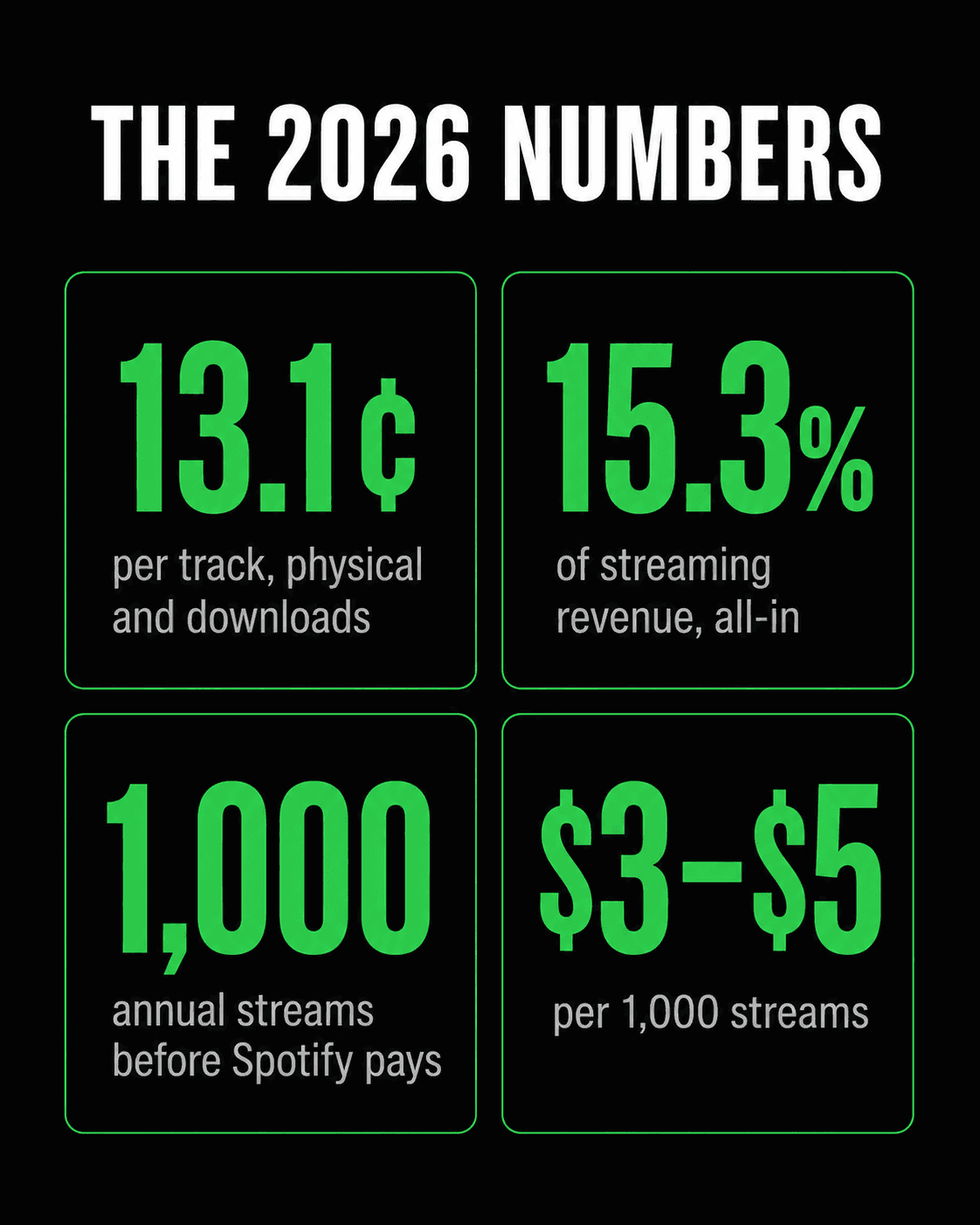
- Physical and permanent downloads: the statutory rate set by the Copyright Royalty Board is 13.1¢ per track in 2026, up from 12.7¢ in 2025. For context, that rate was frozen at 9.1¢ for fifteen years, from 2006 through 2022, until the Phonorecords IV settlement covering 2023 to 2027 introduced annual cost-of-living adjustments.
- Streaming: not a penny rate at all. Songwriters and publishers collectively receive an all-in headline rate of 15.3% of a streaming service's revenue in 2026, rising to 15.35% in 2027. Performance royalties already paid to PROs are subtracted from that all-in pool to reach the mechanical payout.
In the US, digital mechanicals are collected by The MLC (the Mechanical Licensing Collective), created under the Music Modernization Act. Registration is free. If you have never registered with the MLC, your streaming mechanicals are accruing and not reaching you. This is the single most commonly missed royalty for self-releasing artists.
Performance royalties (composition, public performance)
Owed when your composition is performed publicly: radio, TV, live venues, shops and bars, and interactive streaming.
Collected by Performing Rights Organisations. In the US that is ASCAP, BMI, SESAC or GMR; elsewhere PRS, SOCAN, APRA and their equivalents. You register as a writer, and separately as a publisher if you want the publisher's share as well, which as a self-releasing artist you should, because otherwise it goes unclaimed.
ASCAP and BMI are open to anyone; SESAC and GMR are invitation-only. Pick one, not several, for the same works.
Digital performance royalties (master, non-interactive)
This is the one almost nobody claims, because it sounds like a duplicate of the above and is not.
When your recording is played on non-interactive digital radio, Pandora, SiriusXM, internet radio stations, a separate royalty is owed to the recording owner and the featured performers. In the US it is collected by SoundExchange, which splits it 50% to the rights owner, 45% to featured artists and 5% to a fund for session musicians.
Two things to be clear about:
- SoundExchange is not a PRO. PROs pay on the composition; SoundExchange pays on the recording. You need both.
- Spotify and Apple Music do not pay through SoundExchange, because they are interactive. Pandora, SiriusXM and radio-style services do.
Sync royalties
Paid when your music is licensed into visual media: film, TV, adverts, games, trailers. Uniquely on this list, sync is negotiated rather than administered, and it needs permission from both copyright owners, composition and recording. If you own both, you can clear a sync single-handedly, which is a real competitive advantage over a signed artist. Fees range from a few hundred dollars to five figures and beyond. Covered properly in music sync licensing.
UGC and Content ID royalties
When other people use your music in their videos, YouTube, TikTok, Instagram, the platform pays out against the recording. You collect via Content ID, either through your distributor's add-on or a dedicated administrator. Worth registering if your music gets used by creators, and worth understanding that most distributors take a cut of this stream even when they take 0% of your streaming royalties.
Neighbouring rights abroad, and why US artists collect less
Outside the US, plays of your recording on terrestrial radio and in public venues generate neighbouring rights royalties, collected by each country's collective management organisation. Most countries require AM/FM radio to pay for sound recordings and extend that to foreign artists through reciprocal agreements.
The US does not. The Digital Performance Right in Sound Recordings Act of 1995 created a performance right for digital transmissions only, which is why SiriusXM and Pandora pay through SoundExchange while over-the-air radio pays the recording owner nothing. Because reciprocity is conditional, a number of territories therefore withhold terrestrial payments from US performers on the grounds that the US does not pay theirs.
Two practical consequences. If you are outside the US, register with your national CMO, because this is real money your distributor will never collect for you. If you are in the US, you can still collect neighbouring rights in territories that do pay, but usually only by signing up with a dedicated neighbouring rights administrator rather than expecting it to arrive on its own.
Black box royalties
Money that was collected but could not be matched to an owner gets pooled. In the industry it is called the black box, and after a holding period it is typically distributed by market share, which in practice means it flows to the largest rights holders rather than to whoever actually earned it.
The reason your registrations matter is not abstract, then. Unclaimed royalties do not wait indefinitely for you to turn up; eventually they get redistributed to somebody else. Registering with the MLC, a PRO and SoundExchange, and keeping your metadata accurate, is how you stay out of that pool.
Spotify's 1,000-stream rule
A policy that materially changes the maths for new artists, and one many still do not know about.
Since April 2024, per Spotify's own documentation, a track must reach at least 1,000 streams in the previous 12 months to be included in the recorded-music royalty pool at all. There is also a confidential minimum number of unique listeners, which Spotify deliberately does not publish so it cannot be gamed.
Below that threshold, your track earns nothing from Spotify. Not a reduced amount, nothing. Spotify's stated rationale is that 99.5% of streams are of tracks clearing 1,000 annual plays, that the redistributed money goes to those tracks, and that sub-threshold payouts mostly never reached artists anyway because they sat below distributor withdrawal minimums. Whatever you make of that, plan around it: a release that gets 400 streams is a release that earned zero.
Where independent artists actually leave money
In rough order of how much goes unclaimed:
- Not registered with the MLC. Streaming mechanicals accrue and never arrive. Free to fix.
- Not registered with SoundExchange. Every non-interactive play of your recording goes uncollected. Free to fix.
- Registered with a PRO as writer but not publisher. You collect the writer's share and forfeit the publisher's.
- No Content ID registration while creators use your music.
- Wrong or missing metadata. If your ISRC, writer credits and splits are wrong, the money cannot find you even where everything else is registered. See ISRC codes explained.
None of these require a lawyer or a label. They require an afternoon of registrations, and they are the difference between collecting three of your royalty streams and collecting all of them.
The uncomfortable arithmetic
Now the part the royalty guides tend to soften. Collect every stream above, perfectly, and streaming still pays very little.
At typical rates of $0.003 to $0.005 per stream, a million Spotify streams is roughly $3,000 to $5,000 on the recording side, before your distributor's cut and before any splits with co-writers. A thousand streams is $3 to $5. The full breakdown is in how much artists make per stream.
A single $10 direct sale is worth about 2,000 to 3,000 streams. That ratio is the whole economics of being independent in 2026, and no amount of royalty optimisation changes it.
A note on AI music and frozen royalties
If you release AI-generated music, there is a risk that does not appear on any royalty diagram: royalties that get frozen rather than paid.
Platforms scan uploads, and a track can go live, accrue earnings for weeks, then be pulled with everything it earned withheld. Spotify tightened this considerably in September 2025, removing more than 75 million spammy tracks in the prior year and adding a spam filter plus DDEX-based AI disclosure in credits. Raw AI exports carry SynthID watermarks, C2PA credentials and spectral fingerprints that survive re-encoding, so the usual workflow is to master the track, run it through a purpose-built processor such as Undetectr so scanners do not misread music you legitimately own, then disclose where asked. More in distributing AI music without takedowns.
The revenue line with no collection society
Every royalty on this page has an intermediary: a distributor, a PRO, the MLC, SoundExchange. Each takes time, takes a share, and pays months later.
Direct sales have none of that. A fan buys from your storefront, the money lands in your account, and no organisation needs to match metadata for you to get paid. On Played you keep 100% of music sales before payment provider fees: fans pay you through your own payout link, so Played is never in the money flow and never takes a cut, and you pay a Played subscription plus your own payment processor's standard fee. Every genre is welcome, including AI music.
Register for every royalty you are owed, absolutely. Then open your storefront and build the income line that does not depend on any of them.
Frequently asked questions
How much does a song make in royalties?
It depends entirely on where it is played. On streaming, roughly $3 to $5 per 1,000 plays on the recording side at typical rates, plus smaller mechanical and performance royalties on the composition. A single sync placement can pay more than years of streaming. There is no per-song figure, only per-use rates.
Do artists get royalties every time a song is played?
Mostly, but not always. On Spotify a track must reach at least 1,000 streams in the previous 12 months, plus a confidential minimum of unique listeners, before it earns anything at all. Below that threshold plays generate no royalty. Registration also matters: unregistered mechanicals and digital performance royalties accrue without reaching you.
How much does Spotify pay for 1,000,000 streams?
Roughly $3,000 to $5,000 on the recording side at typical per-stream rates of $0.003 to $0.005, before your distributor's commission and before splits with any co-writers. Composition royalties are paid separately to songwriters and publishers.
What is the difference between mechanical and performance royalties?
Both are on the composition. Mechanical royalties are owed when the song is reproduced, on physical copies, downloads and on-demand streams, and are collected in the US by The MLC. Performance royalties are owed when it is performed publicly, on radio, TV, in venues and via streaming, and are collected by PROs like ASCAP and BMI.
Is SoundExchange the same as a PRO?
No. PROs such as ASCAP and BMI pay on the composition. SoundExchange pays on the sound recording, for plays on non-interactive services like Pandora and SiriusXM, and splits it 50% to the rights owner, 45% to featured artists and 5% to session musicians. You need to register with both.
What royalties do most independent artists miss?
Streaming mechanicals, by not registering with The MLC, and digital performance royalties, by not registering with SoundExchange. Both are free to join. Also common: registering with a PRO as a writer but not as a publisher, which forfeits the publisher's share of every performance royalty.
The bottom line
Every song is two copyrights, and each earns separately. Recording royalties arrive through your distributor. Mechanicals need The MLC. Performance royalties need a PRO, as writer and publisher. Non-interactive plays of your recording need SoundExchange. Sync you negotiate yourself. Miss a registration and that money accrues without ever reaching you.
Do all of it, then face the arithmetic honestly: perfectly collected streaming royalties still pay fractions of a cent per play, and one $10 sale beats 2,000 streams. Open your storefront on Played and keep 100% of every sale.