ASCAP vs BMI is a closer contest than most guides admit. Both are free to join as a songwriter, both exist to collect the same royalty (performance royalties on your compositions, not mechanicals), both pay quarterly, and both say you can belong to only one US performing rights organisation at a time as a writer. Join either, register your songs, and you start collecting money you are not collecting now.
The differences that matter are practical: what a publisher membership costs, whether you need one, how and when you can leave, the smallest payment each will send, and who owns the organisation. Each is below, checked on ascap.com and bmi.com in October 2026, with step-by-step registration for both. What you will not find is a verdict on which pays more, because no reliable public data exists to base one on.
Key takeaways
- Writers join both for free. Publisher fees: $50 at ASCAP (waived if you join as writer and publisher together), $175 to $500 at BMI.
- BMI pays self-published writers both shares with no publishing company. ASCAP says you need a publisher membership to collect it.
- Both run on roughly two-year cycles for writers, and you can only leave inside a notice window.
- ASCAP is member-governed and not for profit. BMI is for-profit, majority-owned by New Mountain Capital since February 2024.
ASCAP vs BMI at a glance
Every row comes from the organisation's own site, checked October 2026. Confirm on the linked pages before you apply.
| ASCAP | BMI | |
|---|---|---|
| Writer fee | Free | Free, no annual dues |
| Publisher fee | $50 one-time; waived if you join as writer and publisher together | $175 individual, $250 corporation or LLC, $500 partnership, one-time |
| Self-published writer | Needs a publisher membership to collect the publisher share | Paid both shares, no publishing company needed |
| Writer term | Resign only in a three-month window every two years | Two-year initial term, renews for two years at a time |
| How to leave | Online, in Member Access, during your window | Signed notice by tracked mail, 3 to 6 months before the term ends |
| US payments | Quarterly; publishers two quarters after the performance quarter, writers three | Quarterly: February, May, August, November |
| Minimum payout | $1 direct deposit; $100 by cheque | $2 direct deposit or Payoneer; $250 by cheque or wire ($25 in August) |
| Ownership | Founded 1914; member-governed; not for profit | Founded 1939; for-profit; majority-owned by New Mountain Capital |
| Size, own figures | 1.1 million+ members | 1.5 million+ writers and publishers |
What ASCAP and BMI collect, and what they don't
A performing rights organisation (PRO) licenses businesses that play music in public, from TV networks and radio to streaming services and venues, then pays the writers and publishers of the works it tracks. ASCAP's membership FAQ says it “ONLY distributes public performance royalties.” BMI's FAQ warns that registering a song with BMI does not register your mechanical rights. Mechanicals, SoundExchange and distributor income are covered in how music royalties work; this page is only about choosing the PRO.
Joining fees
Writer membership costs nothing at either. BMI's creators FAQ says there are “no fees or annual dues of any kind” for songwriters and composers. ASCAP has waived its writer fee since 13 February 2023 and calls the waiver temporary, so check its join page before you apply.
- ASCAP publisher: free if you apply as writer and publisher at the same time. On its own, including later as an existing writer, a one-time, non-refundable $50.
- BMI publisher: a one-time $175 for an individual, $250 for a corporation or LLC, $500 for a partnership. Not refundable, not deductible from earnings, no annual dues.
Do you need a publishing company?
This is the most practical difference, and one many comparisons get wrong. Performance royalties are split into a writer share and a publisher share. Without a publishing deal, the publisher share is yours to claim, and the two PROs handle it differently.
At ASCAP, you need a publisher membership. Its guidance for writers: “If you haven’t signed a publishing deal and you want to collect your publisher’s share, you will need to set up a publishing company with ASCAP.” It need not be a registered company: the Individual/Sole Proprietor option takes an address, an email, a US tax ID and, ASCAP estimates, about ten minutes.
At BMI, you don't. BMI's FAQ says it pays “all royalties (writer and publisher) to the composer on any self-published works,” showing “Manuscript” where a publisher would appear, and that a publishing company “will not mean that you receive more royalties.” You can still add one if you want the two streams paid separately.
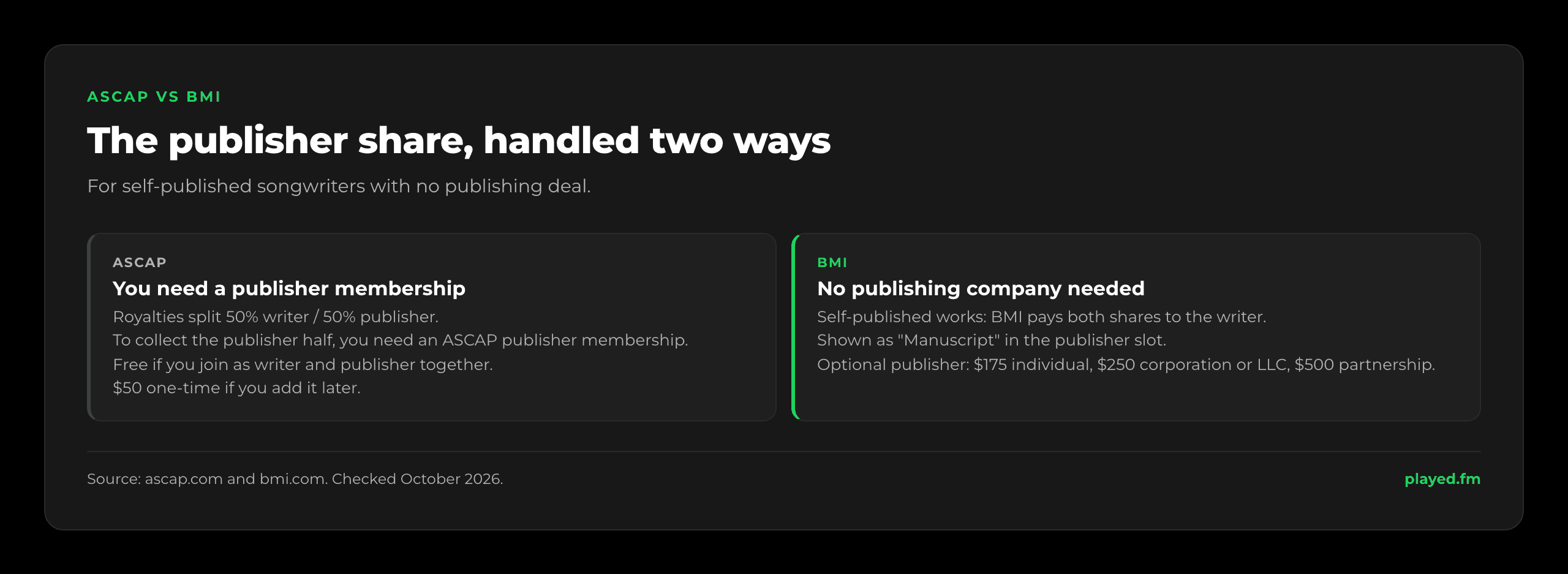
So if you join ASCAP, apply as writer and publisher together: it costs nothing. If you join BMI self-published, skip the publishing company until you have a reason for one, such as publishing other writers. Neither membership collects mechanicals.
Contract length and how to leave
Neither lets you leave on any day you choose, and missing your window can cost two more years.
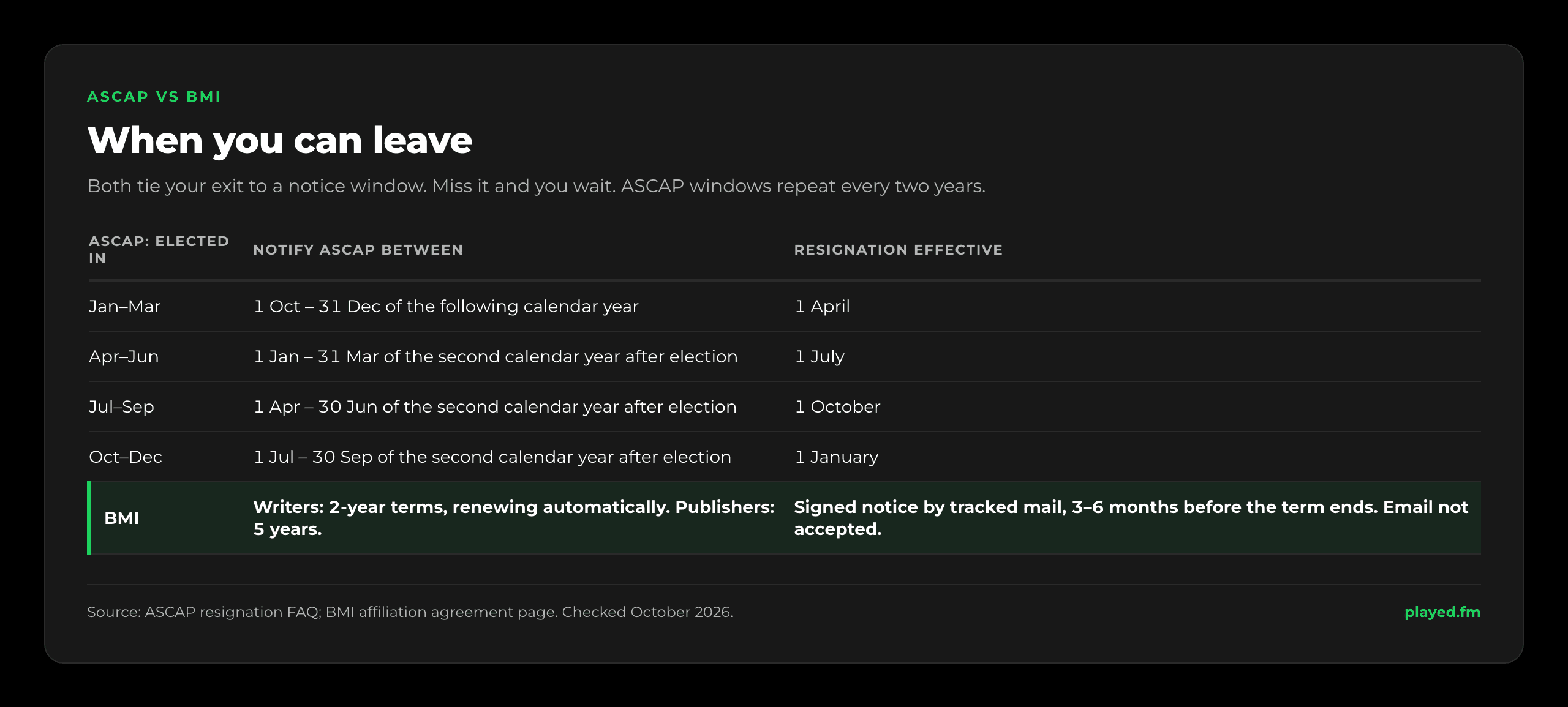
ASCAP gives each member a three-month notification window every two years, based on the quarter you were elected. Elected in January to March, for example, and your window is 1 October to 31 December of the following calendar year, effective the next 1 April. Your first exit therefore falls about two years after joining. Per its resignation FAQ, you resign in Member Access under Profile, then Membership Status, where your personal window is listed. Most leavers let ASCAP keep licensing their existing works; moving them to a new PRO needs every publisher on them to agree.
BMI's agreement page says the standard writer agreement runs for two years, then renews for two years at a time; publisher agreements run in five-year periods. To terminate, send signed notice postmarked three to six months before your term ends, by registered, certified or Express mail or a courier that records the send date. Email “will not be processed.” Older agreements can differ, so check paragraph 1 of yours.
BMI keeps paying for performances before your end date, and ASCAP keeps paying on licences already in effect. Switching? ASCAP's application asks for a release from your current PRO, and ASCAP warns that income can be missed if your new PRO is slow to update the international IPI database, so avoid a gap.
When you get paid, and the minimum payout
- ASCAP pays US royalties quarterly: publishers two quarters after the performance quarter, writers three. January to March 2026 performances were paid to publishers in September and to writers on 13 October 2026, per its distribution schedule. International royalties come in four further distributions a year.
- BMI distributes in February, May, August and November, per its royalty policy manual. Its FAQ puts radio royalties six to eight months after airplay and foreign royalties one to two years after the performance.
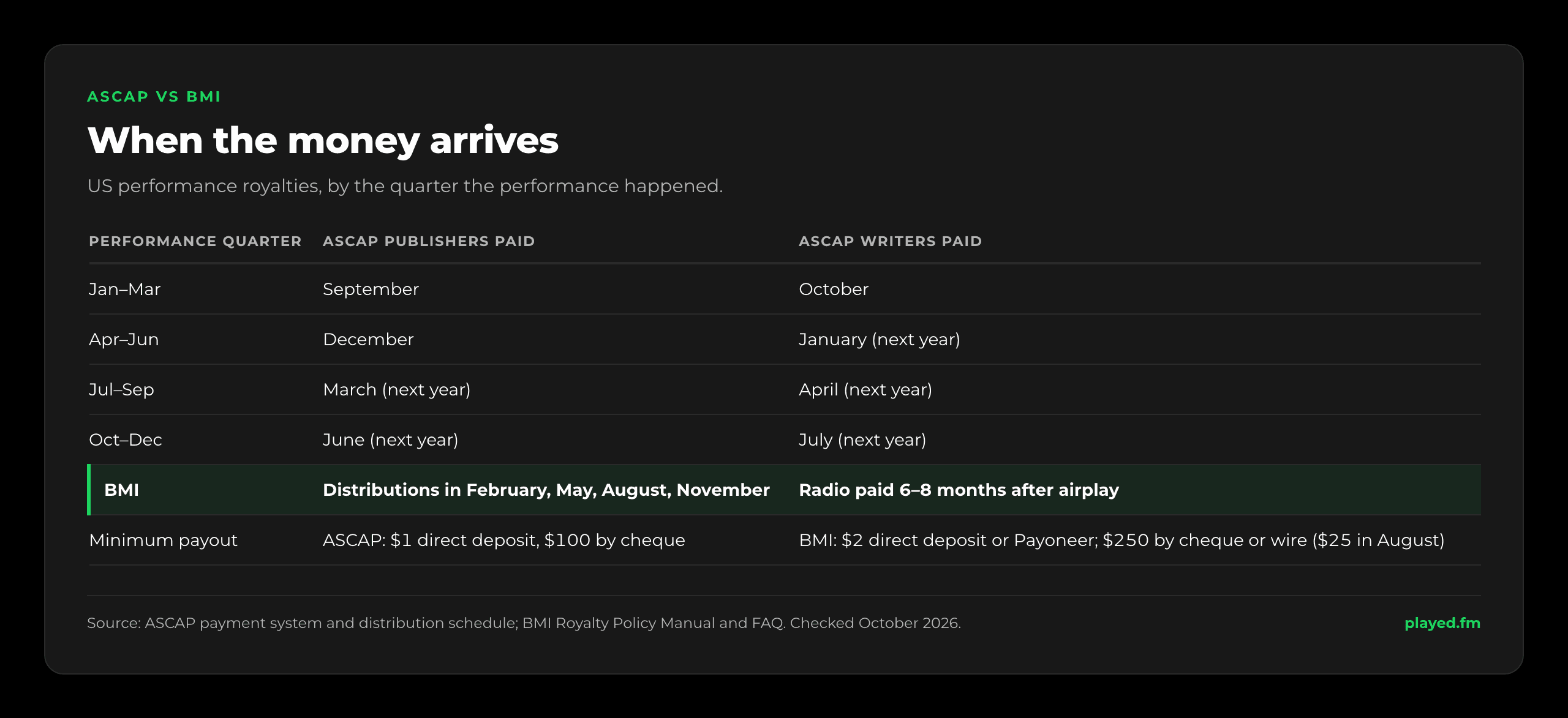
ASCAP's payment page says it pays $1 or more by direct deposit, while cheques wait for $100. BMI pays $2 or more by direct deposit or Payoneer; cheques and wires need $250, or $25 in August, and smaller sums are held for up to 12 quarters. Set up direct deposit either way.
Who owns them
ASCAP, founded in 1914, says on its about page that it is the only US PRO “founded and governed by songwriters, composers and publishers,” with a board elected by members every two years. Its join page says “Not for Profit, Not for Sale” and that 90 cents of every dollar collected goes back to members.
BMI, founded in 1939, is a for-profit company. A group led by investment firm New Mountain Capital completed its acquisition on 8 February 2024, with CapitalG taking a passive minority stake, and the former shareholders allocated $100 million of the proceeds to affiliates. In the November 2023 announcement, BMI said it had targeted paying out 85% of its 2023 licensing revenues. The 90% and 85% figures are each organisation's own, calculated differently, so they do not show which pays you more.
Which pays more?
We looked for an independent, like-for-like comparison of ASCAP and BMI payouts and found none we would stand behind. “Pays more” claims usually rest on one writer's statements or the percentages above. Three things make a fair test hard:
- Values move every quarter. ASCAP sets the value of a performance credit quarterly from the credits processed and money available; BMI says its rates vary quarterly with licence fees and total performances.
- They weight uses differently. ASCAP's credits depend on the type of use, the medium, the licensee's fee and, for TV, the time of day. BMI uses its own categories and rates.
- Nobody can run the experiment. Your writer share sits with one PRO at a time.
Choose on what you can check: fees, the publisher rule, exit terms and thresholds.
What about SESAC and GMR?
The US has two more PROs, and neither is open the way ASCAP and BMI are. SESAC's help centre tells would-be affiliates “we are not accepting any submissions at this time.” Global Music Rights describes its clients as “a select, invitation-only client base.” Unless one approaches you, the choice is ASCAP or BMI.
How to register with ASCAP, step by step
- Check eligibility: at least one song you wrote or co-wrote that is public, whether performed live, streamed, on YouTube or sold.
- Gather documents. Every applicant verifies identity with a government-issued ID and a camera “liveness check.” Corporate publishers also upload formation documents.
- Apply yourself. Writer applications must come from the writer, not a manager.
- Choose Writer & Publisher, free together. The form checks your publisher name is available.
- Switching PROs? Get your release form from the current one first.
- Submit. ASCAP says you should hear by email within 15 days. No US Social Security number? Apply with a W-8BEN form.
- Once elected, wait five business days, activate Member Access and register your songs.
How to register with BMI, step by step
- Go to bmi.com/join and choose Songwriter or Composer. You need a valid email address; under-18s need a custodial trust account at a US bank.
- Read the standard writer agreement linked there. It sets your term and exit rules.
- Complete the online writer application and sign.
- Add a publisher only if you want one: proposed company names, a US-issued credit card for the fee, and an email to sign the agreement and tax form. Online publisher affiliation is for US publishers.
- Register your songs at once. The agreement asks for registrations within ten days, and BMI need not pay for performances before it has your registration details.
Outside the US? BMI says you can affiliate if you belong to no other performing rights organisation anywhere.
Registering your songs after you join
- ASCAP: Member Access, then Register a Work, or the mobile app. The app's Quick Registration is designed for songs not intended for film, TV, ads or other audiovisual use; for anything you might pitch for sync, ASCAP points you to Guided Registration.
- BMI: Online Services, then Works Registration and Add New Work. It is free, and most registrations appear within 24 hours, or up to seven business days.
Use identical titles, writer names and shares everywhere. Co-writing? Agree splits first with a split sheet; each writer registers through their own PRO. The four US PROs reconcile ownership data through Songview.
Sync placements: why registration comes first
A broadcast placement can pay twice: the upfront fee, then backend performance royalties each time the programme airs. The backend only reaches you if you are a PRO member, the song is registered, and the production files a cue sheet listing it (see what is a cue sheet; the fee side is in how much sync licensing pays). Register before you pitch. On Played's sync briefs board, Played takes 0% of the placement and you keep your publishing, so the backend on a broadcast use is yours too.
Outside the US: the equivalents
Outside the US, start with your home society. It collects locally and gathers US income through reciprocal agreements, which ASCAP and BMI each hold with societies worldwide:
- UK: PRS for Music, which says it is owned and governed by its members.
- Canada: SOCAN, which handles performing and reproduction rights.
- Australia: APRA AMCOS: APRA for performance, AMCOS for mechanicals.
- Germany: GEMA, for composers, lyricists and publishers.
So which should you join?
- Self-published and want the simplest setup: BMI, which pays both shares with no publishing company or publisher fee.
- Want a member-governed, not-for-profit body: ASCAP, applying as writer and publisher together so both are free.
- Publishing other writers: ASCAP's $50 publisher fee beats BMI's $175 to $500.
Above all, pick one this week. Which PRO you join matters less than whether your songs are registered before they are played.
Frequently asked questions
Is it better to join ASCAP or BMI?
Neither is clearly better, and no reliable public data shows that one pays more. Both are free for writers and pay quarterly. The real differences are the publisher share, exit windows and minimum payouts: BMI pays self-published writers both shares without a publishing company, while ASCAP needs a publisher membership, free if you join as writer and publisher together.
How much does it cost to join ASCAP or BMI?
Writer membership is free at both, checked October 2026. ASCAP charges a one-time $50 publisher fee, waived if you join as writer and publisher together. BMI charges a one-time publisher fee of $175 for an individual, $250 for a corporation or LLC and $500 for a partnership.
Can I be a member of both ASCAP and BMI?
Not as a writer. ASCAP says you can belong to only one US PRO at a time as a writer, and BMI accepts writers who belong to no other PRO. ASCAP notes you can be a publisher member at more than one society.
Do I need a publishing company to get paid by ASCAP or BMI?
At BMI, no: it pays self-published writers both shares and says a publishing company will not increase your royalties. At ASCAP, you need a publisher membership to collect the publisher share. A sole-proprietor membership using your own tax ID works, and it is free if you join as writer and publisher together.
How long does it take to get paid by ASCAP or BMI?
Months. ASCAP pays publishers two quarters and writers three quarters after the performance quarter. BMI distributes in February, May, August and November and says radio royalties arrive six to eight months after airplay. Foreign royalties take longer.
How do I switch between BMI and ASCAP?
Leave in your window, then join the other. BMI needs signed notice by tracked mail three to six months before your term ends. ASCAP resignations go through Member Access during a three-month window every two years. ASCAP asks for a release from your current PRO before you join.
The bottom line
ASCAP and BMI collect the same core royalty, pay quarterly and cost nothing to join as a writer. The real differences are the publisher share (automatic for self-published writers at BMI; a free add-on at ASCAP if you join both together), the exit windows and the payout thresholds. Nobody can show you which pays more.
Pick one, join as writer and publisher if it is ASCAP, and register every song before it is performed or placed. A registration takes minutes; a missing one can cost royalties that pass their claim deadline before you notice.