A split sheet is a one-page agreement, signed by everyone who wrote a song, that records what percentage of the song each writer owns. The percentages add up to 100%, and they decide how the songwriting royalties are divided for as long as the song earns. Fill it in at the end of the session, before anyone leaves, while everyone still agrees on who wrote what.
Below is a free split sheet template to copy, a filled-in example, how co-writers settle on the numbers, what US law does when nobody wrote anything down, and where the agreed splits go next. A split sheet covers the song, not the recording. The royalty types themselves are in how music royalties work.
Key takeaways
- Agree the split before anyone leaves, in writing, adding up to exactly 100%.
- A split sheet covers the composition only. Master ownership and producer points need a separate agreement.
- Without one, US law makes co-writers co-owners of the whole song but sets no percentages. That gap is where disputes start.
- A signed split sheet is evidence. The MLC lists signed split sheets among the documents it accepts when claims to a song conflict.
What is a split sheet?
A split sheet is a short written record of who wrote a song and what share each person owns. It names every writer, gives each a percentage of the composition, lists the details collection societies need to pay them, and carries everyone’s signature.
Nobody issues it and nobody files it centrally. It is a private agreement between the writers, and its job is to make everything downstream agree: each writer’s PRO registration, each claim at The MLC, the credits your distributor sends to stores, and any licence a buyer asks you to sign. When those match, the money flows. When they contradict each other, it stops.
ASCAP’s guidance for co-writers puts it plainly: at the point of creation, “amicably agree on splits - ideally in writing - that add up to exactly 100%.” Its FAQ adds that “Royalty percentages are completely up to you and your collaborators.” The PRO does not decide your split. It records the one you give it.
When to fill one in
In the session, before anyone leaves. It is the only moment everyone remembers the same version of events. A week later, the person who wrote the hook remembers writing it, and the person who rewrote it remembers that.
- Every co-written song, finished or not. Demos get released and pitched years later. A sheet for a song that never comes out costs two minutes.
- Before the song goes online. ASCAP recommends registering works “ideally before they are uploaded online anywhere”, and you cannot register accurately without agreed splits.
- Whenever the writer list changes. A new co-writer on a later draft means a new sheet, signed by everyone.
What a split sheet covers, and what it does not
Every recorded song is two copyrights: the composition (melody, chords, lyrics) and the master (one specific recording). A split sheet divides the composition. It says nothing about who owns the recording or earns from it.
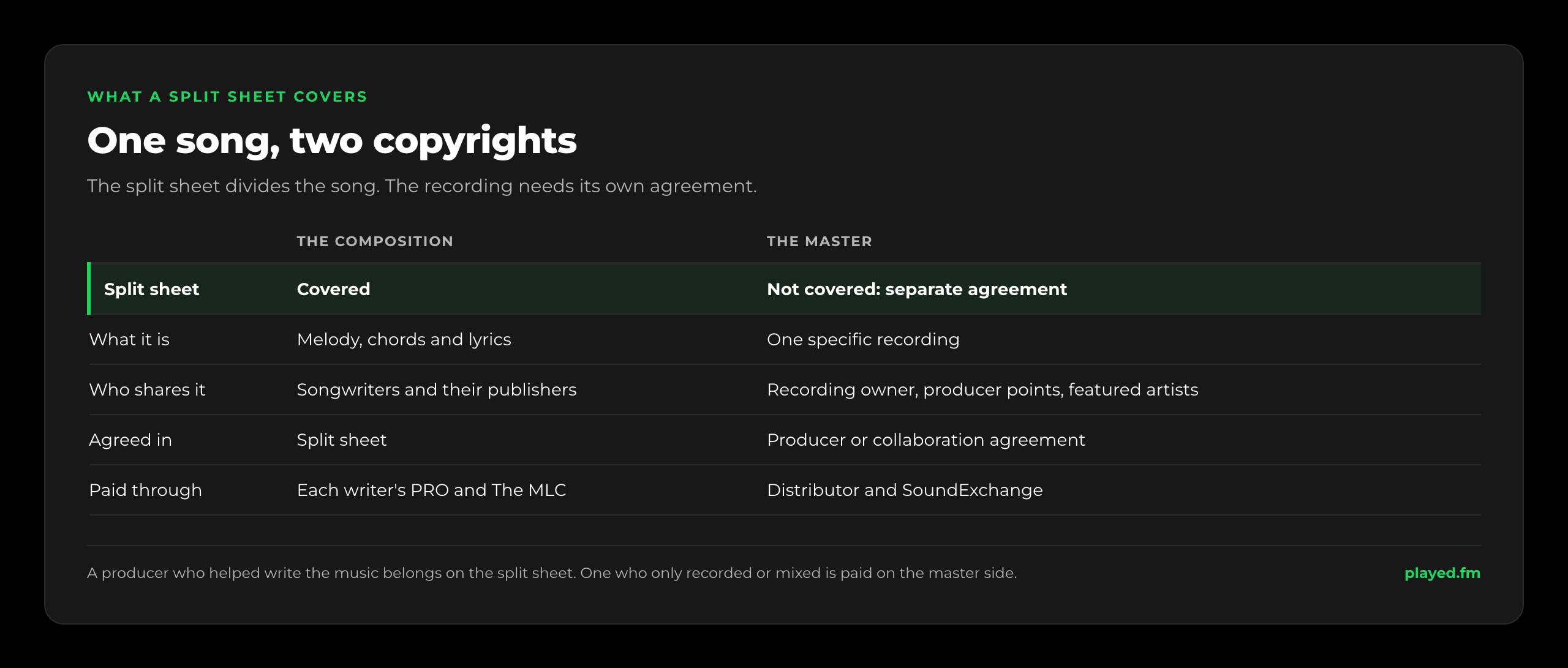
This matters most with producers, who can sit on either side:
- A producer who helped write the music (a chord progression, a melodic part, a topline) is a co-writer and belongs on the sheet. ASCAP’s FAQ notes that producers often “do contribute to the underlying composition”, and leaves the decision to you and your co-writers.
- A producer who recorded or mixed without writing usually earns on the master side, through a producer agreement that sets a fee, a share of master royalties (“points”), or both.
- A leased beat comes with a licence that may already set what the beat producer keeps. Your split sheet should match it, not quietly override it.
Featured vocalists and session players are master-side questions too, unless they also wrote part of the song.
What to put on a split sheet
One sheet per song. Collect what a PRO or The MLC will ask for, so nobody has to chase it later.
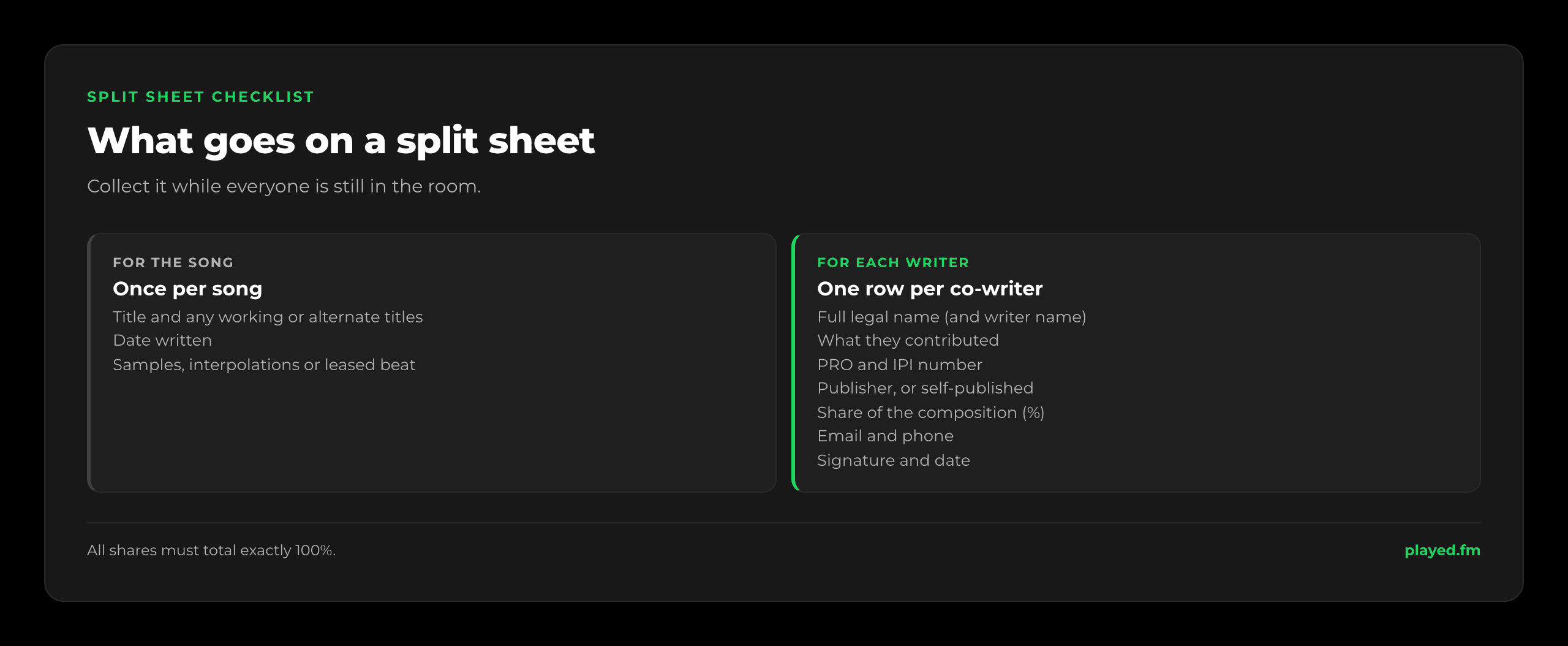
- Song title and any working titles, so nobody registers it twice under different names.
- Date written, and the session or place.
- Each writer’s full legal name, plus any writer or stage name.
- Contribution: lyrics, music or both. Optional, but useful if the split is ever revisited.
- PRO for each writer, or “none yet”.
- IPI number: the identifier collection societies use worldwide for writers and publishers, from CISAC’s IPI system. Older paperwork may call it a CAE number. Your PRO can tell you yours.
- Publisher for each writer’s share, or “self-published”.
- Percentage share of the composition. All shares together must total exactly 100%.
- Email, phone, signature and date for every writer.
- Samples, interpolations or a leased beat, noted at the top. If an outside writer will need a share once a sample is cleared, say the shares are subject to that.
Free split sheet template
Copy this into a document, add a block for each co-writer, and get everyone to sign. It is plain on purpose, so it works in an email, a notes app or on paper.
SONG SPLIT SHEET

Song title: ____________________
Working / alternate titles: ____________________
Date written: ____________________
Session or place: ____________________
Samples, interpolations or leased beat
(name and licence, or "none"): ____________________

WRITER 1
Legal name: ____________________
Writer name (if different): ____________________
Contribution (lyrics / music / both): ________
PRO: ____________________
IPI number: ____________________
Publisher (or "self-published"): ____________________
Share of the composition: ______ %
Email: ____________________
Phone: ____________________
Signature: ____________________
Date: ____________________

WRITER 2
(repeat every field above)

TOTAL OF ALL SHARES: 100 %

This sheet records each writer's share of the
composition (music and lyrics) only. It does not
cover ownership of, or income from, any sound
recording of the song. Each writer will register
these shares with their own PRO and, where they
administer their own publishing, with The MLC.
Save the signed copy as a PDF named after the song and keep it with the audio files. It is the document you will be asked for when a registration conflicts or a buyer wants proof the track is clear.
A filled-in example
The names, song and numbers below are invented to show the format. They are not a recommended split.
| Writer (illustrative) | Contribution | PRO | Publisher | Share |
|---|---|---|---|---|
| Avery Example | Lyrics and topline melody | ASCAP | Self-published | 40% |
| Blake Sample | Music and second-verse lyrics | BMI | Self-published | 40% |
| Casey Placeholder | Producer; wrote the chords and bass line | None yet | Self-published | 20% |
| Total | 100% |
Song: “Example Song” (illustrative). What it shows:
- Writers at different PROs are normal. Each registers the song with their own PRO, listing all three writers and their shares.
- A PRO’s form may not use the sheet’s numbers. ASCAP divides performance royalties evenly between writers and publishers, so its registration FAQ asks for writer splits adding up to 50% and publisher splits adding up to 50%. Avery’s 40%, self-published, goes in as 20% writer and 20% publisher. Follow your own PRO’s instructions.
- A writer with no PRO still goes on the sheet. Casey owns 20% either way, but The MLC notes that writers still need to join a PRO to collect public performance royalties.
How co-writers decide the split
There is no legal formula. Two approaches cover most rooms, and both work if everyone agrees the method before the arguing starts.
Equal split. Everyone who wrote in the session takes an equal share, however many lines each contributed. Three writers, a third each. It is fast, it ends the scorekeeping, and it keeps people willing to throw out half-ideas that someone else turns into the hook. The cost: a writer who carried the song may feel short-changed.
Contribution-based split. Writers agree percentages that reflect what each one wrote. It suits sessions where one writer arrives with most of a song. The cost is the conversation itself: is a hook worth more than a verse, or a chord progression as much as a melody? Those questions have no neutral answers.
You will hear rules of thumb, such as lyrics and music each being worth half. Some writers use them as a starting point. They are not rules anyone has to follow.
- Agree the method at the start and the numbers at the end. “Equal split for whoever is in the room” is easy to agree before anyone has written a line.
- Deal with samples up front. If another song’s writers will need a share, everyone else’s shrinks. Say so on the sheet.
What happens without a split sheet
The song does not become ownerless. In the US the law fills the gap, just not with numbers.
The Copyright Act defines a joint work as one “prepared by two or more authors with the intention that their contributions be merged into inseparable or interdependent parts of a unitary whole.” The Copyright Office’s Compendium, section 505, explains that each joint author owns “an undivided interest in the copyright for the work as a whole”, with co-owners “treated generally as tenants in common, with each co-owner having an independent right to use or license the use of a work, subject to a duty of accounting to the other co-owners for any profits.”
- The statute names no percentages. It makes co-writers co-owners of the whole song and stops there. Disagree later and someone else may end up deciding the numbers.
- Not everyone in the room is a joint author. The Compendium describes the key test as the intention, at the time of writing, to merge the parts into one work, and says a collaborator who contributes only a de minimis amount of expression is not a joint author.
- Registrations collide. Writers who register different versions of the split create conflicts at their PROs and overclaims at The MLC. An overclaim happens when claimed shares total more than 100%, and it is “the responsibility of those claiming shares on the work to resolve” it.
This is general information about US law, not legal advice. Other countries have their own rules on joint authorship. If real money or a real dispute is involved, talk to a music lawyer.
How to register the agreed splits
The split sheet is the source. Everything else should match it.
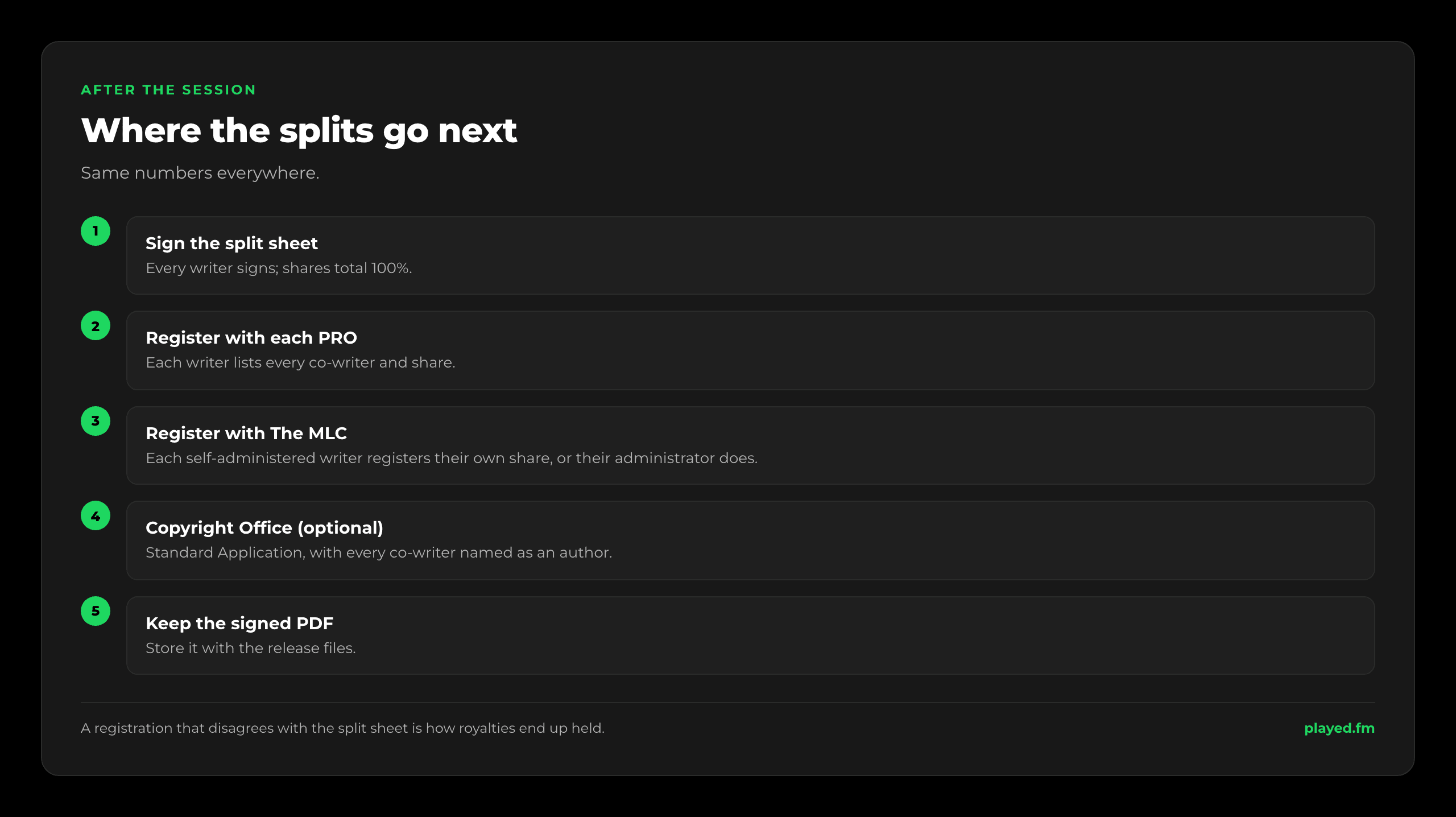
- Each writer registers the song with their own PRO, listing every co-writer and share. ASCAP’s FAQ says that if your co-writer belongs to a different PRO, you need to register the work with ASCAP yourself before it can track the song and pay you. Not affiliated yet? Start with ASCAP vs BMI.
- Each self-administered writer registers their own share with The MLC, which collects US digital mechanical royalties. The MLC’s guidance on co-written songs is that each party with the right to register and collect for their share should join and register it separately. Joining is free. If you have a publishing administrator, it generally registers for you, so check before joining.
- Register the copyright if you want the legal protections that come with it. A co-written song cannot use the Copyright Office’s cheaper single-author application; it needs the Standard Application, naming every joint author. See how to copyright a song.
- Keep the signed PDF with the release files, and make sure the writer credits you give your distributor match it.
Why sync buyers ask about splits
A music supervisor licensing a song for a film, ad or game needs a yes from every owner of the composition and the master. If you wrote and recorded the track yourself, you can give both, which makes you a one-stop clearance and gives independent artists a real advantage. The full picture is in music sync licensing.
A co-write with no signed split breaks that. “We never wrote it down” is exactly the gap that sends a supervisor to a track they can clear today. If you pitch the sync briefs on Played, where Played takes 0% of the placement and you keep your masters and publishing, have the signed sheet ready before you pitch.
Disputes, and fixing a split later
Splits do change. When they do, change them the way you set them.
- Write a new split sheet, dated, naming the sheet it replaces, signed by every writer.
- Update every registration to match. ASCAP lets you revise a work you registered online, but if a change removes another party or reduces their share, it may require signed correspondence from that party.
- Resolve MLC overclaims with documents. Claimants can amend their shares, relinquish them, or upload supporting documents. The MLC’s ownership dispute policy lists “Signed Split Sheets” among the documents it accepts.
- Know what a dispute costs. Under that policy, a work in dispute stays there, with royalties held in suspense, until The MLC receives written evidence that all parties have resolved it, or a legal order. The MLC does not judge disputes itself.
- Fix a copyright registration with a supplementary registration if the song was registered with the wrong authors: $100 online as of October 2026, with a proposed change to $85.
If the writers cannot agree at all, that is the moment for a mediator or a music lawyer, not another round of messages.
Frequently asked questions
What is a split sheet in music?
A short written agreement, signed by every writer of a song, that records what percentage of the composition each person owns. The shares add up to 100% and decide how songwriting royalties are divided. It also lists each writer’s PRO, IPI number and publisher so registrations can match.
Is a split sheet legally binding?
A signed split sheet is a written agreement between the writers, and The MLC lists signed split sheets among the documents it accepts when ownership claims conflict. Whether a particular sheet holds up in court depends on its wording and local law, so for large deals or disputes, ask a music lawyer.
Who should be on a split sheet?
Everyone who wrote part of the composition: lyrics, melody, chords or other musical parts, including a producer who helped write the music. People who only performed, engineered or mixed usually earn on the recording side through a separate agreement, unless the writers agree otherwise.
Does a split sheet cover the master or producer points?
No. A split sheet divides the composition, the song as written. Master ownership, producer points and featured-artist shares are agreed separately, usually in a producer or collaboration agreement.
What if a co-writer will not sign the split sheet?
Do not register a split they have not agreed to: conflicting registrations create PRO conflicts and MLC overclaims that can hold royalties for everyone. Put the disagreement in writing, and if you cannot settle it between you, use a mediator or a music lawyer.
Can you change a split sheet after it is signed?
Yes, if every writer agrees. Write a new, dated sheet that names the one it replaces, get every writer to sign it, then update each PRO registration and MLC claim to match. ASCAP, for example, may ask for signed confirmation from a writer whose share goes down.
The bottom line
A split sheet is two minutes of paperwork that decides who gets paid from a song for decades. Fill it in before anyone leaves, put every writer’s legal name, PRO, IPI number, publisher and percentage on it, make the shares total 100%, and get every signature. Then make every registration match it.
Keep the signed copy with the audio. The next person to ask for it might be a supervisor with a budget.