An electronic press kit (EPK) is one link that gives the people who book, cover and license music everything they need to make a decision about you: a short and a long bio, photos they are allowed to use, music they can stream in full, any genuine press, the numbers that matter, and a direct contact. It is the digital version of the printed press kit, and it answers the questions a promoter, journalist, curator or music supervisor would otherwise email you about.
Making one takes an afternoon. Write two bios, choose three to six credited photos, pick the two or three tracks you most want heard, gather real quotes and stats, add your contact details, and put the lot behind a URL that never changes. Below: who reads an EPK, what to include, four examples by artist type, a copy-paste template, EPK vs one-sheet, where to host it and how to send it.
Key takeaways
- Send one link, never attachments. A link can be updated after you send it. A 40MB zip cannot, and it may not arrive at all.
- Lead with what the reader is deciding. Bookers want live video, journalists want a story and photos, supervisors want streamable tracks and clear rights.
- Only real quotes and real numbers. One inflated figure discredits the whole page.
- Credit every photo. The photographer normally owns the copyright, so get permission for press use and name them.
What an EPK is for, and who actually reads it
An EPK is a working document for people in the music business, not a fan page. Fans listen and buy. Industry readers make a yes-or-no decision quickly, then grab a file, a photo or a link.
The readers are different people deciding different things:
| Reader | What they are deciding | What they look for first |
|---|---|---|
| Promoters and talent buyers | Can you fill a room on a given night? | Live video, past shows, where your listeners are |
| Journalists and bloggers | Is there a story, and can I illustrate it? | The bio's angle, release details, credited high-resolution photos |
| Playlist curators and radio | Does this track fit? | A full-length stream of the track, genre, release date |
| Music supervisors | Does it fit the scene, and can it clear? | Streamable tracks, instrumentals, who controls the rights |
| Labels, agents and managers | Is there momentum? | Releases, audience numbers, press, live video |
Very little overlaps, so the strongest kits are short, put the most persuasive thing first and let each reader jump to their section. A generic PDF sent to everyone underperforms: the booker scrolls past three paragraphs of origin story looking for a live video that is not there.
What to include in an EPK
Ten sections cover almost every request. Not every artist needs all ten, and a padded section looks worse than a missing one.
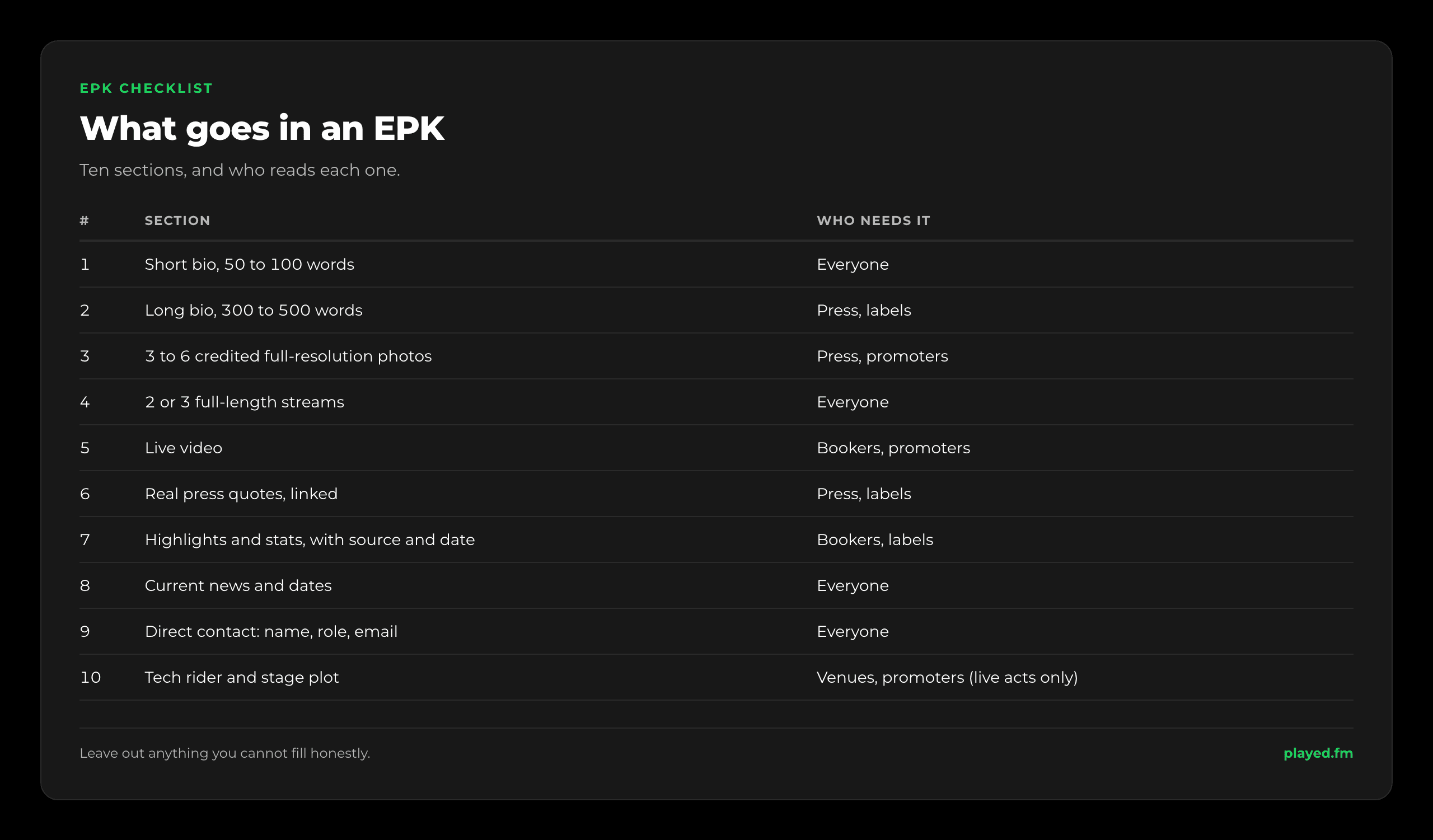
- A short bio, 50 to 100 words. Who you are, what you sound like, where you are from and what is new, in the third person so it can be pasted straight into a listing.
- A long bio, 300 to 500 words. The story, the releases and shows that mattered, and what is next. One or two honest comparisons beat a list of influences.
- Three to six press photos. Recent, in focus and supplied as full-resolution files, because print needs far more pixels than a screen. Include horizontal and vertical crops, one with space for a headline, and name the photographer next to each.
- Music. Two or three tracks you want heard first, as links that play in full in a browser without signing in. Use private streaming links for unreleased music.
- Video. One live clip matters more to a booker than anything else here. An official video is a bonus, not a substitute.
- Press quotes. Short, exact, attributed to the publication and linked to the original. No coverage yet? Leave the section out.
- Highlights and stats. Only figures you can back up, with a date: monthly listeners, a sold-out show, a support slot, a placement, a genuine playlist add.
- Current news. The next release, upcoming shows, anything time-sensitive. It goes stale fastest, so date it.
- Contact. One name, their role, an email address and, for bookings, a phone number. Not a contact form.
- For live acts: a tech rider and stage plot. The stage plot shows where each performer and their gear stands; the input list and rider say what the sound engineer must provide. Venues and festivals often ask for them before a show.
On photos: under US law, copyright belongs to the author of a work, which for a photograph is normally the photographer rather than the artist pictured (US Copyright Office). Make sure your agreement with the photographer covers press use, and credit them wherever the image appears.
EPK examples: four artist types and what each leads with
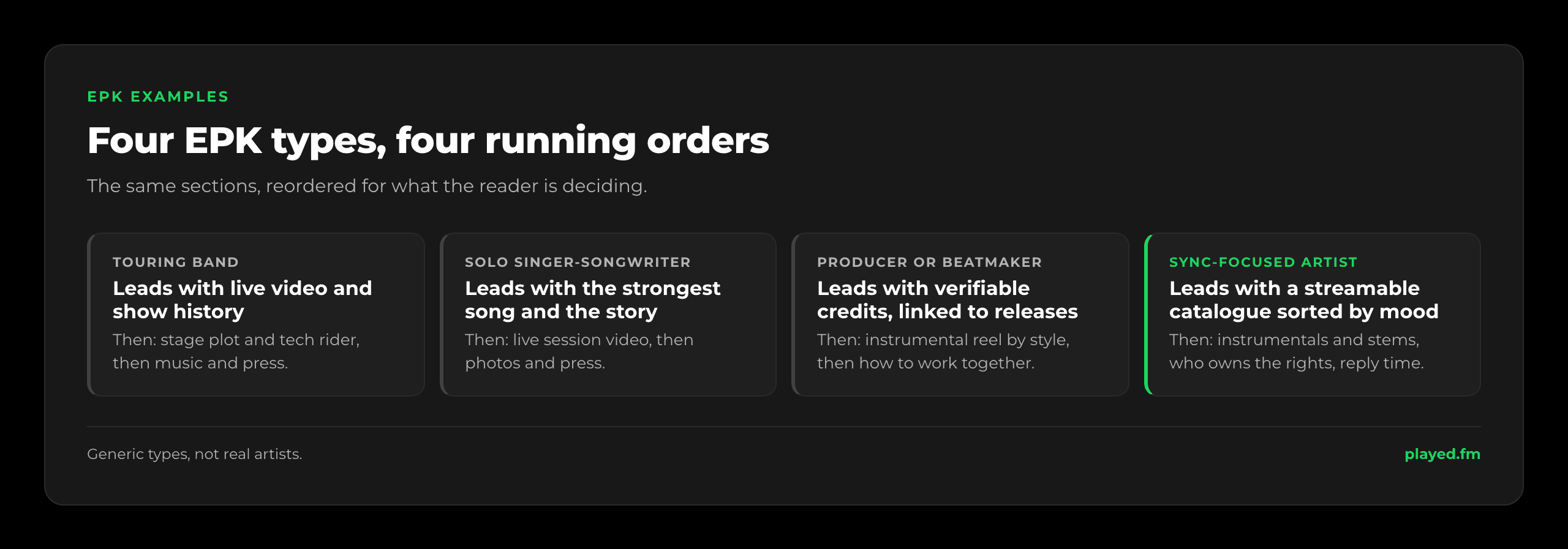
We are not going to screenshot other artists' kits: they change constantly and are not ours to reproduce. The pattern is more useful anyway. The same sections, reordered, make four quite different EPKs.
1. Touring band
Lead with a live video and a short show history: venues, support slots, festivals and the cities where people turn up. Put the stage plot and rider one click away, then music and press. A promoter wants to know you can fill a room on a Thursday; the long bio comes last.
2. Solo singer-songwriter
Lead with the song and the story: a strong single, a stripped-back live session and a bio with a real angle, which gives a journalist something to write. Photos carry more weight here, because you are the visual identity of the project.
3. Producer or beatmaker
Lead with verifiable credits, linked to the releases, then a short reel of instrumentals by style and a plain line on how to work with you or license a beat. Proof of work beats press photos. The selling side is in our guide to selling beats online.
4. Sync-focused artist or composer
Lead with a fully streamable catalogue organised by mood and use, not by album. Say that instrumentals and stems are available, that you control 100% of the master and publishing if that is true, and how fast you reply. The full readiness checklist lives in our sync licensing guide, and what a music supervisor does explains who is on the other end.
EPK template you can copy
Paste this into a document or a web page and replace everything in square brackets. Delete any line you cannot fill honestly rather than padding it.
[ARTIST NAME] · [genre in three words] · [city or region]
Headline: [Name] is a [genre] [band / artist / producer] from [city]. [New single / album / tour]: [title], [date].
Listen: [Track 1 link] · [Track 2 link] · [Track 3 link]
Watch: [Live performance video link] · [Official video link, optional]
Short bio (50 to 100 words): [Third person. Who you are, your sound, where you are from, what is new.]
Long bio (300 to 500 words): [The story, the milestones, what is next.]
Press: “[Exact quote]” [Publication, linked] · “[Exact quote]” [Publication, linked]
Highlights: [Real stat, with source and date] · [Notable show, support slot or festival] · [Placement or playlist, linked]
Photos: [Link to a folder of full-resolution files] · Credit: [photographer name]
Live (if applicable): [Stage plot link] · [Tech rider and input list link] · [Set lengths you can play]
Contact: [Name], [role] · [email] · [phone, for bookings]
Links: [Website] · [Streaming profile] · [Socials]
Reorder it for each kind of reader, following the four types above, and keep the same URL for good: update the page rather than sending a new link.
EPK vs one-sheet
A music one sheet is a single page that summarises one release, or the act at one moment, for someone who will give it ten seconds: title and release date, cover art or a photo, a three-sentence description, a few selling points and one contact. It is built for triage, typically when pitching a specific release. The EPK is the reference the reader clicks through to.
| One-sheet | EPK | |
|---|---|---|
| Covers | One release or moment | The whole act |
| Format | One page, usually a PDF | A scrollable web page |
| Lifespan | The weeks around a release | Updated continuously |
| Best for | Pitching a specific release | Booking, press, sync, labels |
They work best together: link the EPK from the bottom of the one-sheet.
Where to host your EPK
The format matters less than one rule: the link should still work, and still be current, a year after you send it.
| Option | Good for | Watch out for |
|---|---|---|
| A page on your own website | Full control, your own domain, a permanent URL | Nobody else will keep it current |
| A PDF | Printing, offline reading, formal applications | Out of date the day you send it; no streaming inside; large files bounce |
| A link-in-bio page | Quick, mobile-friendly | Built for fans, with little room for bios, credits or photo downloads |
| A Bandcamp page | Full-length streams and a buy button | Bio text past 400 characters gets cut off; built for fans buying music, not press |
| A shared cloud folder | Holding full-resolution photos and riders | A folder of files is not a front page; pair it with one of the above |
| Your Played press kit | Built automatically from your storefront | No quotes, video or rider sections (details below) |
The Bandcamp limit is from Bandcamp's own artist guide. On PDFs: if you must send one, link to it rather than attaching it. Personal Gmail accounts cap attachments at 25MB and swap anything larger for a Google Drive link (Gmail Help). Both checked October 2026.
The Played press kit
If you sell on Played, you already have an EPK. Every live storefront gets a public press kit at played.fm/epk/yourname, built from what you have already entered, so there is nothing separate to maintain. It shows:
- your profile photo, your name, and up to four genres taken from your tracks;
- how many tracks and releases you have, plus your Played follower count once you have followers;
- your bio;
- up to 12 photos with your captions, each opening the full-size file;
- your 12 most recent public tracks, each with a player and a link to its track page;
- a contact section linking to your storefront and any social profiles you have added (Instagram, TikTok, YouTube, Spotify, Apple Music, SoundCloud, Facebook, X).
It has a print layout too, so you can save it as a PDF from your browser when someone insists on one.
What it does not do: there is one bio rather than a short and a long version, and no sections for press quotes, video, tour dates, a tech rider or a stage plot. There is no email field, so if you want bookings by email, put the address in your bio. Captions run to 120 characters, enough for a photographer credit. And the page only works while your storefront is live: if your plan lapses, so does the link. Live acts should host their rider and stage plot elsewhere and link them in the email.
How to send an EPK so it gets opened
- Pick the right person. The promoter who books your genre at that venue, the writer who covers your scene. If they publish submission guidelines, follow them.
- Write a subject line that says what this is. For example “[Genre] act from [city], available [dates]: EPK” or “New single for review: [Artist], [Title], out [date]”.
- Keep the email to four or five sentences. Who you are, why this person, what you are asking for, your strongest fact, and the link.
- Send one link, not attachments. Attachments get filtered or ignored, and are frozen the moment you send them. Music supervisors interviewed by Spotify for Artists made the same request: a link to a good-quality stream rather than a large attachment. Test every link while logged out.
- Follow up once. A short nudge after a week or so is fine. A third email is not.
- Answer fast when they reply. A booker holding a date will move on to the next act.
Put together, a booking email looks something like this:
Subject: Indie folk duo from [city], free [dates]: EPK
Hi [first name],
We're [Artist], an indie folk duo from [city]. You booked [similar act] at [venue] last month, and our audiences overlap. We're in [city] on [dates] and would love a weeknight slot. Our last hometown show sold [real number] tickets.
Live video, stage plot and everything else: [EPK link]
Thanks, [name] · [phone]
Common EPK mistakes
- Burying the music below five paragraphs of bio.
- Inflated numbers or paraphrased quotes. Listener counts take seconds to check. Quote exactly and link the original.
- Uncredited photos, or photos you are not cleared to share. Get permission for press use in writing, and name the photographer every time.
- Stale news. Last year's tour dates say nobody is minding the page.
- No direct contact. A social handle is not a booking contact.
- One kit, every reader. Reorder before you send.
And one that has nothing to do with the kit: an EPK makes it easy to say yes to an act that is ready, but it does not create demand. If you need the audience first, start with how to build a fanbase.
Frequently asked questions
What is an EPK?
An EPK, or electronic press kit, is a single page or link that gives promoters, journalists, curators and music supervisors what they need to assess an artist: a short and a long bio, photos cleared for press use, streamable music, real press quotes and stats, and a direct contact.
What should an EPK include for musicians?
A short bio of 50 to 100 words, a longer bio of 300 to 500 words, three to six credited full-resolution photos, two or three streamable tracks, a live or official video, genuine press quotes, verifiable highlights, current news and a direct contact. Live acts should add a tech rider and stage plot.
How long should an EPK be?
Short enough to scan in under a minute: one web page, or the equivalent of one or two printed pages. Put the most persuasive item for that reader first and let bios, photos and riders sit further down.
What is the difference between an EPK and a one-sheet?
A one-sheet is a single page summarising one release or moment, built for a reader who will give it seconds. An EPK is the full reference for the act, with bios, photos, music, press and contacts, and it is updated continuously. Many artists link the EPK from the one-sheet.
Should I send my EPK as a PDF or a link?
A link. A web page can be updated after you send it, plays music in place and never bounces for being too large. If someone specifically asks for a PDF, keep it small and link to it rather than attaching it.
Do I need an EPK if I do not play live?
Yes, if you want press, playlist, label or sync attention. Drop the rider and stage plot and lead with the music: verifiable credits for producers, a streamable catalogue sorted by mood and a clear rights statement for sync.
The bottom line
An EPK is one link that lets a busy person decide about you quickly and find what they need without emailing you. Two bios, credited full-resolution photos, streamable music near the top, only real quotes and numbers, a direct contact, and a rider and stage plot if you play live. Reorder it for each reader, host it somewhere you can update, and send the link, never the files.
If you sell your music on Played, your press kit is already live at played.fm/epk/yourname and updates whenever your storefront does. See how the storefront works.