A track earning 100,000 Spotify streams a month pays its artist somewhere around $300–$500 before the distributor takes anything. That is the number most guides bury, and it is the one that reorganises everything else: streaming is how people find you, and almost never how you get paid.
This is a breakdown of every route that actually pays a musician in 2026 — what each one returns, what it costs you to start, and where each is the wrong answer. No route here requires a label. Most do not require an audience yet either, which matters if you are starting from zero.
Key takeaways
- Live performance is still the biggest single source of income for working musicians — roughly 65% — and also the hardest to start from nothing.
- Spotify pays about $0.003–$0.005 a stream. Apple Music pays roughly double, at $0.007–$0.010.
- One direct $1.29 sale equals about 323 Spotify streams. One $10 album equals about 2,500.
- Sync placements pay $120–$3,000 per track on the briefs currently open on Played.fm.
- Artists earning full-time stack three to five streams. Almost nobody lives on one.
- Sync and fan subscriptions are growing faster than streaming for most independents.
What each route actually pays
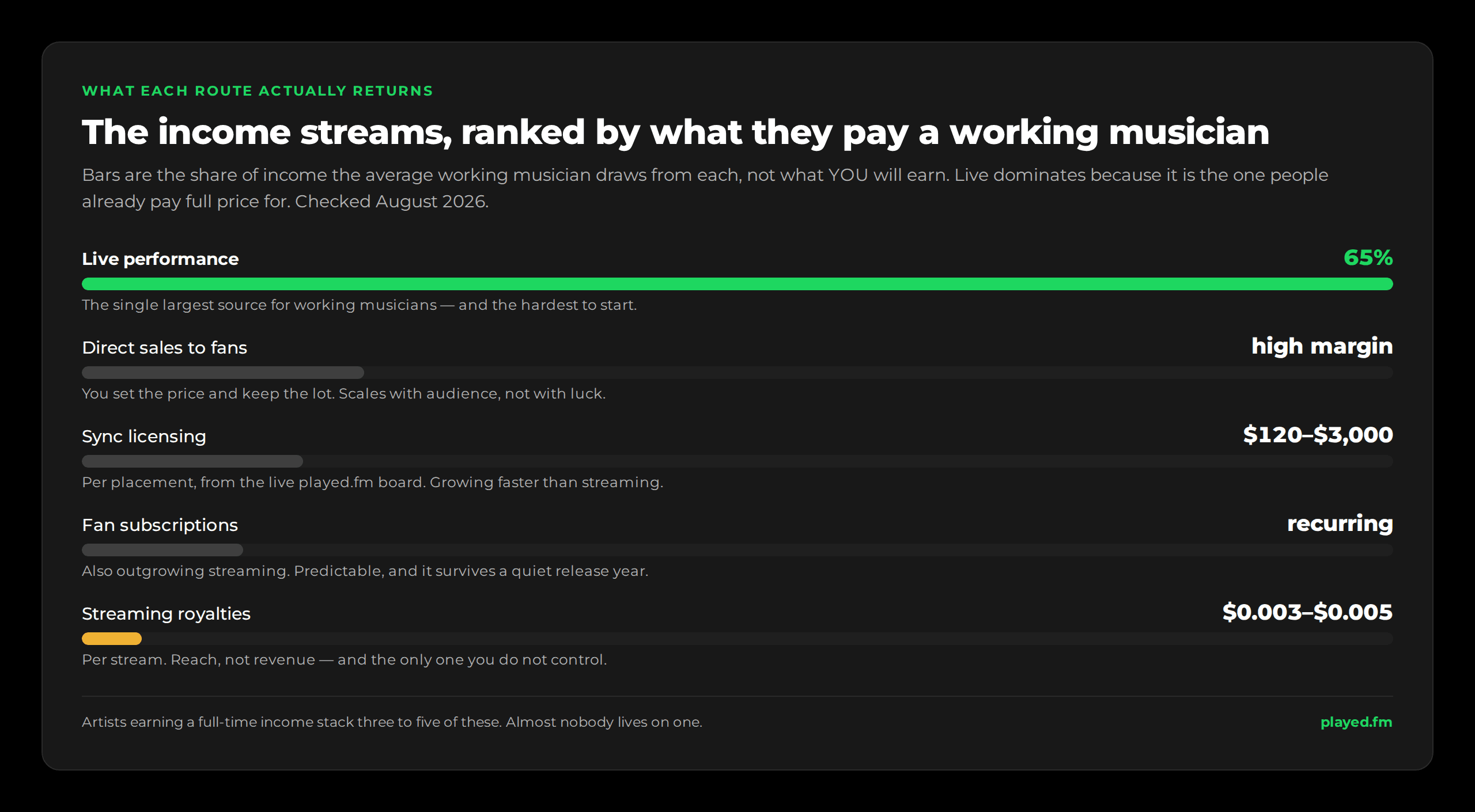
Ranked by what it returns to a working musician, not by how often it gets written about.
1. Live performance — the biggest, and the slowest to start
Playing to people remains the largest single source of income for working musicians, accounting for roughly 65% of what they earn. It is the one thing in music that audiences still routinely pay full price for, and the money arrives the same night.
It is also the route with the highest barrier. A show needs an audience in one city on one date, and building that takes months of groundwork before the first paid booking. Wrong answer if: you are starting from nothing this month, or your music is not built to be performed — a lot of produced and AI-assisted work simply is not.
2. Direct sales — the highest margin, and the one you control
Selling music straight to listeners returns more per person than anything except a placement. You set the price, and on a storefront that takes 0% you keep all of it. There is no algorithm deciding whether your release surfaces this week.
The arithmetic is what makes it worth taking seriously. At the $1.29 most independents price a single at, one sale is worth about 323 Spotify streams. A $10 album is worth about 2,500. Getting ten people to buy an album is a realistic afternoon; getting 25,000 streams is not.
Wrong answer if: you have no way to reach anyone. Direct sales convert an audience — they do not create one. That is the honest limitation, and it is why this is not ranked first. See how to sell music online for the mechanics and how to build a fanbase for the part that has to come first.
3. Sync licensing — the biggest single cheques
Sync is your music used in something visual: film, TV, a game, an ad, a podcast. One placement can pay more than a year of streaming for the same track. On the Played.fm briefs board, open budgets currently run from $120 to $3,000 per track.
It rewards preparation over volume. Buyers want an instrumental version, a clean master, and metadata that describes the mood rather than the genre. It also has the least predictable timing of anything here — reviews commonly take months, because a brief moves when the project moves.
Wrong answer if: you need money this month, or you would be counting on it. A pitch is a submission, not a placement. More in how sync licensing works and what sync licensing actually pays.
4. Fan subscriptions — the one that survives a quiet year
Recurring support from a small number of committed listeners is the most predictable money in independent music, and it is growing faster than streaming for most artists. Fifty people at $5 a month is $250 arriving whether or not you released anything.
Wrong answer if: you cannot commit to a rhythm. Subscriptions are a promise of ongoing output, and the churn when that stops is brutal.
5. Streaming — reach, not revenue
Worth doing. Not worth counting on. Streaming puts your catalogue where casual listeners find things, and that discovery genuinely feeds everything above it. What it does not do is pay.
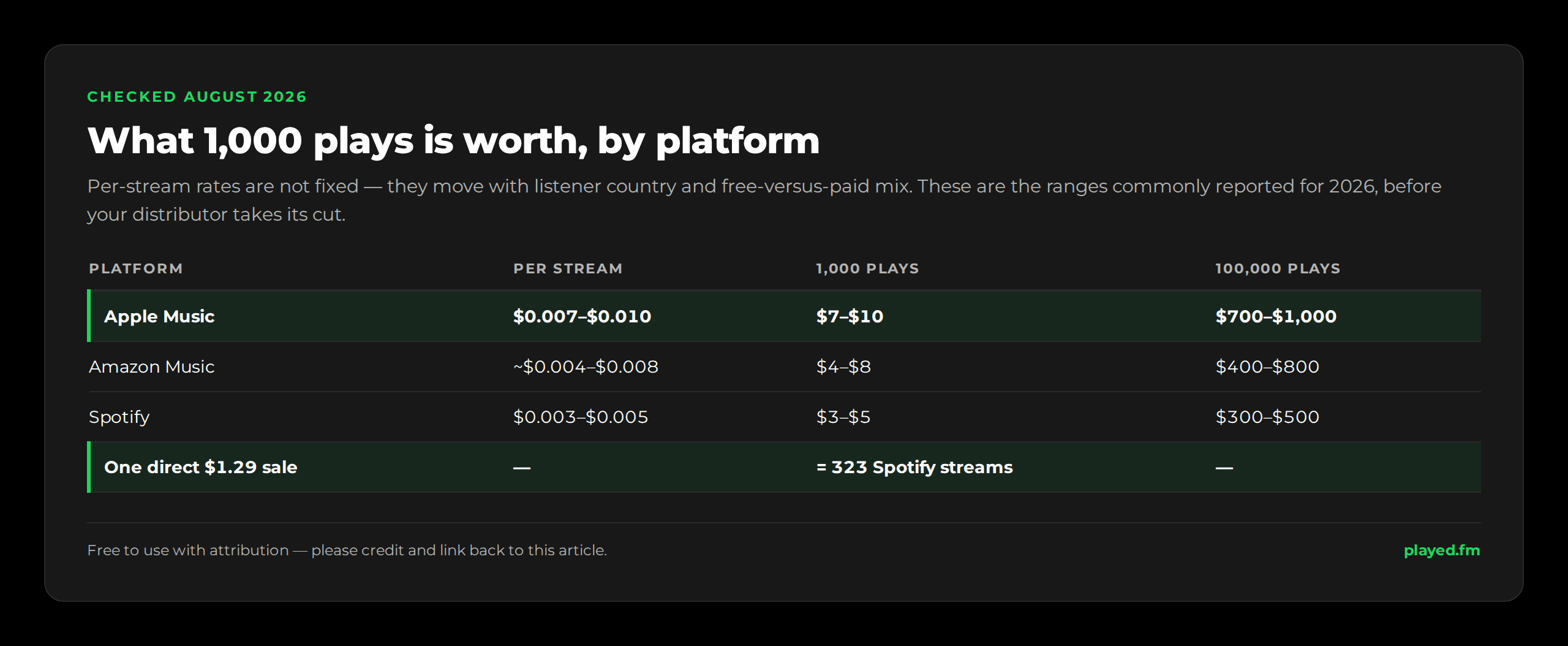
Two things worth noticing in that table. Apple Music pays roughly double what Spotify does, so a catalogue skewed toward one platform earns very differently from the same play count spread across another. And the per-stream figure is not fixed — it moves with the listener's country and whether they are on a paid or ad-supported tier, which is why your own rate drifts month to month without you changing anything. The detail is in what artists actually make per stream.
Wrong answer if: you are treating stream counts as progress toward income. They are progress toward being findable, which is a different thing and still worth having.
The routes that fill in around the five
None of these carries a career on its own, but each one turns idle assets into money, and together they are often the difference between a good month and a flat one.
Publishing royalties — money you may already be owed
Every song is two copyrights: the composition (melody, chords, lyrics) and the recording. Your distributor collects on the recording. Nobody collects on the composition unless you register it. That means performance royalties from PROs and mechanical royalties from The MLC sit unclaimed by default, sometimes for years.
It is the only route here that is pure recovery — the money exists whether or not you do anything else. Worth an afternoon: how music royalties work covers who collects what.
Beat and sample sales — inventory that resells
A beat can be licensed to many buyers at once, which is a fundamentally different economic shape from a song sold to a fan. It suits producers with volume and no interest in performing. Wrong answer if: you are building an artist identity — beat buyers are customers, not fans, and they do not come back for your next release. See how to sell beats online.
Teaching, session work and commissions — time for money
Paid promptly, priced reasonably, and completely reliable — because you are selling hours rather than competing on catalogue. The trade-off is that it builds no asset: stop working and the income stops the same week. Most working musicians use it as the floor that makes the riskier routes survivable.
Merch and physical — margin, but only with demand
Merch carries good margins and fans genuinely want it, but it inverts the usual risk: you pay upfront for stock, and unsold inventory is a real loss rather than a missed opportunity. Print-on-demand removes that risk at the cost of most of the margin. Wrong answer if: you cannot yet name fifty people who would buy a shirt.
Why nobody lives on one of these
The artists earning a full-time income from music are not the ones who found the single best route. They are the ones who run three to five of these at once, so that a quiet quarter in one is covered by another.
That matters for how you sequence things. Chasing the biggest number first — live, or a sync placement — means competing where the barrier is highest before you have anything to compete with. The routes stack in a particular order for a reason: each one makes the next easier. Direct sales need an audience, an audience needs discovery, discovery is what streaming is for, and a placement needs a finished, well-prepared catalogue you built while doing the rest.
The realistic path to your first $100
Not the fastest route in theory. The one that does not depend on an audience you have not built yet.
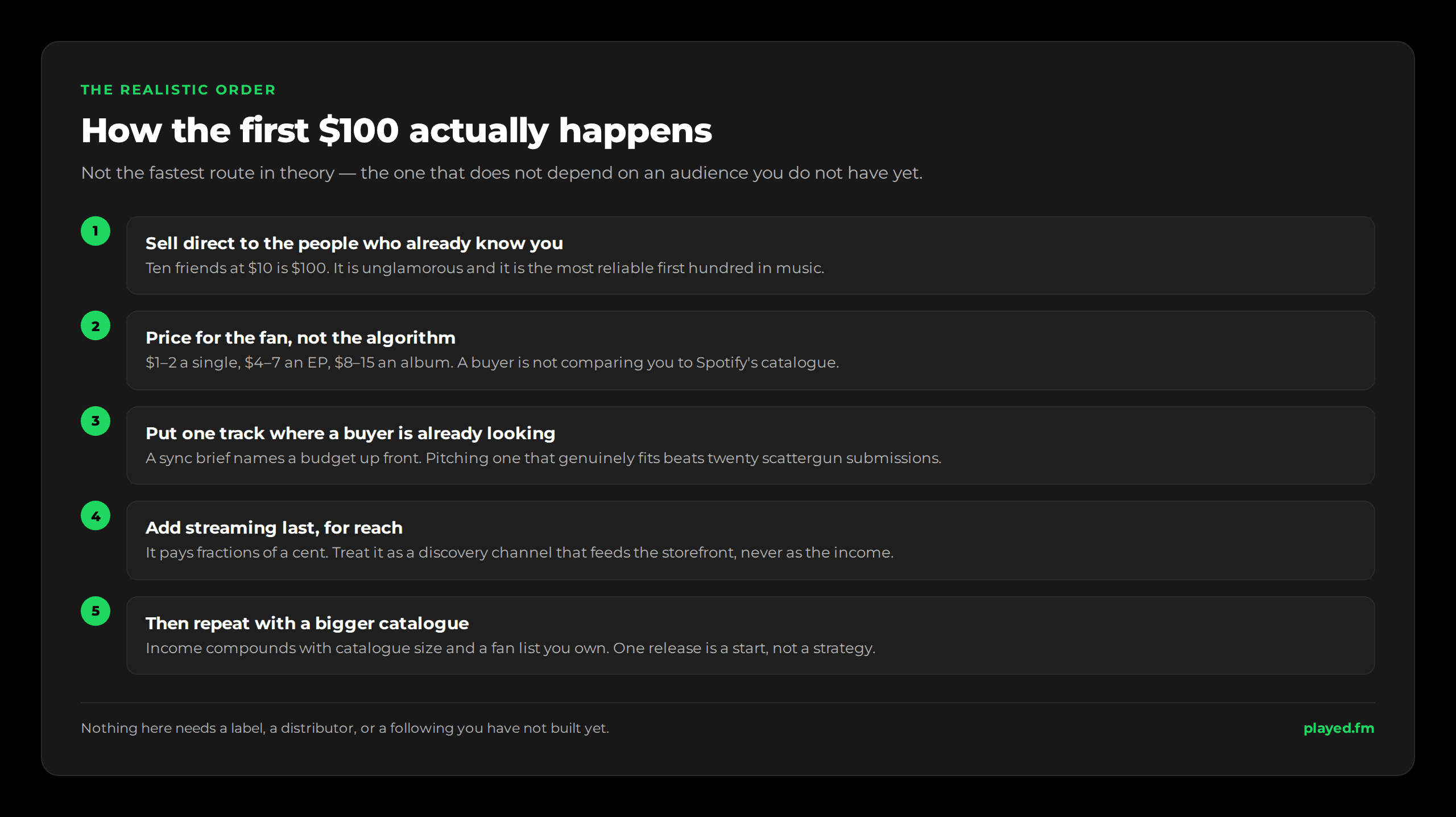
The step people skip is the first one, because it feels like cheating. It is not. Ten people who already know you, at $10 each, is $100 — and it is a more reliable first hundred than any amount of playlist strategy. Every artist earning real money started with a small number of people who paid, not a large number who listened.
The part nobody ranks: what you keep
Every route above is a gross figure. What lands in your account depends on who takes a cut on the way.
- Streaming: your distributor takes a subscription or a percentage before you see anything. Compared properly in every distributor fee compared.
- Storefronts: Bandcamp takes 15% on digital, dropping to 10% after $5,000 in sales, plus 4–6% payment processing. The arithmetic is in what Bandcamp actually takes.
- Sync agencies and libraries: commonly 25–50%, and many take exclusivity with it — meaning you cannot license that track anywhere else.
- Selling direct on Played: 0% of the sale. Fans pay through your own PayPal or Wise link, so the money never passes through us. We earn from subscriptions instead.
A 15% cut sounds small next to a 70/30 streaming split until you notice it applies to the channel with the highest per-fan value you have. On $2,000 of direct sales it is $300 — roughly a sync placement's worth of budget, gone to a middleman on a transaction you generated yourself.
If that is the trade you want to stop making, Played.fm exists for exactly this: your own storefront, 0% on every sale, and a sync board where the buyer names the budget up front.
Does any of this change if you make music with AI?
The economics do not. The gatekeeping does.
Direct sales, sync and fan subscriptions work identically whether a track was played or generated — there is no reviewer between you and a buyer. Streaming is where it gets complicated, because each distributor sets its own AI policy and they disagree sharply: some accept fully AI-generated music with disclosure, others reject it outright. That is covered in which distributors allow AI music, and the selling side in how to sell Suno music.
The practical consequence is that AI-assisted artists are pushed toward the routes that pay better anyway. It is an odd silver lining, but it is a real one.
Frequently asked questions
How much money can you make from music?
Anywhere from nothing to a full-time income, and the difference is rarely talent. Artists earning full-time typically run three to five income streams at once. A single stream — especially streaming royalties — supports almost nobody.
How do musicians make money in 2026?
Live performance is the largest single source at roughly 65% of working-musician income, followed by direct sales, sync licensing, fan subscriptions and streaming. Publishing royalties, session work, teaching and beat sales fill in around them.
How much does Spotify pay per 1,000 streams?
Roughly $3–$5, before your distributor takes its cut. Apple Music pays roughly $7–$10 for the same 1,000 plays. Your actual rate varies with listener country and whether they are on a paid or ad-supported plan.
Can you make a living from streaming alone?
Almost nobody does. At $0.004 a stream you need around 750,000 streams a month to reach a modest full-time income before any cut — and that is a level of reach that itself unlocks better-paying routes.
What is the fastest way to make money from music?
Selling direct to people who already know you. Ten sales at $10 is $100 and can happen this week. Every other route needs either an audience, a booking, or a buyer's timeline you do not control.
Is sync licensing worth it for a small artist?
Yes, with expectations set. Placements pay $120–$3,000 on the briefs we see, and one can outpay a year of streaming. But a pitch is a submission, reviews take months, and most pitches are not chosen.
Do I need a distributor to make money from music?
Only for streaming. Direct sales, sync and fan subscriptions involve no distributor at all — nobody approves the release, and nobody takes a cut of it unless you let them.
How many streams do I need to make $1,000?
Roughly 250,000 on Spotify at $0.004 a stream, before your distributor's cut. The same $1,000 is about 775 single sales at $1.29, 100 album sales at $10, or one mid-range sync placement.
What pays more, streaming or selling direct?
Direct, by a wide margin per listener — one $1.29 sale equals about 323 streams. Streaming wins only on reach, which is why the two are complements rather than alternatives.
How do I make money from music without playing live?
Direct sales, sync licensing and fan subscriptions all work without a stage. That combination is what most producers and AI-assisted artists build on, and none of the three requires a venue, a booking or a city.
The bottom line
Money in music follows the routes where somebody has decided in advance to pay: a ticket, a purchase, a licence, a subscription. Streaming is the one channel where nobody decided anything — it pays a fraction of a cent because attention was given rather than bought.
So build in the order that reflects that. Sell to the people who already know you, price it like it has value, put one track where a buyer is already looking, and let streaming do the job it is actually good at. Start the 7-day trial if you want a storefront and a sync pitch to test that with — card verified, not charged, $19.99/month after only if you stay.