Nearly every "best music distribution" roundup ranks services by feature lists. That is the wrong axis. Distributors all do roughly the same job, they put your track on Spotify, Apple Music, and 150-odd other stores, and the differences that actually change your income are pricing model, what happens when you stop paying, and whether they will accept your music at all.
So this compares them on those three things, with the arithmetic worked out. Prices move, and several changed sharply in 2025 and 2026, so treat every figure as accurate at the time of writing and confirm on the distributor's own pricing page before you commit.
There are only three pricing models
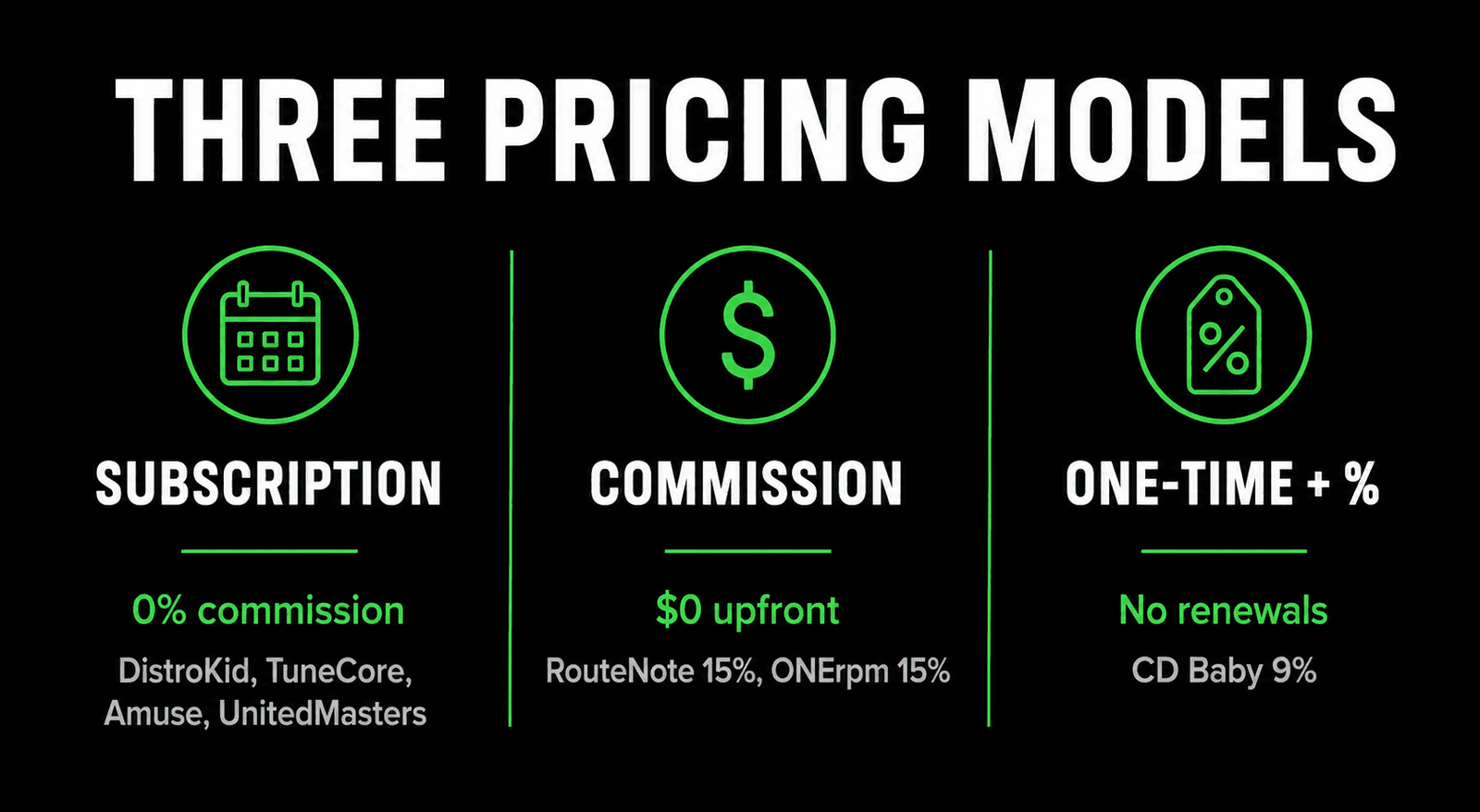
Once you see the models, the choice gets much simpler:
- Annual subscription, 0% commission. You pay a flat yearly fee and keep every penny of royalties. DistroKid, TuneCore, Amuse, UnitedMasters. Cheapest by far for anything that earns, but stop paying and your catalogue is at risk.
- Commission only, nothing upfront. The distributor keeps a percentage of royalties forever. RouteNote's free tier at 15%, ONErpm's free tier at roughly 15%. Cheapest for music that earns almost nothing, permanently expensive for anything that works.
- One-time fee plus commission. CD Baby: a per-release charge and an ongoing percentage. No renewals, so your music stays up indefinitely, but you pay twice in a sense.
"Free" and "0% commission" are marketing terms for the two ends of this spectrum. Nobody works for nothing; you are only choosing which way to pay. We went deeper on the commission end in free music distribution.
The services, with real numbers
DistroKid
The default recommendation for good reason: unlimited uploads, fast delivery, and 0% commission. At the time of writing the plans are Musician $24.99/yr, Musician Plus $44.99/yr, and Ultimate $89.99/yr, having risen during 2026 from $22.99 and $39.99 respectively. Check DistroKid's pricing page for today's numbers.
The catch is add-ons. Content ID, "Leave a Legacy," custom release dates and store-specific pricing sit on higher tiers or cost extra, and a moderately active artist can end up well north of the headline price. Budget for what you will actually switch on, not the advertised figure.
TuneCore
Now paid-only, roughly $24.99 to $49.99/yr depending on tier, and owned by Believe. Its real advantage over the pure-play distributors is integrated publishing administration, which collects royalty streams your distributor alone will not (more on those in how music royalties work).
TuneCore also supplies this comparison's most important cautionary tale. It discontinued its free New Artist plan on 18 June 2025, and per its own support documentation, artists who did not upgrade had their releases taken down from all stores and could not upload anything new until they subscribed.
CD Baby
The one major distributor with no annual renewal. Roughly $9.99 per single and $14.99 per album as a one-time charge, plus an ongoing 9% commission on digital distribution revenue. Because there is nothing to renew, your catalogue stays up whether or not you keep paying, which for a back catalogue you never want to think about again is a genuine structural advantage.
The 9% is the trade. It never stops, so on anything earning meaningfully it costs far more than a $24.99 subscription.
Amuse
Formerly the best-known free option, now paid only. Published plans are Artist $23.99/yr, Artist Plus $39.99/yr, and Professional $59.99/yr. Mobile-first and pleasant to use; the Artist tier applies a 15% royalty fee to collaborators who do not have their own subscription, which matters if you release with co-writers.
UnitedMasters
The free DEBUT distribution tier is gone. Entry is now DEBUT+ at $19.99/yr (unlimited releases, 150+ services, 100% of royalties), with SELECT at $59.99/yr adding sync opportunities. DEBUT+ is currently the cheapest 0%-commission subscription of the majors, and the brand-partnership and sync pipeline is a real differentiator if that is a route you want.
RouteNote
The only remaining free tier with genuine scale and a long history. Free means you keep 85% of net revenue with RouteNote taking 15%, unlimited uploads, no annual fee. Premium is $10 single / $20 EP (2-6 tracks) / $30 album (7-18) / $45 extended album (19+), then a $9.99 per-release annual renewal, at 0% commission, per RouteNote's support hub. Free-tier releases sit in the review queue longer, so do not use it against a hard release date.
The arithmetic, at three earning levels
This is the comparison that actually decides it. Assume one album released, and ignore add-ons:
- Earning $100/yr. RouteNote free costs $15 in commission, so you net $85. DistroKid costs $24.99 flat, netting $75. UnitedMasters DEBUT+ nets $80. The commission tier wins.
- Earning $1,000/yr. RouteNote free costs $150, netting $850. DistroKid nets $975. CD Baby costs $90 in commission plus $14.99, netting about $895. The subscription wins clearly.
- Earning $10,000/yr. RouteNote free costs $1,500. CD Baby's 9% costs $900. DistroKid costs $24.99. The subscription wins by an enormous margin.
The break-even points, which no roundup seems to print:
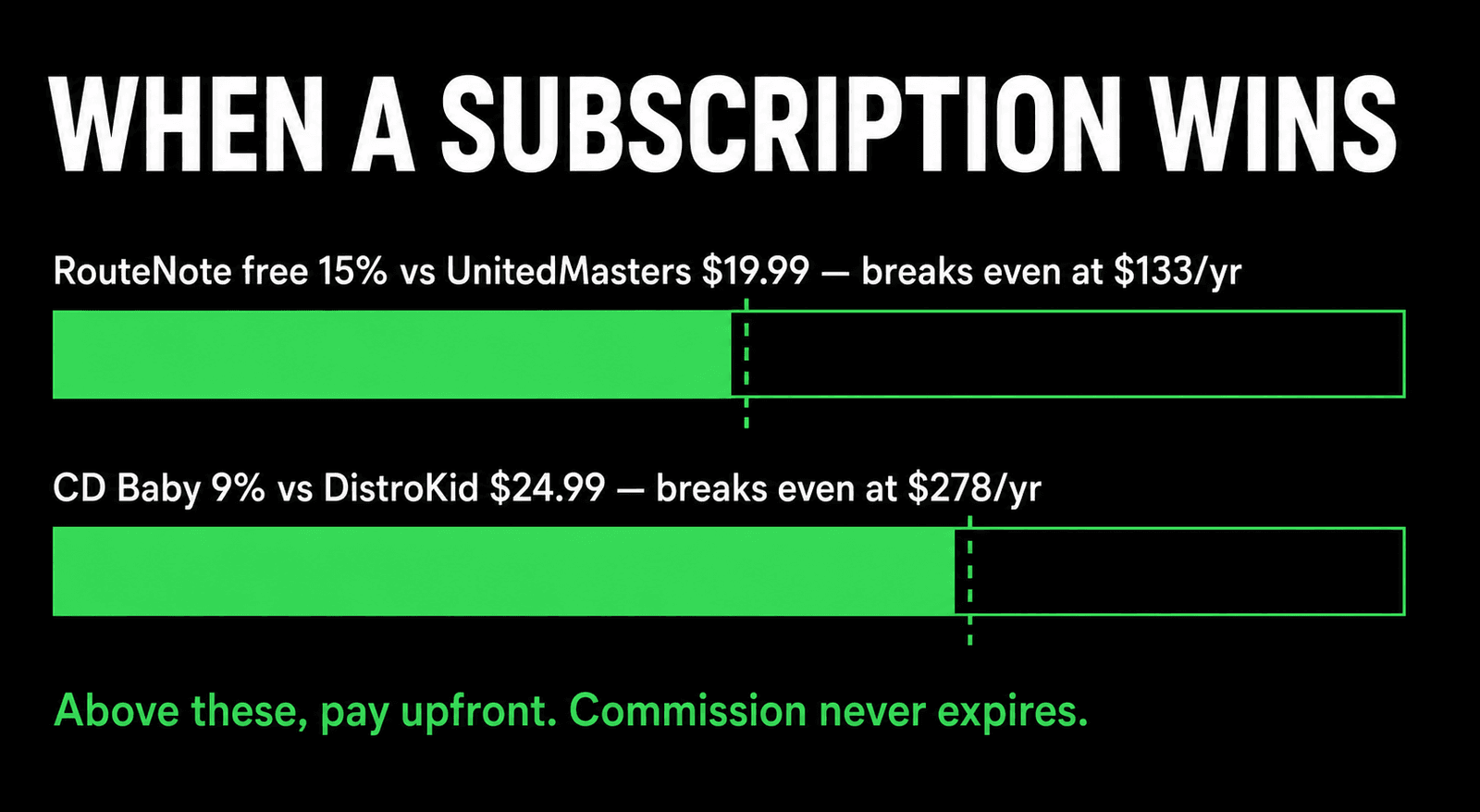
- RouteNote free (15%) vs UnitedMasters DEBUT+ ($19.99): they cost the same at about $133/yr of revenue. Above that, pay the subscription.
- CD Baby (9%) vs DistroKid ($24.99): they cost the same at about $278/yr. Above that, the subscription is cheaper on cash, though CD Baby still buys you no-renewal permanence.
At $0.003 to $0.005 per stream, $278 a year is roughly 56,000 to 93,000 streams. Most artists releasing consistently clear that, which is why the flat subscription is the right default for anyone with any traction at all. The per-stream figures behind this are in how much artists make per stream.
The question to ask before you pick: what happens if you stop paying?
This is the single most consequential difference and almost nobody leads with it.
On a subscription distributor, your catalogue's continued existence is contingent on an annual payment. Miss it, or decide in three years that music is not paying and cancel, and your releases come down. Streams stop, playlist placements vanish, and the URLs your fans saved break. TuneCore's 2025 cull demonstrated exactly this at scale.
On CD Baby, or RouteNote Premium once the renewal is paid, there is no annual cliff of the same kind. For a catalogue you intend to leave up for a decade, that permanence can be worth more than the commission costs.
Think of it as the difference between renting shelf space and buying it. Neither is wrong, but only one of them survives you losing interest.
AI music: not every distributor will take it
If you generate with Suno, Udio or similar, policy matters more than price, because the cheapest distributor is useless if it rejects your upload.
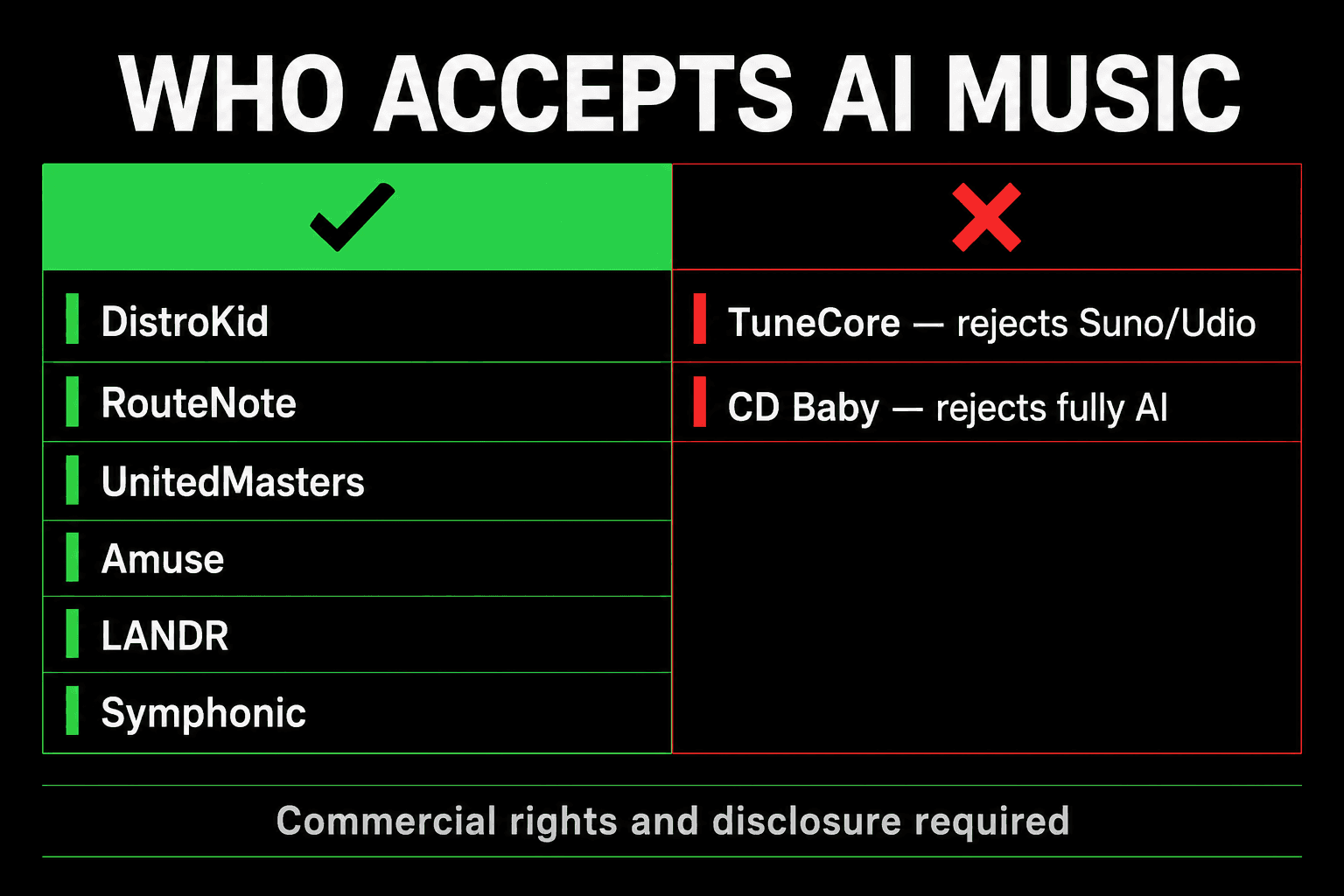
- Accept AI-generated music: DistroKid, RouteNote, UnitedMasters, Amuse, LANDR and Symphonic, generally on condition that you hold commercial rights and disclose AI involvement at upload.
- Reject or restrict: TuneCore rejects tracks created primarily with Suno, Udio or equivalents. CD Baby rejects fully AI-generated music, while distinguishing AI used as a production tool alongside meaningful human authorship.
Check your generator's terms first, too. Free tiers of Suno and Udio typically grant personal use only, and you need a paid plan that explicitly grants commercial rights before distributing anywhere. The rights picture is covered properly in is it legal to sell AI music.
Clearing the distributor is also only half of it, because the platforms scan independently. Raw AI exports carry SynthID watermarks, C2PA credentials and spectral fingerprints that re-exporting does not remove, which is why tracks sometimes go live and then disappear weeks later with royalties frozen. Artists releasing AI music at any volume generally master the track first, then run it through a purpose-built processor such as Undetectr so an automated scanner does not misread work they legitimately own, then disclose honestly where asked. The detail is in distributing AI music without takedowns.
"Is there a 100% artist money distributor?"
It is one of the most common searches on this topic, and the honest answer is: on the distribution side, several, if you count 0% commission. DistroKid, TuneCore, Amuse, UnitedMasters and RouteNote Premium all take 0% of royalties. They just charge a subscription instead.
But there is a bigger point hiding in the question. Even at 0% commission, you are still splitting with everyone upstream, and streaming platforms pay fractions of a cent per play. Optimising your distributor from 15% to 0% on income that averages $0.004 a stream is a rounding error next to the actual problem, which is that streaming is a terrible way to get paid.
Selling direct is where 100% is real rather than nominal. On Played you keep 100% of music sales before payment provider fees: fans pay you through your own payout link, so Played is never in the money flow and never takes a cut, and you pay a Played subscription plus your own payment processor's standard fee. Every genre is welcome, including AI music. One $10 sale is worth about 2,000 to 3,000 streams, which is the entire argument. Use a distributor for reach and your own storefront for income.
How to choose
- First release, no audience. RouteNote's free tier. You will not clear the break-even, so 15% costs less than any fee.
- Releasing regularly, some traction. UnitedMasters DEBUT+ ($19.99) or DistroKid Musician ($24.99). Unlimited uploads, 0% commission, lowest total cost.
- A back catalogue you want up permanently. CD Baby. The 9% buys you no renewal cliff.
- You want publishing collected too. TuneCore, or pair any distributor with a publishing administrator.
- Releasing AI music. Check policy first, then price. DistroKid, RouteNote and UnitedMasters are the usual picks.
- Whichever you choose, sell direct alongside it. Distribution is reach; direct sales are income.
Frequently asked questions
Which distributor is best for music?
For most artists with any traction, a 0%-commission annual subscription: UnitedMasters DEBUT+ at $19.99/yr or DistroKid Musician at $24.99/yr. If you have no audience yet, RouteNote's free 85/15 tier costs less. If you want your catalogue to stay up without renewals, CD Baby.
Who is better than DistroKid?
It depends what you are optimising. UnitedMasters DEBUT+ is cheaper at $19.99 with the same 0% commission. TuneCore adds publishing administration. CD Baby has no annual renewal, so your music never comes down for non-payment. DistroKid remains the strongest all-round default for speed and unlimited uploads.
How much does TuneCore pay for 1,000 streams?
TuneCore takes 0% commission, so you receive whatever the platform pays, minus nothing. On Spotify that is roughly $3 to $5 per 1,000 streams at typical per-stream rates. The distributor does not change the rate; the platform sets it.
Is there a 100% artist money music distributor?
Several take 0% commission, including DistroKid, TuneCore, Amuse, UnitedMasters and RouteNote Premium, in exchange for a subscription or per-release fee. But 100% of a streaming royalty is still fractions of a cent per play. Selling direct to fans is where keeping 100% actually amounts to meaningful money.
What happens to my music if I stop paying my distributor?
On subscription distributors like DistroKid and TuneCore, your releases are taken down. TuneCore did exactly this to artists who did not upgrade when it discontinued its free plan in June 2025. On CD Baby, and on RouteNote Premium, there is no annual renewal of the same kind, so your catalogue stays up.
Do all distributors accept AI-generated music?
No. DistroKid, RouteNote, UnitedMasters, Amuse, LANDR and Symphonic generally accept it with commercial rights and disclosure. TuneCore rejects tracks made primarily with Suno or Udio, and CD Baby rejects fully AI-generated music while allowing AI used as a production tool. Check the current policy before you upload.
The bottom line
Ignore the feature grids. Pick by pricing model: a 0%-commission subscription (UnitedMasters DEBUT+ or DistroKid) for anything earning more than about $280 a year, RouteNote's free tier below that, CD Baby if you want permanence without renewals. Then ask what happens when you stop paying, because that answer decides whether your catalogue is an asset or a rental.
And keep the whole thing in proportion. Every distributor here is competing over a slice of income that pays fractions of a cent per stream. The money is in selling to the fans you already have. Open your storefront on Played and keep 100% of every sale.