A music supervisor chooses the music in a film, TV series, advert, video game or trailer, and then makes it legally usable. That means finding the songs, negotiating and clearing the licences for both the composition and the recording, keeping the music inside its budget, and handling the paperwork that gets the writers paid. The Guild of Music Supervisors describes the role as a professional who "oversees all music related aspects of film, television, advertising, video games" and other visual media, from development through delivery and marketing.
People search for this because they want the job, or because they want their music in front of someone who has it. This covers both: the work, the types, how people get in and what it pays (with caveats, because there is no official salary figure), then how an independent artist gets on a supervisor's radar.
Key takeaways
- The job is part creative, part legal, part budget. Taste gets a supervisor noticed. Clearing rights on deadline and on budget gets them hired again.
- Most work is project by project. Many established supervisors work independently with a coordinator or two, and run several productions at once.
- There is no official pay figure. Salary aggregators put the US average somewhere between about $49,000 and $77,000, and freelance fees scale with the production's budget.
- The usual route in is intern, assistant, coordinator, supervisor. No licence or qualification is required, and few jobs are advertised under the title.
- For artists: one short email, one streamable link, one sentence on rights, and a fast reply.
What a music supervisor does
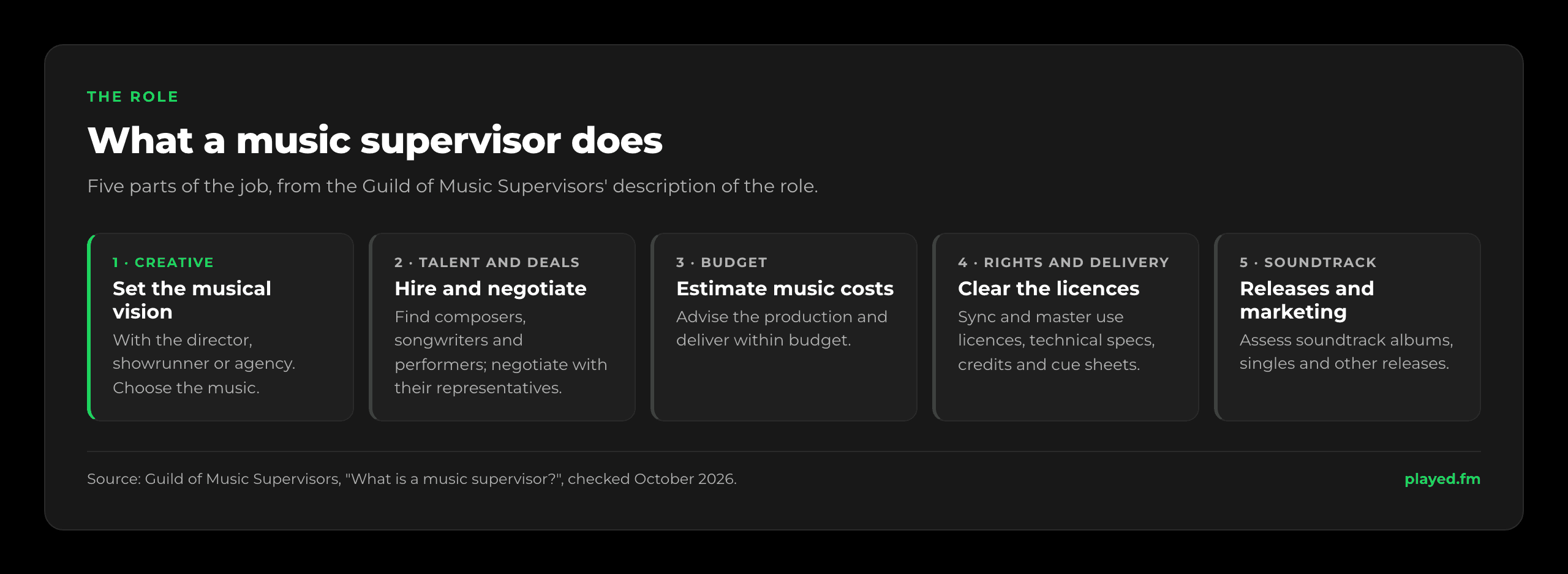
The Guild's own description splits the job into five areas, and it is a more accurate picture than "picks the songs".
Creative: choosing the music
The supervisor works with whoever has the final say: the director on a film, the producers or showrunner on a TV series, the agency on an advert, according to CareersInFilm's career profile. Together they decide which moments get original score and which get licensed songs, and the supervisor coordinates with the composer so the two fit. Mike Turner, a working film and TV supervisor interviewed for that profile, describes working "parallel" with the composer once one is hired.
The supervisor finds options and argues for them, but the decision is not theirs. As the same profile puts it, the director and producer have their own opinions, and the supervisor's comes second.
Clearance: making it legal
Every song used on screen needs two permissions: a synchronisation licence for the composition, from the songwriters and their publishers, and a master use licence for the recording, from whoever owns it. The supervisor negotiates both and chases every rights holder until the song is cleared. A song with several writers can mean several publishers, and missing one is exactly the kind of mistake that ends in a dispute. Our sync licensing guide explains the two licences from the artist's side.
This is the part outsiders underestimate. Turner's view is that taste is the easy bit, because good taste "doesn't help make using a song legal", and that the music department is where "the vast majority of copyright infringement disputes" on a production come from.
Budget
The supervisor estimates what the music will cost, advises the production on what it needs to spend, and then delivers inside that number. Money shapes creative decisions directly. Turner's example: if the budget only stretches to clearing 30 seconds of a song, the scene has to be rehearsed to work with that slice rather than paying to clear more.
Paperwork, delivery and cue sheets
Licences, credits, technical delivery specs and, at the end, the cue sheet: the log of every piece of music in the finished work, with timings and the writers and publishers behind it, which performing rights organisations use to pay royalties when it is broadcast. ASCAP says the production company is typically responsible for submitting cue sheets (ASCAP cue sheet help) and that they are normally sent by the producer or music supervisor, not the writer (ASCAP member guide, both checked October 2026). What goes on one, and why artists should check theirs, is in what is a cue sheet.
Some productions add on-camera performances (a band miming on set needs the right playback and lyrics) and soundtrack albums, though Turner says only three of the 35 films he has worked on released a soundtrack at all.
Types of music supervision
The Guild's annual awards honour music use in six areas: film, television, advertising, trailers, video games and documentaries. The core job is the same in each. The rhythm and the client differ.
- Film. One long project, with licensed songs planned around the score. Turner says the middle of the market, films budgeted at $10 million to $30 million, has largely disappeared, leaving a few huge studio films and many small independent ones.
- Television. Episodic, so the deadlines repeat with every episode, and the supervisor answers to the producers or showrunner. Turner calls TV "the new creative frontier" for supervisors, and the profile notes it tends to pay better and more reliably than independent film.
- Advertising. The client is the agency and the brand. Spots are short, so a track often has to set its mood and shift energy within 15 to 30 seconds, as supervisors told Spotify for Artists.
- Trailers, games and documentaries. Each is a separate category in the Guild's awards. Trailer work is music for marketing a film or series rather than for the work itself.
The role has also gained formal recognition. Since 2017 the Primetime Emmys have included a category for Outstanding Music Supervision, first presented at that year's Creative Arts Emmys.
How to become a music supervisor
There is no exam, licence or required degree. As Turner told CareersInFilm, "as soon as someone is hired to be a Music Supervisor, now they are one". That makes the job open in principle and hard in practice, because hiring runs on relationships and credits.
The usual ladder, per the same profile, is an internship with an established supervisor or supervision company, then assistant, then music coordinator, then supervisor. The last step is the hardest, and many supervisors only make it by setting up on their own.
Other ways in:
- Supervise small projects. Student films, shorts and low-budget independents, often for little or nothing, to build credits and relationships with directors who will later have budgets.
- Work on the other side of the desk. Sync and licensing roles at a publisher, label or sync agency teach the same rights and negotiation skills from the seller's side. Turner came into supervision after pitching a publisher's catalogue to advertisers.
- Clearance and coordination. Music clearance and coordinator roles handle much of the licensing paperwork, the part of the job outsiders underestimate.
- Music editing. Turner argues a supervisor should be able to edit, so they are not dependent on the music editor to test a track against picture.
The skills that matter: copyright and licensing knowledge, budgeting and negotiation, relentless organisation and basic editing. Taste matters too, but everyone has taste.
Formal training is optional. If you want it, Berklee Online's Music Supervision Professional Certificate runs to five courses (music business, licensing, copyright law and two supervision courses) for $7,875 in tuition, checked October 2026. The Guild of Music Supervisors offers discounted student membership and runs a conference and annual awards, which are as useful for meeting people as for learning.
Where music supervisor jobs are posted
Few advertised jobs carry the title. A LinkedIn search for music supervisor jobs on 29 October 2026 returned mostly adjacent roles: copyright and clearances managers, a creative music director at a film studio, business and legal affairs posts, and church and school music director jobs. General job and salary sites have the same problem: they match words in a title, not the work.
Search instead for the roles that feed the job: music coordinator, music clearance, licensing coordinator, and sync or creative licensing roles at publishers and labels. Then look where supervisors actually work: independent supervision companies, studio and network music departments, and advertising agencies. Hiring at the assistant and coordinator level leans heavily on networking, which is why an internship and the Guild's events tend to matter more than any job board.
Music supervisor salary: what the numbers say, and what they don't
There is no official figure. The US Bureau of Labor Statistics does not publish one for music supervisors. Its nearest occupation, music directors and composers, covers conductors and composers, and its occupational profile does not mention supervisors at all. Some careers sites still present that occupation's median, $73,710 in May 2025, as a music supervisor salary. It is a different job.
What exists instead is a handful of secondary sources, each with a catch:
| Source | What it says | The catch |
|---|---|---|
| Talent.com | $49,440 average; $37,343 at entry level up to $113,129 for the most experienced | Matches on the job title, so it can include jobs unrelated to film and TV |
| Comparably | $76,707 average | The page says it was last updated in November 2023 |
| Mike Turner's own rates, via CareersInFilm | $15,000 to $20,000 per film budgeted at $1M to $6M; $40,000 and up above $10M; $80,000 to $90,000 for studio films over $100M | One supervisor's freelance fees, in a profile last updated May 2024, not a survey |
All three checked October 2026. Together they say more than any single number. The aggregator averages sit between about $49,000 and $77,000. Freelance supervisors are paid per project, their fees scale with the production's budget, and they usually run several projects at once, so annual income depends on how many they land.
One distinction for artists reading this: what a supervisor is paid for their services is separate from the licence fee a production pays you for a track. Placement fees are covered in how much sync licensing pays.
How independent artists get on a music supervisor's radar
Now the other side of the desk. Supervisors are on deadline and receive far more music than they can hear. The artists who get through make the job easier at every step.
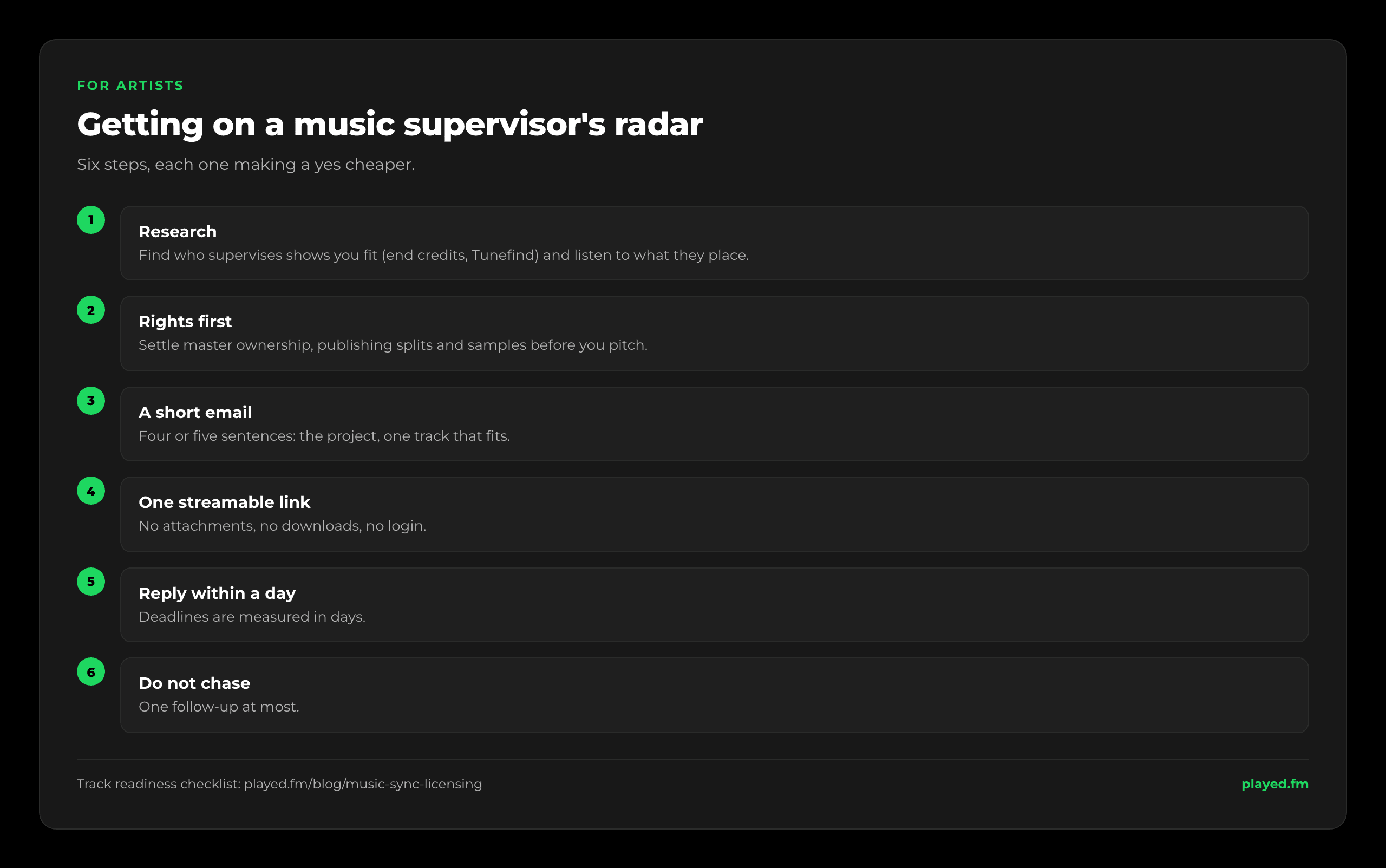
- Research before you write. Find out who supervises the shows you could genuinely fit. End credits name them, and Tunefind show pages list the songs used episode by episode, with the credited music supervisor for each season. Listen to what they actually place.
- Get your rights in order first. Supervisors quoted by Spotify for Artists said to settle master ownership, publishing splits and any sample clearances before pitching. If you wrote with others, a signed split sheet is the minimum.
- Write a short email. Four or five sentences: who you are, which project or show you have in mind and why, one track that fits, and a line confirming you control 100% of the master and publishing, if that is true. That last line matters, because it means one person can clear the whole song.
- Send one streamable link. No attachments, no downloads, no login. The same supervisors asked for a link to a good-quality stream rather than large files, with credits and contact details in order.
- Reply within a day. When a supervisor asks for an instrumental, a clean edit or a quote, deadlines are measured in days, and a slow answer can lose a placement that was nearly yours.
- Do not chase. One polite follow-up at most. Silence usually means not this time, not never.
What makes a track usable once they press play, from instrumentals to broadcast-ready masters and mood metadata, is its own checklist, and it lives in our sync licensing guide. If a supervisor asks to know more about you, send a press kit link rather than a folder of files: how to make an EPK covers what to put in it.
Routes that skip the cold email
Cold emailing is free and slow. Two alternatives change the odds. Sync libraries and agencies pitch your catalogue to supervisors for you, in exchange for a share of the fee and sometimes exclusivity; sync licensing companies compared sets out those trade-offs. Briefs boards reverse the direction: the buyer posts what they need, and you answer it.
That second model is what we run at Played. On the sync briefs board, buyers, often a music supervisor or a producer, post briefs with a stated budget, and artists pitch a track that fits. Played takes 0% of the placement, there is no exclusivity, and you keep your masters and publishing. Be clear about what it is: a pitch is a submission, not a placement, and the buyer may choose someone else or nobody.
Frequently asked questions
What does a music supervisor do?
A music supervisor chooses the music for a film, TV show, advert, game or trailer and makes it legally usable. They work with the director or showrunner on creative choices, negotiate and clear the sync and master use licences, manage the music budget, and handle credits and cue sheets.
How much do music supervisors make?
There is no official figure. Salary aggregators put the US average between about $49,000 and $77,000 (Talent.com and Comparably, checked October 2026), but their data can include unrelated jobs. Freelance supervisors are paid per project, and one veteran film supervisor quoted fees of $15,000 to $20,000 for films budgeted at $1 million to $6 million.
How do you become a music supervisor?
There is no required qualification. The usual path is an internship with an established supervisor, then assistant, music coordinator and finally supervisor. Some also come from licensing roles at publishers or labels, or build credits by supervising student films and shorts. Courses such as Berklee Online's certificate are optional.
Where are music supervisor jobs posted?
Rarely under that title. Search for music coordinator, music clearance and licensing roles on LinkedIn and general job boards, and look at supervision companies, studio and network music departments and advertising agencies. Much of the hiring happens through networking, internships and industry events such as those run by the Guild of Music Supervisors.
How do I contact a music supervisor?
Find the right person through end credits or Tunefind, then send a short, personal email with one streamable link, no attachments, and one sentence confirming you control the rights. Reply within a day if they answer, and do not chase more than once. Sync libraries, agencies and briefs boards are the alternatives to a cold email.
Is a music supervisor the same as a composer?
No. A composer writes original score. A music supervisor oversees all the music in a production, including licensed songs, and handles the rights, budget and paperwork. On a film the two work in parallel once the composer is hired, deciding with the director which moments get score and which get songs.
The bottom line
A music supervisor decides what music a production uses and makes sure it can legally use it, inside a budget and on deadline. The job has no official pay benchmark, it is reached through internships, coordination and licensing roles rather than a qualification, and it rewards organisation and rights knowledge as much as taste.
For artists, the lesson is the same from either side of the desk: be easy to clear. Own your rights, send one streamable link, answer fast. Then pitch supervisors directly, or answer the briefs they post.