
A cue sheet is the official log of every piece of music in a film, TV episode or other production: what played, for how long, how it was used, and who wrote and publishes it. Performing rights organisations (PROs) such as ASCAP, BMI and PRS use it to pay performance royalties when the production is broadcast or streamed. ASCAP calls it “the essential document” for paying royalties on audiovisual performances. If your music is not on one, your PRO has nothing to pay you against.
You will rarely file a cue sheet yourself; the production does. Your part is everything around it: being registered before the placement, giving the production exact details, and checking afterwards that the cue sheet arrived and lists you correctly. This guide covers each step, plus a sample layout and the free templates.
Key takeaways
- A cue sheet lists every cue with its title, usage, duration, writers, publishers, PROs and shares.
- The production company files it. ASCAP generally will not accept one sent by a writer.
- No cue sheet, no backend. PROs need it to pay performance royalties on TV and film.
- Register the song before the placement and send the production exact metadata.
- Missing royalties can be claimed, within deadlines that ASCAP and BMI both publish.
What is a cue sheet?
BMI's definition is the simplest: “an official log of all the music used in a production.” ASCAP describes it as a schedule of the music in a film or TV programme, and PRS for Music as “a breakdown of all music used within an audio-visual production such as a film, TV show or TV commercial.”
It exists because a PRO cannot hear a broadcast and know who wrote the 40 seconds of guitar under a scene. Broadcasters and services report what aired; the cue sheet says what music was inside it and who owns it. (The name is shared with CD “.cue” files and stage managers' running orders, which are unrelated.)
What goes on a music cue sheet
ASCAP and BMI use a shared standard template, built on RapidCue, their joint cue sheet system. It has two parts.
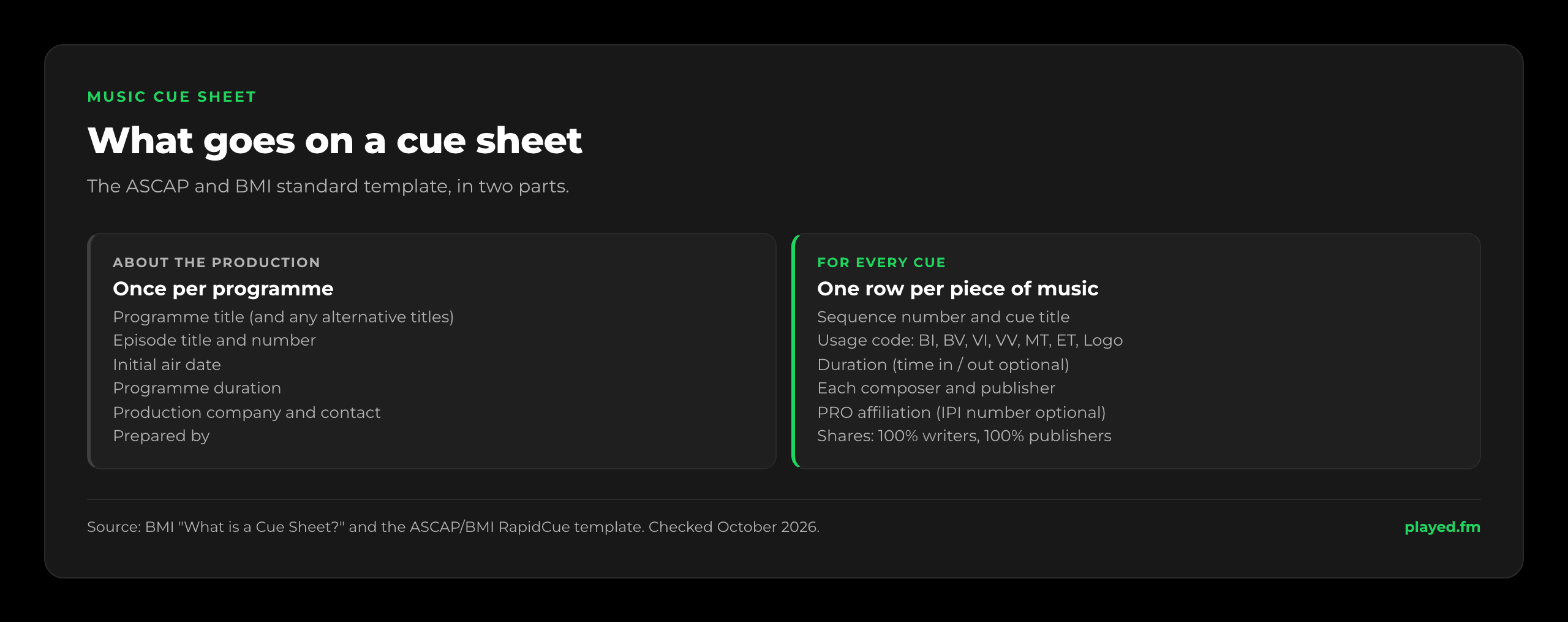
About the production: programme title, episode title and number, initial air date, programme duration, production company, and who prepared the sheet.
For every cue: a sequence number, the cue title, how it was used, its duration, each composer and publisher with their PRO, and ownership shares. The template instructions say shares total 100% for composers and 100% for publishers, and are not required for licensed music. IPI numbers, the international IDs for writers and publishers, have an optional column.
The usage code matters, because PROs pay different uses at different rates. The standard codes:
| Code | Usage | What it means |
|---|---|---|
| BI | Background instrumental | Underscore, or instrumental music from an off-camera source |
| BV | Background vocal | Underscore with vocals, or an off-camera vocal source |
| VI | Visual instrumental | An instrumental performance seen on camera |
| VV | Visual vocal | A vocal performance seen on camera |
| MT | Main title theme | The opening title theme |
| ET | End title theme | The closing title theme |
| Logo | Logo | Music accompanying a company logo |
Source: the ASCAP and BMI template instructions, checked October 2026.
An example cue sheet (illustrative)
Here is the shape of the cue rows for one invented TV episode. Every title, name and company below is fictional. A real template adds the header fields and columns for time in, time out and IPI numbers.
Programme: Harbour Street (fictional series), episode 104. Production company: Example Pictures (fictional).
| # | Cue title | Use | Duration | Writers (PRO, share) | Publishers (PRO, share) |
|---|---|---|---|---|---|
| 1 | Harbour Street Main Title | MT | 0:32 | Sam Placeholder (ASCAP) 100% | Placeholder Tunes (ASCAP) 100% |
| 2 | Night Ferry | BI | 1:47 | Sam Placeholder (ASCAP) 100% | Placeholder Tunes (ASCAP) 100% |
| 3 | Paper Boats | BV | 2:10 | Jo Example (BMI) 50%; Lee Sample (ASCAP) 50% | Example Music (BMI) 50%; Sample Songs (ASCAP) 50% |
| 4 | Paper Boats | VV | 0:58 | Jo Example (BMI) 50%; Lee Sample (ASCAP) 50% | Example Music (BMI) 50%; Sample Songs (ASCAP) 50% |
| 5 | Example Pictures Logo | Logo | 0:05 | Alex Template (BMI) 100% | Example Pictures Music (BMI) 100% |
| 6 | Harbour Street End Title | ET | 0:45 | Sam Placeholder (ASCAP) 100% | Placeholder Tunes (ASCAP) 100% |
Rows 3 and 4 show why each use gets its own line: the same song plays under a scene, then a band performs it on camera, and those are different uses.
Who prepares and files a cue sheet
ASCAP's Cue Sheet Corner says the production company is typically responsible for submitting cue sheets, and treats its version as authoritative. ASCAP's member guide adds that cue sheets are normally sent by the producer or music supervisor, not the writer. Where a production has a music coordinator, the hands-on work often falls to them: Berklee Online's career guide (an educational source, not a PRO) describes coordinators working with music editors, composers and supervisors “to create and deliver cue sheets.” More on the supervisor's side in what a music supervisor does.
Can you file your own? Usually not. ASCAP says it “typically” accepts cue sheets only from a production company or network, and not from members unless the source can be substantiated, for example by forwarding the production's email that contained it. Productions file by email, through the web-based RapidCue system that feeds both ASCAP and BMI, or through software such as Soundmouse.
How PROs use cue sheets to pay you
BMI's royalty policy manual says it gets audiovisual performance data from licensees, Gracenote or other providers, then matches it to cue sheets. The cue sheet decides who is paid; the use decides how much. ASCAP's credits depend on how music is used (feature, theme or background), where it airs, what the licensee pays and, for TV, the time of day. For underscore, duration counts too. BMI separates feature performances (VV and VI) from background, theme and logo uses.
Timing and a few rules worth knowing, all checked October 2026:
- Payment lag: ASCAP generally pays 6 to 9 months after a performance, and cue sheets for aired programmes can take 3 to 5 months to appear in your account.
- Deadlines: ASCAP publishes cut-offs per distribution. A cue sheet received by 2 October 2026 makes the December 2026 and January 2027 distributions; the next cut-off is 1 January 2027.
- Reruns: ASCAP reuses the original cue sheet unless the music changed.
- Adverts work differently. ASCAP uses other data for commercials, promos and infomercials under five minutes; longer infomercials need cue sheets. BMI pays for music over five seconds in nationally broadcast TV ads, but says you or your representative must email it the details, or payment may not be made.
- Cinemas: BMI notes that foreign societies pay on cinema screenings, and ASCAP asks for a theatrical film's cue sheet before its first foreign theatrical performance.
Do you need to register every cue?
Not always. ASCAP says underscore and themes that exist only inside a project need not be registered individually: it registers the theme and “rolls up” the underscore under the project's name, such as “[Show] Cues.” BMI also registers individual underscore cues automatically from the cue sheet.
An existing song is different. If the track was released, streamed or played on radio before it was licensed, register it with your PRO as a song, using the same title you give the production. ASCAP says such music should be registered, and BMI needs a song registration to credit radio, music services, live and internet uses.
Before a placement: five things to do
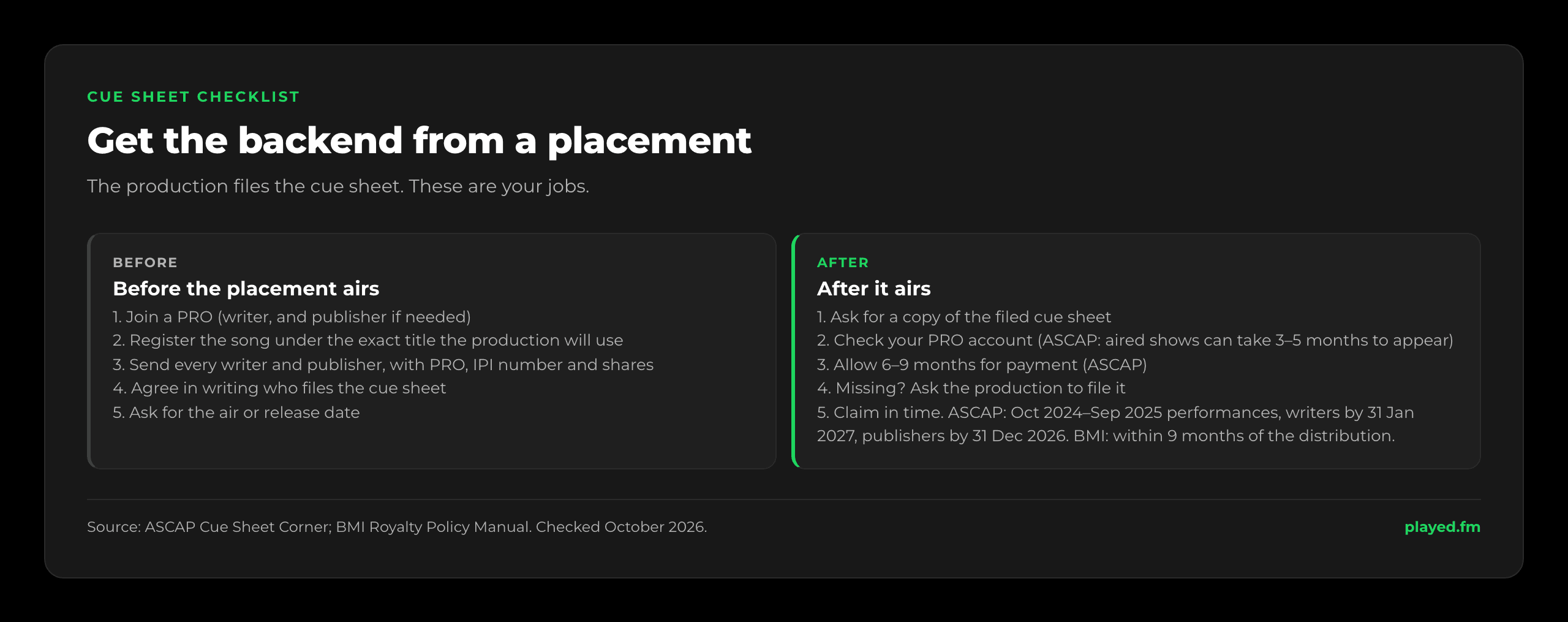
- Join a PRO as writer, and as publisher where it applies. If you have not chosen one, see ASCAP vs BMI.
- Register the song under the exact title the production will use. At ASCAP, music intended for audiovisual use goes through Guided Registration.
- Send the production your metadata in writing: every writer and publisher, each one's PRO and IPI number if you have it, and the shares. If you co-wrote, a split sheet settles the numbers first.
- Agree who files. ASCAP notes that many composers make it a contract term that the production is responsible for submitting cue sheets.
- Ask for the air or release date, so you know when to look.
After it airs: check, then claim
- Ask for a copy of the filed cue sheet and check your title, usage, duration, names and shares.
- Look in your PRO account. ASCAP lists matched cue sheets in Member Access, with optional email alerts. BMI's Online Services has a Cue Sheets feature.
- If it is missing, go to the production first. ASCAP suggests asking them to submit it, and sending its template if they need one.
- Then claim. At ASCAP, send a Member Access message under “Performance Claims.” ASCAP sets an annual deadline per survey year, which runs October to September: performances from October 2024 to September 2025, for example, can be claimed until 31 January 2027 by writers and 31 December 2026 by publishers. At BMI, royalties missed because of a late cue sheet are paid if the documents arrive within nine months of the distribution that should have included them, and other adjustment claims must be in writing within nine months of the distribution.
Direct and source licences
One clause can switch the backend off. BMI's royalty policy manual says that if a writer or publisher directly licenses a user, or source-licenses a production company, to perform a work, BMI must be told within ten days of the licence or three months of the performance, and “no royalties will be paid by BMI for these performances.” If BMI has already paid, it debits the writer and publisher. Whatever a sync contract calls itself, check whether it grants public performance rights as well as synchronisation. If it does, ask whether the fee is meant to cover the backend you are giving up.
Cue sheet templates and tools
- ASCAP: a free blank cue sheet template, a sample and instructions on its Cue Sheet Corner. ASCAP says the template follows the industry standard it agreed with BMI and major production companies.
- BMI: the same standard cue sheet template and a one-page guide, on its cue sheet page.
- RapidCue: ASCAP and BMI's joint web system. ASCAP says a cue sheet sent to RapidCue once is ingested by both PROs, instead of being filed separately with each.
- Soundmouse: Orfium's cue sheet platform, which uses music recognition to build cue sheets and says it supports 60+ collecting societies. PRS for Music works with it, and PRS members can open a free account to upload their audio so it can be identified.
- editingtools.io Music Cue Sheet: turns an XML or EDL export from an edit into a CSV, XLSX or PDF cue list.
- Universal Production Music Cue Sheet Helper: generates editable cue sheets from Final Cut, Premiere or Avid files, recognising tracks from its own catalogue.
None of these shift the duty to file. They make it faster for whoever holds it.
Placements through Played
On Played's sync briefs board, buyers post budgeted briefs and you license directly. Played takes 0% of the placement, there is no exclusivity, and you keep your masters and publishing. That also means nobody else is chasing the paperwork for you. When a placement from the board is for broadcast, ask the buyer who files the cue sheet and when, send your metadata, and ask for a copy. What placements pay is covered in how much sync licensing pays, and how sync works overall in music sync licensing.
Frequently asked questions
What is a cue sheet in music?
A cue sheet is the official log of all music used in a film, TV programme or other production. It lists each cue’s title, how it was used, its duration, and the writers, publishers, PROs and shares behind it. PROs such as ASCAP, BMI and PRS use it to pay performance royalties when the production airs.
Who is responsible for filing a cue sheet?
The production company. ASCAP says the production company is typically responsible for submitting cue sheets and that they are normally sent by the producer or music supervisor. Where a production has a music coordinator, that person often prepares them. Writers can make filing a contract term and should ask for a copy.
Can I submit my own cue sheet to ASCAP or BMI?
Usually not. ASCAP says it typically accepts cue sheets only from a production company or network, and from members only when the source can be substantiated, for example by forwarding the production’s email containing the cue sheet. Ask the production to file it.
Where can I get a cue sheet template?
ASCAP and BMI both offer the same free standard template, built on their joint RapidCue system, with instructions. ASCAP’s is on its Cue Sheet Corner page and BMI’s on its What is a Cue Sheet page, both checked October 2026.
Do TV commercials need cue sheets?
Generally not at ASCAP, which uses other data sources for commercials, promos and infomercials under five minutes; infomercials of five minutes or more need cue sheets. BMI pays for music over five seconds in nationally broadcast TV ads, but says the writer or their representative must email it the details, or payment may not be made.
What happens if a cue sheet is never filed?
Your PRO has no record of your music in that production, so it cannot pay the backend. Ask the production to file it, then claim within your PRO’s deadline: ASCAP sets annual deadlines (writers can claim October 2024 to September 2025 performances until 31 January 2027), and BMI wants the documents within nine months of the relevant distribution.
The bottom line
A cue sheet is the bridge between a placement and its backend. It names every cue, how it was used, for how long, and who owns it, and without it your PRO cannot pay you for the broadcast. The production files it; your job is to be registered first, give exact details, and check afterwards.
Do that and a placement pays twice: once on signing, and again each time it airs. If you are pitching for placements, see the open briefs and keep your registrations ready before you send anything.