Every sync licensing company sells the same promise — your music in TV, film, ads and games. What separates them is not the promise. It is what they take, what they lock, and for how long. Two libraries can both call themselves "artist-friendly" while one returns 80% of a negotiated fee and the other pays a flat buyout and keeps your track for the life of copyright.
This is the comparison, company by company, with the split, the exclusivity, the submission bar and the AI policy for each. It is the companies lane specifically: if you want the mechanics of how a sync deal is structured, that is sync licensing explained, and if you want fee ranges broken down by usage, that is how much sync licensing pays.
The comparison, up front
Seven of the routes most independent artists actually consider, on the four terms that decide your income.
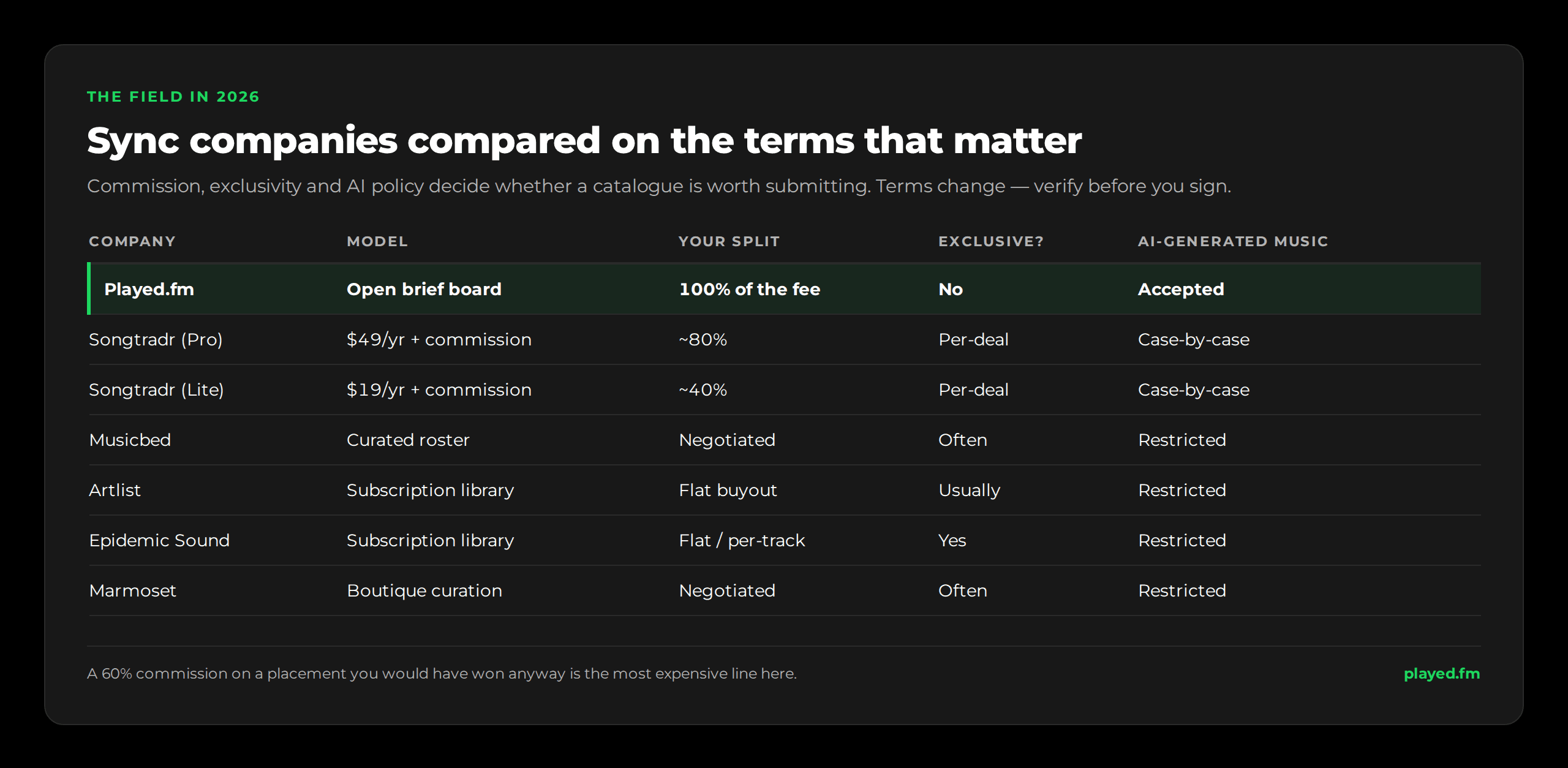
| Company | Model | You keep | Exclusivity | AI music |
|---|---|---|---|---|
| Played.fm | Open brief board | 100% of the fee | Non-exclusive | Accepted |
| Songtradr Pro ($49/yr) | Marketplace | ~80% | Per-deal | Case-by-case |
| Songtradr Lite ($19/yr) | Marketplace | ~40% | Per-deal | Case-by-case |
| Musicbed | Curated roster | Negotiated | Often exclusive | Restricted |
| Artlist | Subscription library | Flat buyout | Usually exclusive | Restricted |
| Epidemic Sound | Subscription | Flat / per-track | Exclusive | Restricted |
| Marmoset | Boutique curation | Negotiated | Often exclusive | Restricted |
Read that table as a spectrum, not a ranking. The left-hand end trades access for control; the right-hand end trades control for a curated pipeline that a solo artist cannot build alone. Both are legitimate. What is not legitimate is a company that hides which end it sits at until you are three pages into a contract.
Three business models, and what each really costs
Twelve company names collapse into three models. Learn the models and any new library you meet is instantly readable.
1. The exclusive subscription library
Epidemic Sound, Artlist, Soundstripe, Storyblocks. Their customer is a filmmaker or YouTuber paying a flat monthly fee for unlimited downloads. Because the customer pays a subscription and not a per-use fee, there is no per-placement fee to split with you — so they pay you a fixed sum, or a share of a usage pool, and take the track exclusively so the same music cannot undercut them elsewhere.
The real cost here is not the percentage. It is that a track signed to an exclusive library is off the market for the term, which for buyout deals can be very long indeed. You cannot pitch it to a supervisor, cannot place it in an ad, cannot license it to a game. Reported buyout figures circulating for Epidemic Sound sit in the region of $2,000 to $8,000 per track plus a share of streaming royalties from the platform's own channels; whether that beats a decade of self-licensing depends entirely on the track.
2. The non-exclusive marketplace
Songtradr, Music Gateway, Audiosocket, Pond5. You upload, they list, buyers search, and the platform takes a percentage when a deal closes. Nothing is locked until a specific licence is signed, which is why marketplaces are the safe first move for most catalogues.
The cost is dilution. A marketplace with hundreds of thousands of tracks is a search-ranking problem, not a pitching relationship, and the percentage is charged for infrastructure rather than advocacy. Songtradr is the biggest of these and has its own trade-offs; we covered them separately in Songtradr alternatives rather than repeating them here.
3. The boutique agency
Musicbed, Marmoset, and the smaller sync agencies that pitch a roster rather than a catalogue. Splits are typically around 50/50 on a negotiated fee, and acceptance rates are low because the whole product is curation. When a supervisor calls Marmoset, they are buying the filter.
The cost is the 50%, and the honest counter-argument is that 50% of a $20,000 national ad you would never have been shown beats 100% of nothing. That maths only works if the agency actually pitches you. Ask, before signing, how many tracks are on the roster and how many placements they did last year.
The companies, one by one
Played.fm — open brief board, 0% of the fee
Not a library. Productions post paid briefs with real budgets on the sync brief board, and you pitch your own catalogue directly at whichever ones fit. Briefs on the board run $120 to $3,000, which is the indie game, podcast and branded-social end of the market rather than the network-TV end. Played takes 0% of the deal; you license on your own terms, keep the whole fee, and keep the buyer's contact details. Artist costs $12.99/month and pitches are pay-as-you-go. Pro is $19.99/month with 3 pitches included each month; Label is $29.99/month with 10. Extra pitches cost credits, and a pitch is a submission, not a placement guarantee. Payment provider fees may apply to a deal. Compare plans. No genre gatekeeping, and AI-generated music is accepted.
Songtradr — the volume marketplace
The largest open sync marketplace, with tiered membership: Lite at $19/year returning roughly 40% of a sync fee, Pro at $49/year returning roughly 80%. Non-exclusive by default with exclusivity agreed per deal, so nothing is locked until you sign a specific licence. AI-generated material is handled case by case rather than banned outright. Best for artists with a deep catalogue who are comfortable with a search-and-match model instead of a personal pitch.
Musicbed — curated, cinematic, selective
A curated roster aimed at wedding films, documentary, brand films and high-end commercial work. Fees are negotiated per project rather than published, deals are often exclusive to the submitted tracks, and acceptance is genuinely selective — a defined artist identity matters more than catalogue size. AI-generated submissions are restricted. Suits artists with a cohesive, emotive, well-produced body of work and no interest in placing the same tracks in ten libraries.
Artlist — subscription library, flat buyout
Sells unlimited licensing to creators on an annual subscription. Contributors are paid a flat amount per track licensed rather than a share of a negotiated fee, and submitted tracks are usually exclusive to Artlist for the term. AI-generated music is restricted. The trade is predictability for ceiling: high-volume ambient, corporate and cinematic beds do well; a distinctive vocal single almost certainly should not go here.
Epidemic Sound — the biggest lock
The default library for YouTube and social creators, and the strictest terms on this list. Contributors assign broad rights for a flat or per-track fee plus a share of streaming royalties earned through Epidemic's own distribution, on a fully exclusive basis. Epidemic does not accept AI-generated music from contributors; it runs a human-first catalogue and screens for it. Suits full-time production-music composers who want steady income and do not need those tracks for an artist project.
Marmoset — boutique, story-led
A small Portland-based agency with a heavily curated indie roster, negotiated fees, and hands-on artist relationships. Splits are typically around 50/50, deals are often exclusive to the licensed catalogue, and AI submissions are restricted. Fees for major campaigns can run well into five figures. It is one of the hardest lists to get on and one of the better ones to be on.
Audiosocket — direct submissions, TV and ads
A mid-sized non-exclusive library with an open submission route and a long history in TV and commercial placements. Splits are in the usual marketplace range and rights stay with you. A reasonable second or third home for a catalogue already listed elsewhere, precisely because nothing is locked.
Music Gateway — paid membership plus commission
A membership platform that aggregates briefs and opportunities and takes a commission on placements it sources. You are paying for deal flow before any deal exists, which is fine if the briefs match your catalogue and expensive if they do not. Read the brief board before paying for the year.
TAXI — you pay to submit
Not a library and not a publisher. TAXI is an A&R and forwarding service: you pay an annual membership plus a per-submission fee, and screeners decide whether to forward your track to the listed opportunity. It does not pay you a split, because it never licenses anything — it sells you access and feedback. Some artists rate the feedback highly. Go in understanding it is a cost centre, not an income stream.
Soundstripe and Pond5 — the mid-market subscription tier
Both sell to creators and brand teams on subscription or per-track pricing, with contributor terms closer to Artlist than to Marmoset. Pond5 is the more open of the two for submissions; Soundstripe is more curated and more oriented to stems and broadcast use. Volume plays, both of them.
APM Music and Universal Production Music — the broadcast libraries
The production libraries that actually service network television, sport and studio trailers, with catalogues in the hundreds of thousands to over a million cues. Entry is via composer agreements and existing relationships rather than an upload form. If you are writing purpose-built cues at broadcast standard, this is the tier that pays PRO backend consistently; if you are an artist with twelve songs, it is not your route yet. The film and TV path is covered in music licensing for film and TV.
UnitedMasters — distribution with a sync arm
Distribution first, with a brand-partnership pipeline attached, taking a share of placements it sources. Convenient if you are already distributing there. Not a substitute for a sync strategy on its own.
What the placements actually pay
Company choice only matters relative to what the placement is worth in the first place. These are the 2026 ranges for the whole upfront sync fee, before any library split.
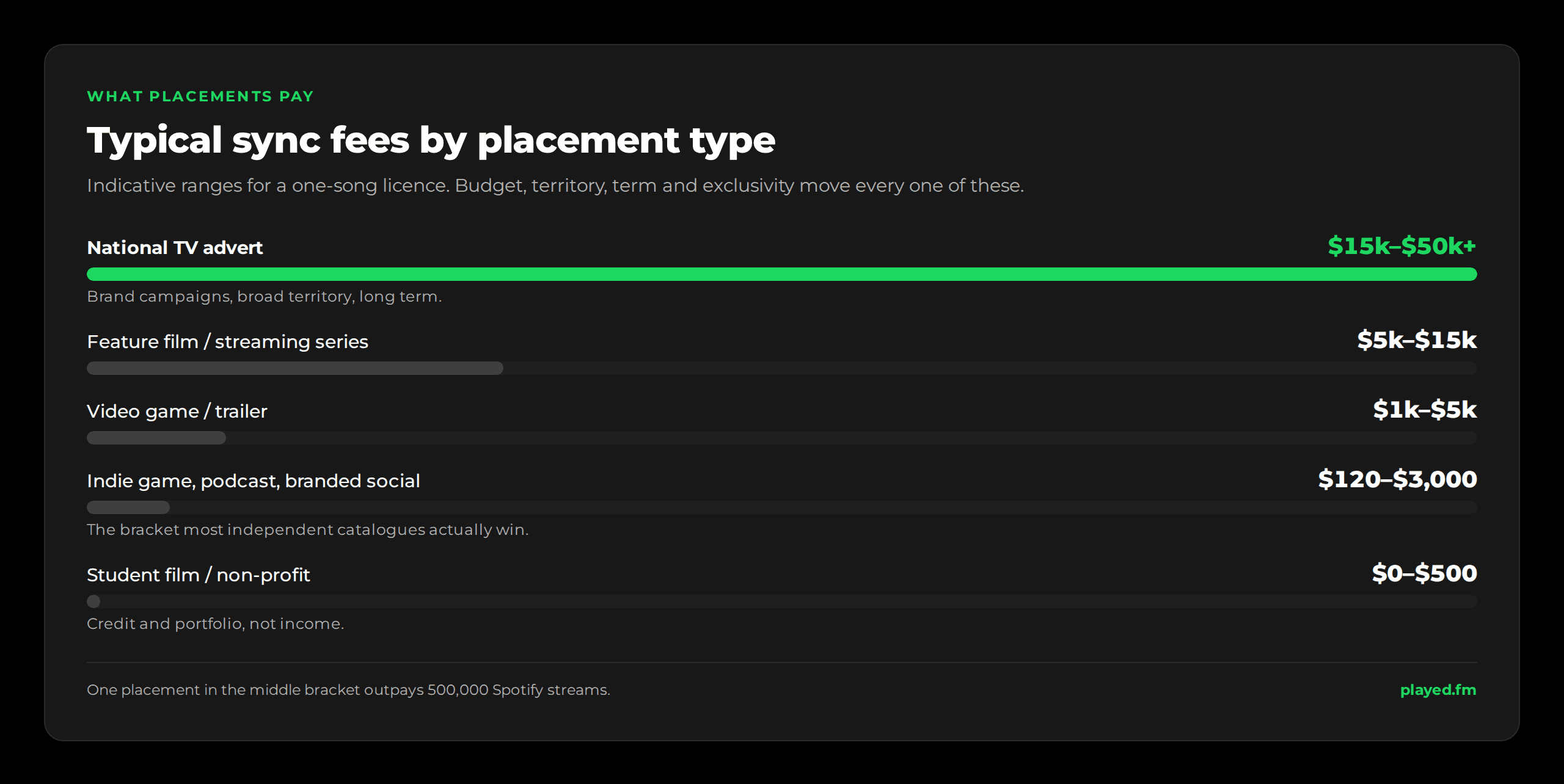
- National TV advert: $15,000–$50,000+
- Feature film or streaming series: $5,000–$15,000
- Video game or trailer: $1,000–$5,000
- Indie game, podcast or branded social: $120–$3,000
- Student film or non-profit: $0–$500
Two things follow. First, a boutique agency taking half of a $30,000 ad is not the villain of this story. Second, in the $120–$3,000 band — which is where most independent artists actually get placed, repeatedly — a 40% or 50% cut is the difference between a real income line and a rounding error. That band is exactly what the brief board serves. Backend performance royalties are separate money on top; the full breakdown lives in how much sync licensing pays.
How to read a sync contract in four clauses
Whatever the company, four clauses do almost all the work. Find them before you read anything else.
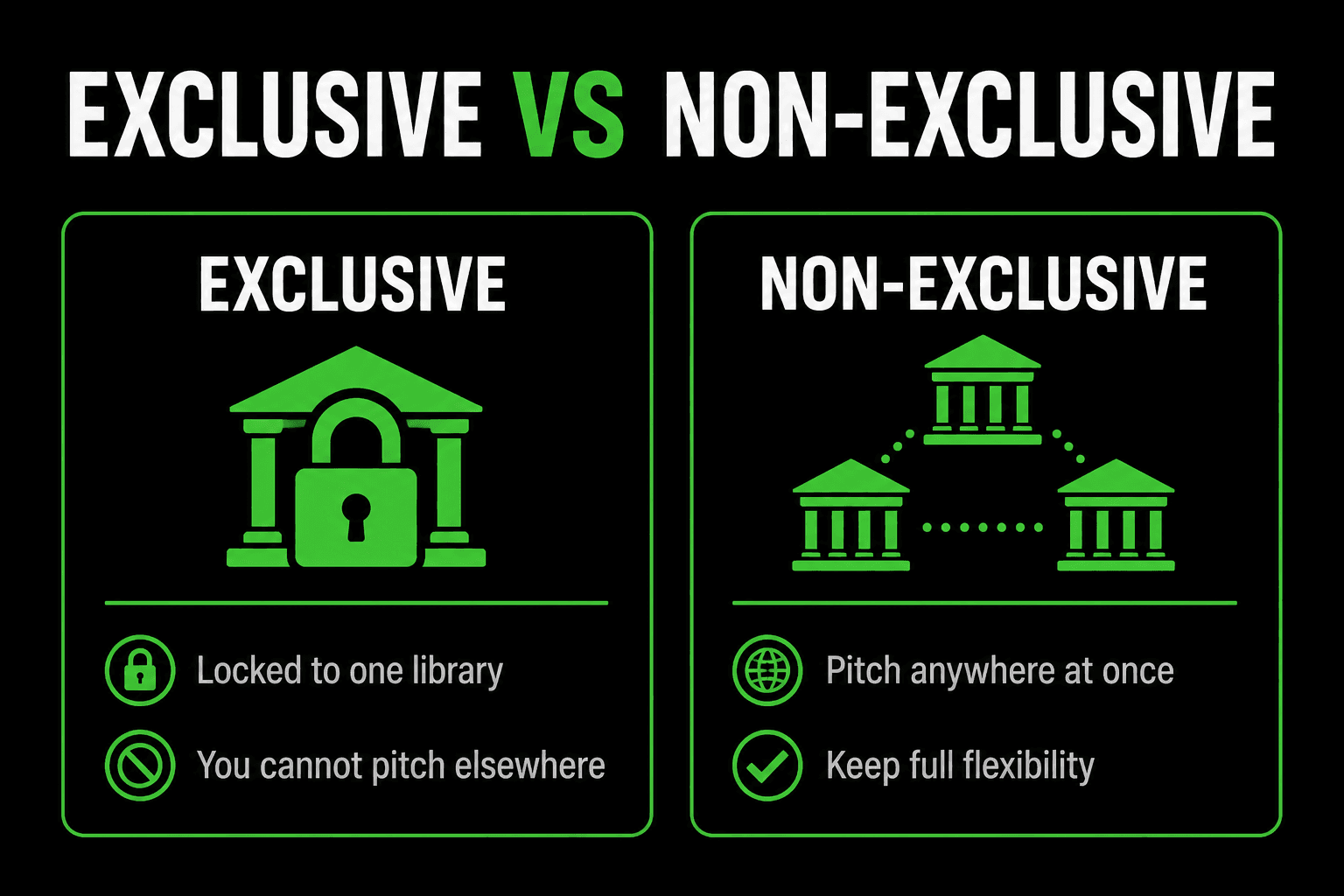
Exclusivity. Does this cover the track everywhere, or only within the library's own channels? "Exclusive to the library" and "exclusive for licensing purposes" are different animals, and some deals let you keep streaming and selling the track while locking only its sync rights.
Term and reversion. How long, and what returns the track to you. A three-year term with a reversion clause if the track is not placed within 12–24 months is reasonable. "For the life of copyright" with no reversion is a sale, not a licence, whatever the heading says. Never sign an exclusive without a reversion path.
Territory and media. "Worldwide, all media, in perpetuity" is the buyout formulation. It is not automatically bad — it is what a subscription library needs to function — but it should be priced as what it is, because that track is finished as an asset for anything else.
Most favoured nations. MFN means your fee matches the highest fee paid to any other rights holder in the same placement. If the publisher on the composition side gets $8,000, MFN gets the master side $8,000 too. Ask for it. It is the single most valuable clause an unrepresented artist can request and it costs the buyer nothing they have not already agreed to pay.
One more, less glamorous: the indemnity warranty. You are promising the track is clean and agreeing to cover the buyer's costs if it is not. That promise is enforceable. Do not sign it over an uncleared sample or a co-writer who never confirmed their split.
The AI question, stated honestly
The field is split, and the marketing rarely says so plainly. As of 2026:
- Accepted: Played.fm's brief board takes AI-assisted and AI-generated tracks with no genre or origin gatekeeping. Buyers see what they are getting and decide.
- Case-by-case: Songtradr handles AI material per submission and per deal rather than banning it, since some buyers care and some do not.
- Restricted: Epidemic Sound, Artlist, Musicbed and Marmoset all restrict or refuse AI-generated contributor submissions. Epidemic is explicit that it runs a human-first catalogue.
These are contributor policies and they change, so read the current terms before submitting rather than trusting a comparison table, including ours. What does not change is the reason buyers hesitate: an AI track with unclear provenance is an indemnity risk, and a supervisor who cannot verify the chain of rights will pick a different cue rather than argue about it.
There is also a practical failure that happens before a library ever sees the track. Raw exports from AI generators carry watermarks, provenance credentials and spectral fingerprints that distributors screen for, and a rejected or taken-down release is a track you cannot honestly warrant as delivered and clean. Artists who hit that wall usually master the file properly and run it through a purpose-built processor such as Undetectr — €39 one-time, unlimited tracks, browser-based — so scanners stop misreading music they legitimately own. That is about getting a clean, distributable master, not about hiding anything: disclose AI use wherever a contract or submission form asks, because the indemnity warranty above is exactly where a concealment would land on you. More on the pitch side in AI music and sync licensing.
Are you actually submission-ready?
Most rejections are not aesthetic. They are the library running five checks and failing you on one of them.
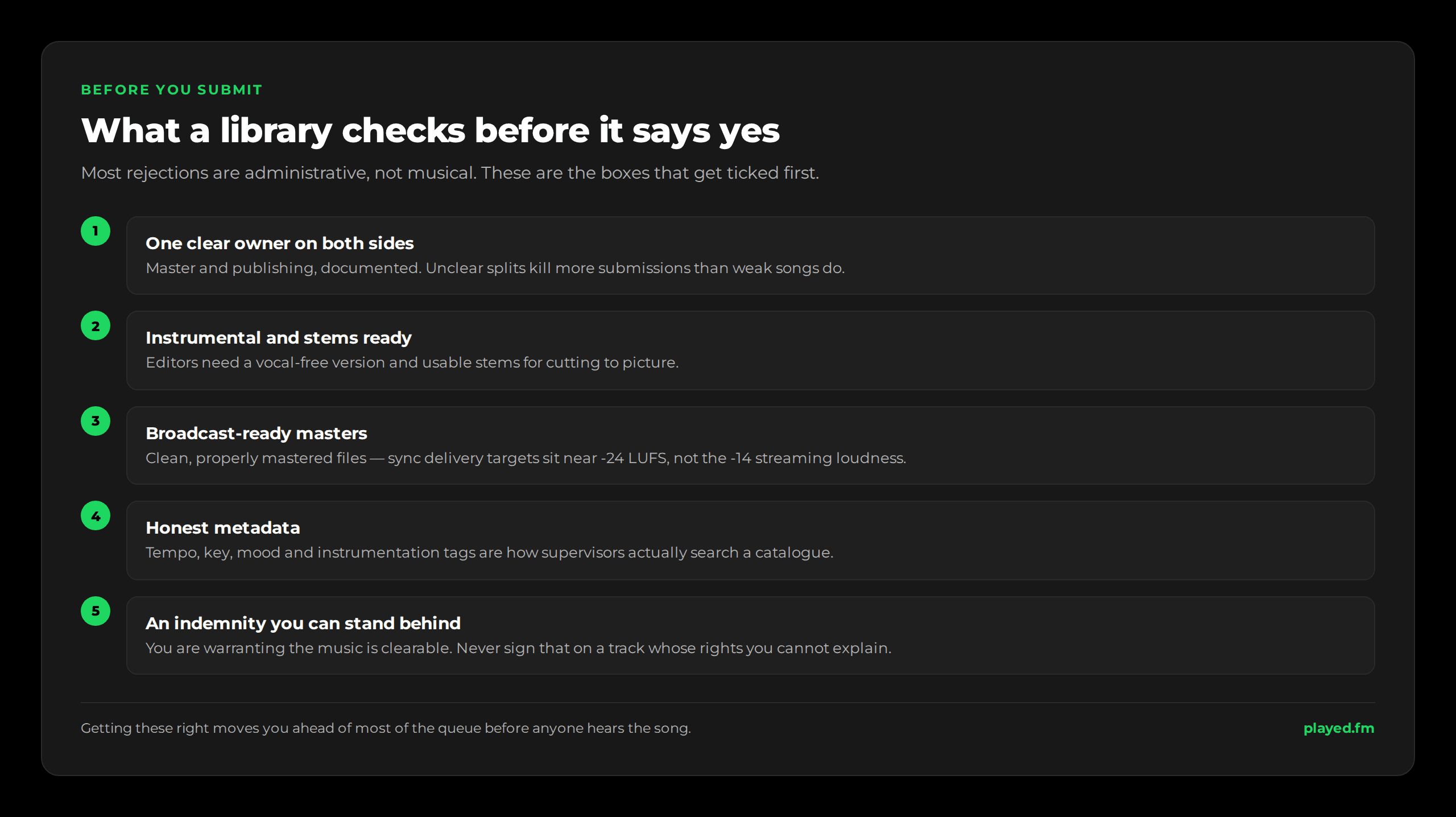
- One clear owner on master and publishing. One signature has to be able to clear the whole track. Unconfirmed co-writer splits and uncleared samples are the most common single reason a deal dies late.
- Instrumental and stems ready. An editor needs to duck the vocal under dialogue. No instrumental usually means no placement.
- Broadcast-ready masters near -24 LUFS, not the -14 LUFS you mastered for streaming. Loudness-war masters do not sit under a mix. See mastering for delivery if you are working from generator exports.
- Honest metadata: tempo, key, mood, instrumentation, and a correct ISRC. Supervisors search on these fields. Inflated mood tags get you shown to the wrong briefs and then ignored.
- An indemnity warranty you can stand behind. If you cannot honestly promise the track is clean, fix the rights before you submit anywhere.
Start here, by situation
Our actual recommendations, which depend entirely on where you are.
No catalogue yet (under 10 tracks). Do not submit to libraries. You will burn first impressions at the places with the highest bar. Write toward sync, instrumentals, stems, clean 30-second and 60-second edits, and in the meantime pitch open briefs where one right track wins on its own merits rather than on roster depth. That is the whole point of a brief board.
10–50 tracks. Go non-exclusive and go wide. List with two or three marketplaces, pitch briefs directly, and make one curated submission to Musicbed or Marmoset with your single strongest cohesive set. Lock nothing yet. You do not know which of your tracks is the sync track, and an exclusive deal decides that for you.
Large catalogue (200+ cues). Now the exclusive maths can work. A production-library or exclusive-library deal converts a catalogue you cannot personally pitch into a pipeline that runs without you, and the per-track ceiling matters less than throughput. Negotiate reversion on anything unplaced and keep your best twenty tracks out of the deal.
AI-generated catalogue. Four of the seven companies in the comparison restrict AI submissions, so build where you are welcome instead of arguing at the door: open brief boards, marketplaces that assess case by case, and direct licensing to buyers who care about the cue and not its origin. Get the rights and the master genuinely clean first, disclose where asked, and treat the restricted libraries as closed for now rather than as a target.
The bottom line
There is no best sync licensing company, only a best trade for your catalogue this year. Exclusive libraries buy certainty with your flexibility. Marketplaces sell reach and charge for it. Boutique agencies sell curation and take half. All three are honest deals when the terms are stated plainly, and all three are bad deals when signed without reading the exclusivity, term, territory and MFN clauses.
What we would not do is hand over half of a $500 podcast placement. In the $120–$3,000 band you can pitch for yourself: pitch the sync briefs, keep 100% of the fee and the buyer's contact details, and put your catalogue where fans can buy it too; set up your storefront and open an account. Use the libraries for the tier you genuinely cannot reach alone, and keep the rest.