Songtradr is the name almost every artist hits first when they start looking at sync. It is one of the largest licensing catalogues in the world, it has real brand clients, and it will happily take your music today. The question is not whether it is legitimate. It is whether the tier you can afford leaves you with enough of the fee to be worth the effort.
That is a maths question, and the maths is unusually clear. On the Lite tier you keep roughly 40% of a placement. On Pro you keep roughly 80%. Everything else about the platform is downstream of which of those two numbers applies to you.
This piece is about Songtradr specifically. For the wider field of libraries and agencies see sync licensing companies; for how sync works at all, sync licensing; for what placements pay, how much sync placements pay.
What Songtradr actually is
Songtradr is a business-to-business music licensing marketplace. Productions, agencies and brands search its catalogue for tracks; artists upload music, tag it with metadata, and either get found or submit to posted opportunities. It launched globally in 2016 and reports more than 400,000 artists, producers and songwriters on the platform.
Two things separate it from a normal sync library. The first is scale: it has grown by acquisition rather than by slow catalogue building, buying a series of music-tech and licensing businesses, Bandcamp among them. The second is that it leans heavily on machine tagging. Its own system reads an audio file and generates thousands of descriptive data points, which is how a catalogue that size stays searchable at all.
Practically, that means Songtradr is a discovery surface more than a pitch service. It has an in-house supervisor team that pitches to brands, and placements do come out of the blue when a track fits a search. But nobody is personally working your catalogue, and the platform does not pretend otherwise.
One structural point in its favour that gets lost in the pricing arguments: Songtradr licenses non-exclusively. Your track is not locked to it. You can keep the same recording on streaming, in other non-exclusive libraries, and available for you to pitch directly, all at the same time. That is a materially better deal than the exclusive subscription libraries offer, and it is the reason Songtradr can sit alongside other routes rather than replacing them.
The tier economics, which is the whole decision
Songtradr used to run a free tier. It does not any more. As of 2026 the structure is two paid tiers with very different commission rates, and the gap between them is the single most important fact on this page.
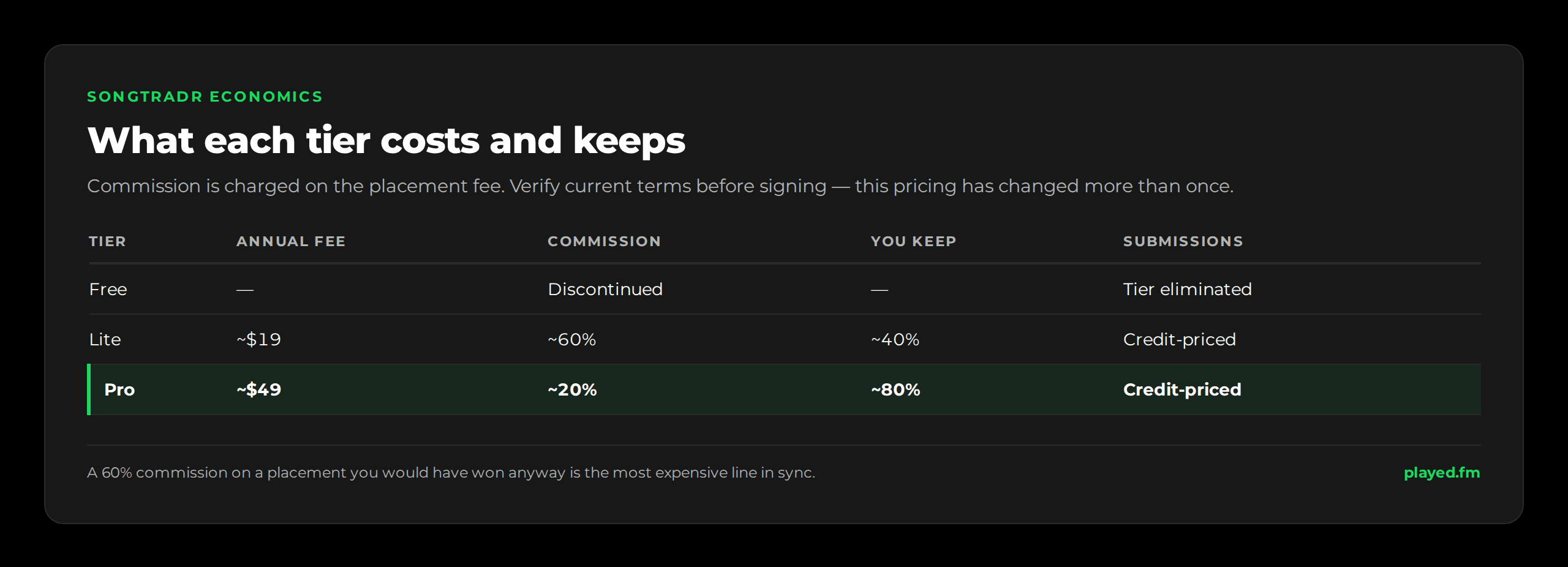
- Lite, around $19 a year. Songtradr takes roughly 60% commission on sync deals. You keep about 40%.
- Pro, around $49 a year. Songtradr takes roughly 20% commission. You keep about 80%. Pro also bundles distribution, with distribution royalties passing through to the artist.
- No free tier. Older reviews describing a free plan with a 40% commission are out of date; that layer was removed.
Look at that gap for a second. The $30 a year between Lite and Pro buys you a 40-percentage-point swing in what you keep. On a single $500 placement, Pro is $200 better off than Lite. There is essentially no scenario where an artist who is serious enough to pay $19 should not pay $49 instead.
Songtradr moves its pricing and terms periodically, and these figures are drawn from public reviews rather than a contract. Verify current terms before signing, and read the commission line specifically, not the marketing page.
What a commission actually costs, in money
Percentages are easy to nod along to and hard to feel. Here is the same placement, a mid-range $2,000 fee, run through each of the commission rates you will meet in sync.
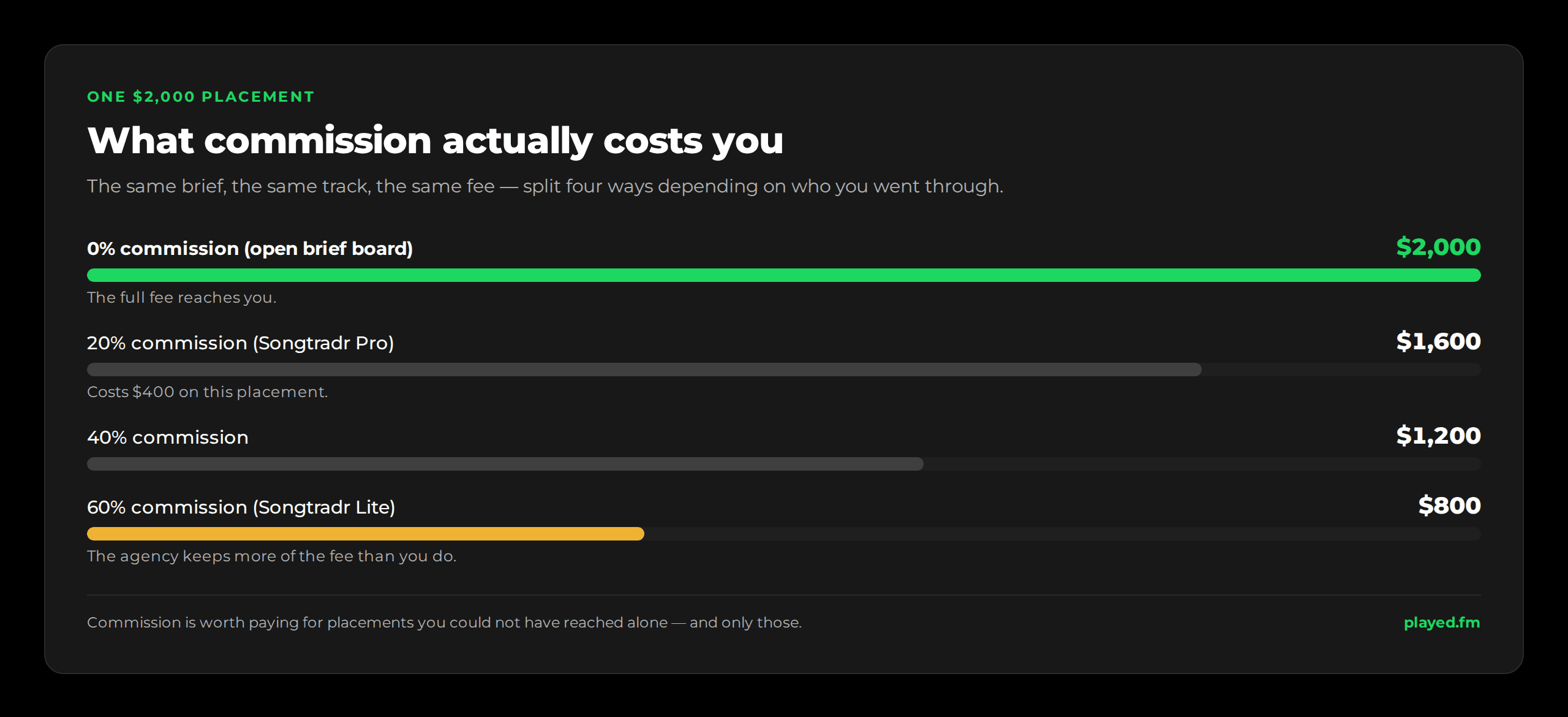
- 0% commission: you keep $2,000.
- 20% (Songtradr Pro): you keep $1,600.
- 40% (roughly where curated agency splits and the old free tier sat): you keep $1,200.
- 60% (Songtradr Lite): you keep $800.
The Lite tier is the one to think hard about. A 60% commission means the platform earns more from your placement than you do. That can still be a good trade if the platform is genuinely the reason the placement happened, which is the honest argument for any library. But it is a trade, not a discount, and $19 a year is a cheap way to buy an expensive deal.
The credit system, and what it means in practice
Songtradr does not simply let you fire your whole catalogue at every opportunity. Submissions to its opportunity board are priced in credits, and each posting has its own cost, historically in the range of 5 to 20 credits per submission depending on the type of placement. Accounts come with a credit allowance, reported at 35 credits to start on current plans, and you buy more or upgrade when you run out.
The stated intent is sensible: credits stop the board drowning in irrelevant submissions, which is exactly what happens on free-for-all pitch boards. The effect on you is more specific.
- You have to triage. With a 35-credit allowance and 5 to 20 credits per submission, you get a handful of shots at a time, so you are choosing between opportunities rather than covering all of them.
- You are spending a scarce resource blind. Selection rates are not published, and rejections come with no feedback, so you never learn which of your guesses was wrong or why.
- Opportunity volume is modest. Reviews put the board at roughly ten to fifteen postings a month, which is not many to spread a catalogue across.
This is worth knowing before you sign up expecting a firehose. Several long-term users report that the placements they did get came from Songtradr's own supervisor team finding their tracks in the catalogue, not from the opportunities they submitted to. If that pattern holds for you, your metadata matters more than your submissions do, and the credit balance is close to irrelevant.
Songtradr's AI music policy
This is the reason a lot of people arrive at this page, so let us be precise. Songtradr has no explicit ban on AI-generated music. Acceptance is handled case by case, and the two things being assessed are quality and whether you hold clear commercial rights to the recording.
That puts it in a small group. Most of the subscription libraries, Epidemic Sound among them, do not accept AI-generated submissions from contributors at all. Songtradr judges the track rather than the method, which is consistent with a platform that already uses machine analysis on its own catalogue.
Two caveats worth taking seriously. Case-by-case means exactly that: no guarantee, and no published criteria you can build against. And "clear commercial rights" is doing real work in that sentence, because it is where most AI submissions actually fail. You need a generator licence that grants commercial use, and you need to be able to say so plainly. We covered the whole rights and delivery checklist in can AI music get sync deals.
One practical note, only if you have already hit it. If a distributor has rejected or flagged an AI track you legitimately own and licensed, the usual cause is watermark and fingerprint data baked into the raw export rather than anything about the music. Artists in that position typically master the track and run it through a processor such as Undetectr (€39 one-time, unlimited tracks, browser-based) so automated screens do not misread a track they have every right to release. That is a file-integrity fix, not a way around a disclosure field: if a platform or a contract asks whether the music is AI-generated, answer honestly.
Who Songtradr genuinely suits
A hatchet job would be easy and wrong. Songtradr is a real marketplace with real placements, and for some artists it is clearly the right choice.
- Large catalogues. Songtradr rewards volume, because discovery is the main mechanism and more well-tagged tracks means more chances of matching a search. If you have 100 tracks, the platform works the way it is designed to.
- Artists who want to submit at volume. If your instinct is to pitch constantly rather than to negotiate individual deals, an opportunity board plus a searchable catalogue suits how you work.
- Anyone who values reach over margin. Paying 20% on Pro to sit in one of the biggest licensing catalogues in the world is a defensible trade. A placement you would never have got is worth 80% of something.
- Instrumental and production-music writers. The catalogue skews toward music that gets searched by mood and use case, which is where well-tagged instrumental work does best.
Who it does not suit
- Artists with a handful of tracks. Five songs in a catalogue of millions is a rounding error. Discovery cannot work for you at that scale, and 35 credits will not fix it.
- Anyone whose maths does not survive a 60% cut. If Lite is the only tier you will pay for, run the numbers on a realistic placement fee first and see whether the remaining 40% justifies the work.
- Artists who need feedback to improve. Rejections are silent. If you learn by iterating on responses, that loop does not exist here.
- Anyone who needs money quickly. Reported timelines from placement to payment run months, which is normal for sync generally but worth planning around.
The other criticism that appears consistently in reviews is placement rate: testimonials suggest only a small minority of paying members ever secure a sync opportunity. Treat that as directional rather than exact, since the platform does not publish selection data. It is the same shape of complaint you will find at every open library, and it is a reason to weigh the subscription against realistic odds rather than best-case ones.
The alternatives, compared honestly
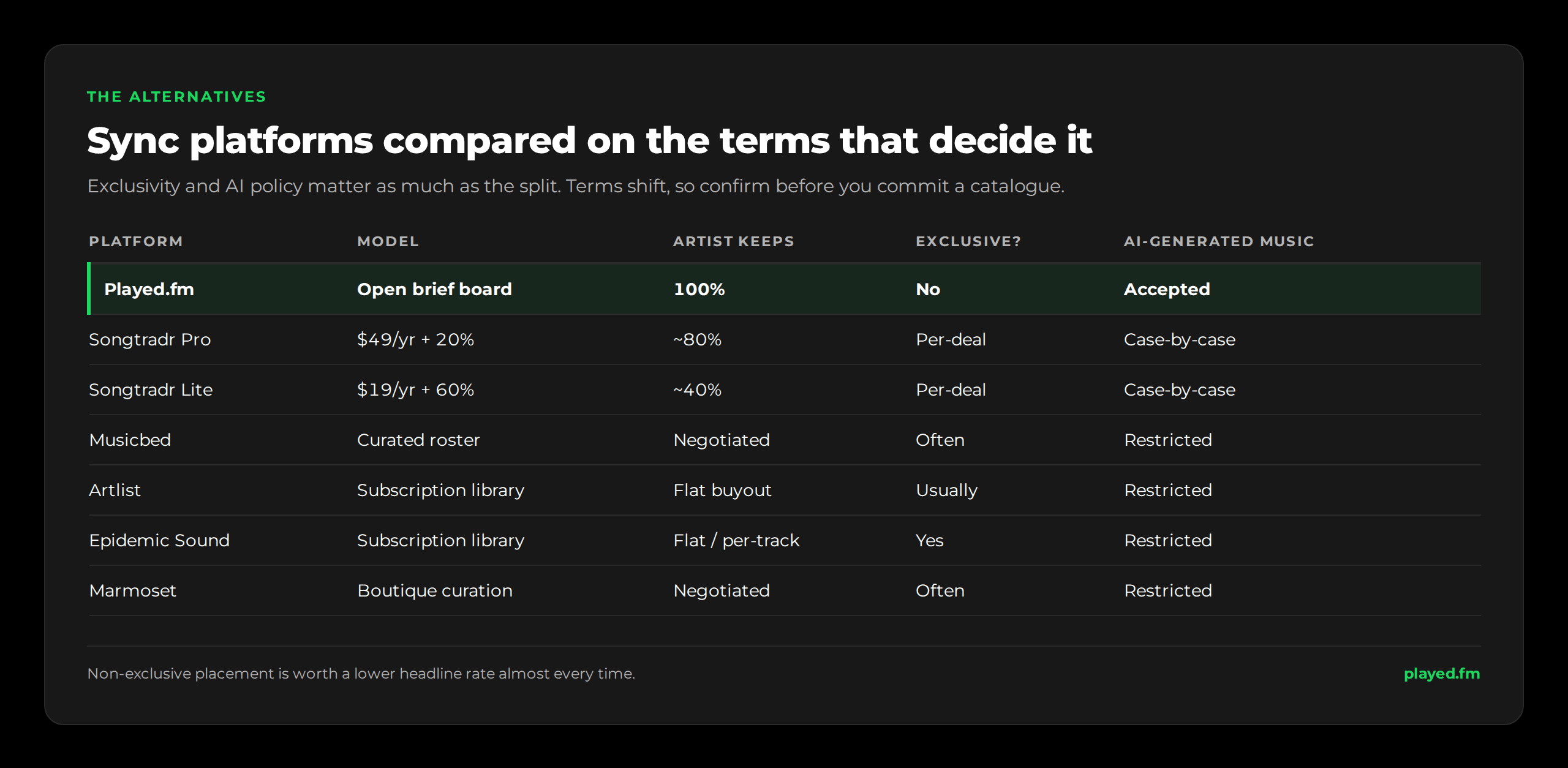
Every option below trades something. There is no route that combines high reach, high margin and easy acceptance, and any page telling you otherwise is selling something. Read each one for three things: what it takes, whether it locks the track, and whether it will accept your music at all.
Played.fm
The trade: you pay a flat subscription and keep the entire fee. Played takes a 0% cut on sales and on sync deals. Briefs are posted openly on the sync brief board by real productions with budgets from $120 to $3,000, you pitch your own catalogue directly, and you license on your own terms. Deals are non-exclusive and there is no genre or AI gatekeeping. The subscription is $12.99 a month, and you also get a storefront where fans buy direct and the money never routes through Played as a cut of sales.
The honest comparison on cost: at $12.99 a month that is $155.88 a year against Songtradr Pro's roughly $49, so Played is more expensive to hold. The extra $107 a year is repaid by a single placement of about $535 at Pro's 20% commission, or about $228 against Lite's 60%. One placement past that line and the flat-fee model is ahead, and it stays ahead on every placement afterwards. Below it, Songtradr is cheaper. That is the actual decision, and it turns on how much you expect to place.
Musicbed
The trade: prestige and higher per-deal fees, in exchange for a gate and usually a lock. Musicbed is curated, so acceptance is genuinely hard, and its catalogue is much smaller than Songtradr's by design. Deals are often exclusive and splits are roughly even. AI-generated music is restricted. If you get in, the placements are strong; most artists do not get in.
Artlist
The trade: predictable subscription income, in exchange for buyout terms and exclusivity. Artlist licenses to creators on a flat subscription and pays contributors from that pool, usually on an exclusive basis, and the licences it grants are broad buyouts rather than per-project deals. AI music is restricted. This is a volume-and-passivity play: you are not negotiating anything, and you are not keeping the track free for other routes.
Epidemic Sound
The trade: the largest creator-facing library, in exchange for exclusivity and a closed door on AI. Epidemic runs a subscription model with exclusive contributor deals, and it does not accept AI-generated music. Upfront track fees for accepted contributors are reported to be substantial, but the track is locked to them for the term and cannot be pitched anywhere else, including by you.
Marmoset
The trade: hands-on curation and creative-led placements, at boutique scale. Marmoset is small, selective and closer to an agency than a library, with per-project negotiation and roughly even splits. If your music has a distinctive identity rather than a searchable mood tag, it is a better fit than a giant catalogue. Volume is low by definition.
What none of them do
Worth saying plainly, because the marketing on all of these sites implies otherwise. No platform on this list will build a sync career for you. Every one of them is a surface: the catalogues wait for a search to match you, the brief boards wait for you to pitch, and the curated agencies wait for you to already be good enough to sign. The variable you control is not which logo you upload to, it is whether your tracks are delivery-ready with masters, instrumentals, stems and clean metadata. An unsigned track that clears instantly beats a better track tangled in splits at every single one of them.
The corollary is that the fee split only matters once placements exist. Which is the argument for choosing on terms rather than on promise: pick the route whose economics you would still be happy with after ten placements, then do the work that produces them.
How to choose in about five minutes
Answer three questions honestly and the field narrows on its own.
- How many finished, sync-ready tracks do you have? Under about 20, discovery-driven catalogues will not work for you, and a brief board where you pitch deliberately will. Over 100, catalogue scale starts paying.
- Will you accept a lock? If no, that removes Epidemic Sound, Artlist and most Musicbed deals immediately, and leaves the non-exclusive routes.
- Is your music AI-generated? If yes, most subscription libraries are closed to you, Songtradr is case-by-case, and open non-exclusive routes are where your time is best spent.
And one rule that applies whichever you pick: never sign an exclusive without a reversion clause returning the track if it has not been placed inside roughly 12 to 24 months. The comparison of exclusive versus non-exclusive terms is in sync licensing companies.
The bottom line
Songtradr is worth it on Pro and hard to justify on Lite. At roughly $49 a year for a 20% commission you are keeping $1,600 of a $2,000 placement inside one of the largest licensing catalogues in the world, and that is a fair trade. At roughly $19 a year for a 60% commission you keep $800 and the platform keeps $1,200, which only makes sense if the platform is genuinely why the deal existed.
It suits large, well-tagged catalogues and artists who are happy to pay for reach. It does not suit five-track artists, anyone who needs feedback, or anyone whose numbers stop working after a 60% cut. Pricing and commission terms shift, so verify current terms before signing rather than trusting any review, including this one.
If what you actually want is to keep the whole fee, the flat-fee route is the one to run the numbers on. Open your storefront on Played, pitch the sync brief board directly, and keep 100% of every placement.