
You can make a broadcast-quality instrumental in Suno in five minutes. So the obvious question follows: can you license that track to a TV show, an ad or a podcast, where a single placement pays real money? The short answer is yes, but only if you clear two hurdles most AI tracks fail — and clearing them is the whole job.
If you are new to the money and mechanics, read sync licensing and how much sync placements pay first. This piece is specifically about AI music.
Why sync is a natural fit for AI music
Sync buyers need a lot of instrumental music — beds under dialogue, transitions, background cues — that is competent, on-brief and, crucially, clearable. They are not chasing the next hit; they need the right mood delivered fast with clean paperwork. AI generators are very good at producing exactly that kind of functional, genre-accurate instrumental. On paper it is a perfect match. In practice, two things scare buyers off.
Why AI tracks scare buyers
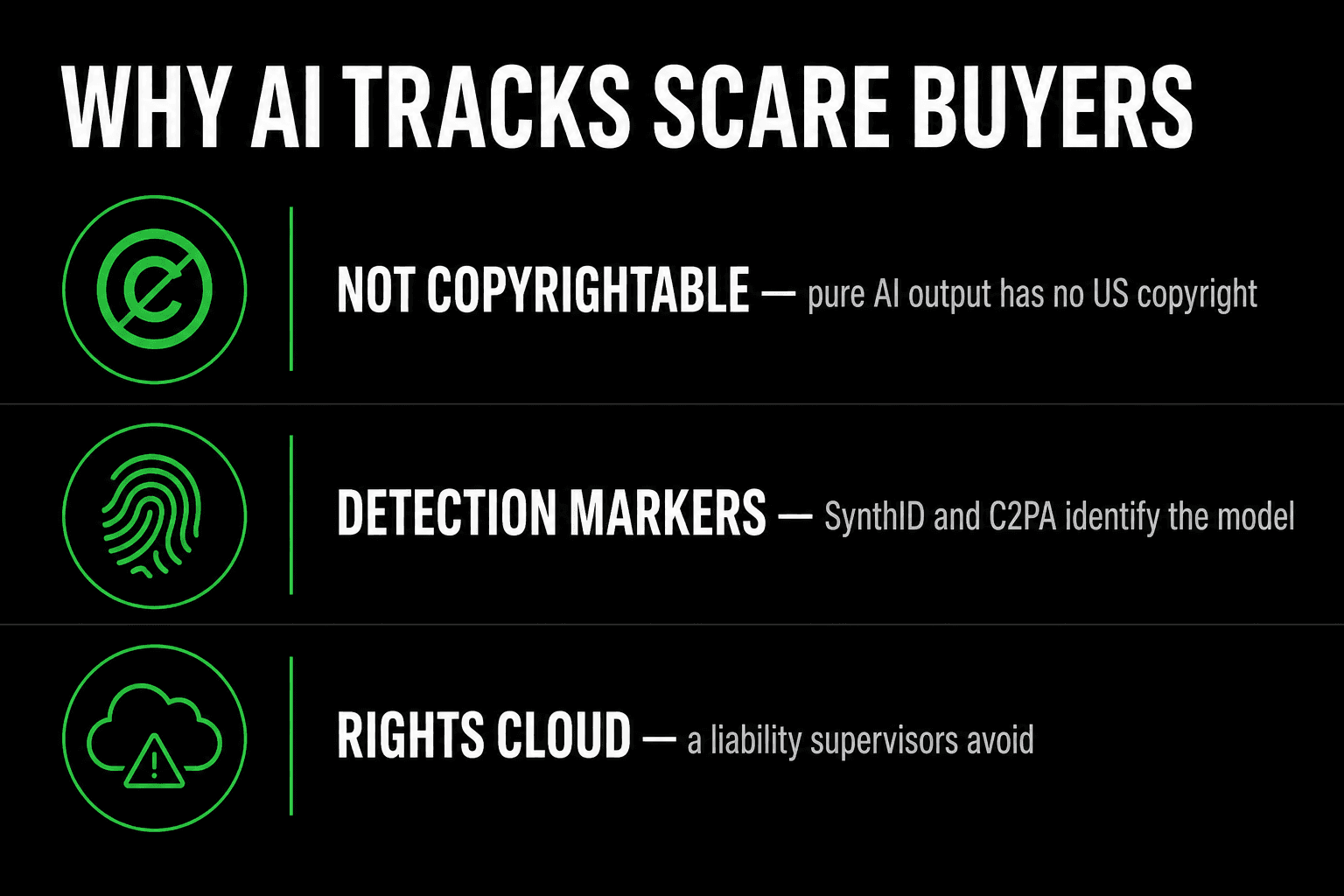
The first problem is rights. The US Copyright Office has been consistent that works generated entirely by a machine, from a prompt alone, lack the human authorship copyright requires, so pure AI output generally cannot be copyrighted — you can only claim the parts a human authored, such as written lyrics or meaningful arrangement. A supervisor wants one-stop, defensible rights; an uncopyrightable track is a weaker, murkier thing to license.
The second problem is detection. Suno and Udio embed machine-readable markers — SynthID-style watermarks, C2PA Content Credentials — that identify a track as AI-generated, and distributors and platforms actively scan for them. A track that could be flagged, disputed or pulled mid-campaign is precisely the liability a supervisor avoids when a clean alternative exists. Together, no copyright plus detection markers equals a rights cloud, and ambiguity is a pass.
How to make an AI track sync-ready
The good news: both problems are addressable, and doing so turns a risky file into a legitimate pitch. Four steps.
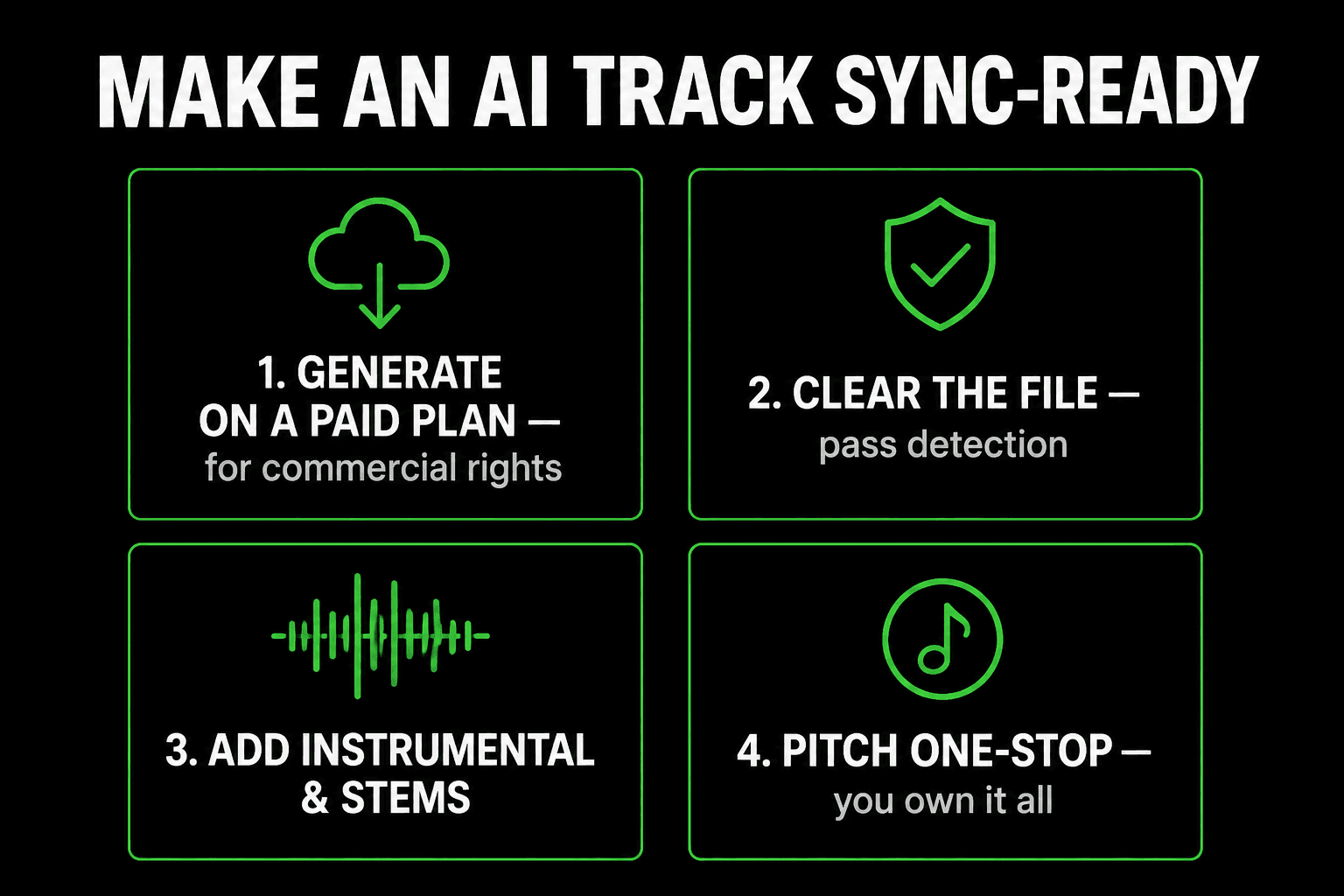
- Generate on a paid plan. Commercial rights to Suno and Udio output require a paid tier — free-tier output is personal-use only and cannot be licensed. Confirm your commercial rights before anything else. The legal picture is here.
- Clear the file so it passes detection. Re-exporting does not remove the markers — SynthID lives in the waveform. The tool built for this in music is Undetectr, which targets SynthID, C2PA and spectral fingerprints in one pass so the finished master reads as clean audio. We cover the mechanics in AI music watermark removers.

Undetectr’s before-and-after: the same track flagged as AI, then passing clean. Screenshot from undetectr.com. - Prepare the deliverables. Sync needs an instrumental version and separated stems, plus a broadcast-quality master and clean metadata — the same bar any track faces, covered in music licensing for film and TV.
- Pitch one-stop. Because you generated the track and hold the commercial rights, you control it end to end — you can license it yourself and keep the fee.
One boundary worth stating plainly: this is about clearing music you generated and hold the rights to, so it can be legitimately licensed. It is not about disguising anyone else's copyrighted work. Do the first, never the second.
Where to pitch an AI track for sync
Most traditional libraries are wary of AI or ban it outright, Epidemic Sound, for instance, does not accept AI-generated music from contributors. That makes a direct route more valuable, not less. Played's sync briefs board welcomes every genre, AI music included, and posts real paid briefs from TV, film, podcasts, games and ad campaigns. You pitch your cleaned, cleared, one-stop track directly, license on your terms, and keep 100%, Played takes no cut of the deal. And the same clean track can sell direct on your storefront alongside it. See how to sell Suno music for the full playbook.
The bottom line
AI music can absolutely land sync deals; the demand for clean, on-brief instrumental music is real; but only once it is genuinely clearable. Generate on a paid plan for commercial rights, clean the file with Undetectr so it passes detection, prepare an instrumental and stems, and pitch it one-stop. Then a Suno track stops being a liability and becomes a licensable asset. Open your storefront on Played and pitch the sync board.