Your song is copyrighted the moment you record it or write it down. There is nothing to file for that. What people mean by how to copyright a song is registering that copyright with the US Copyright Office: an online application through its eCO system, a fee of $45 or $65 for one song as of October 2026, and a copy of the work.
Registration is optional, but it is what makes the copyright enforceable. For a US work you cannot sue for infringement without it, and if you register late, statutory damages and attorney’s fees are off the table. This guide covers which form fits a song and which fits a recording, every application option and fee (including the increase the Office has proposed), the eCO steps, deposits, processing times, the “poor man’s copyright” myth, and what changes outside the US.
Key takeaways
- Copyright is automatic once the song is fixed. Registration is the part you pay for.
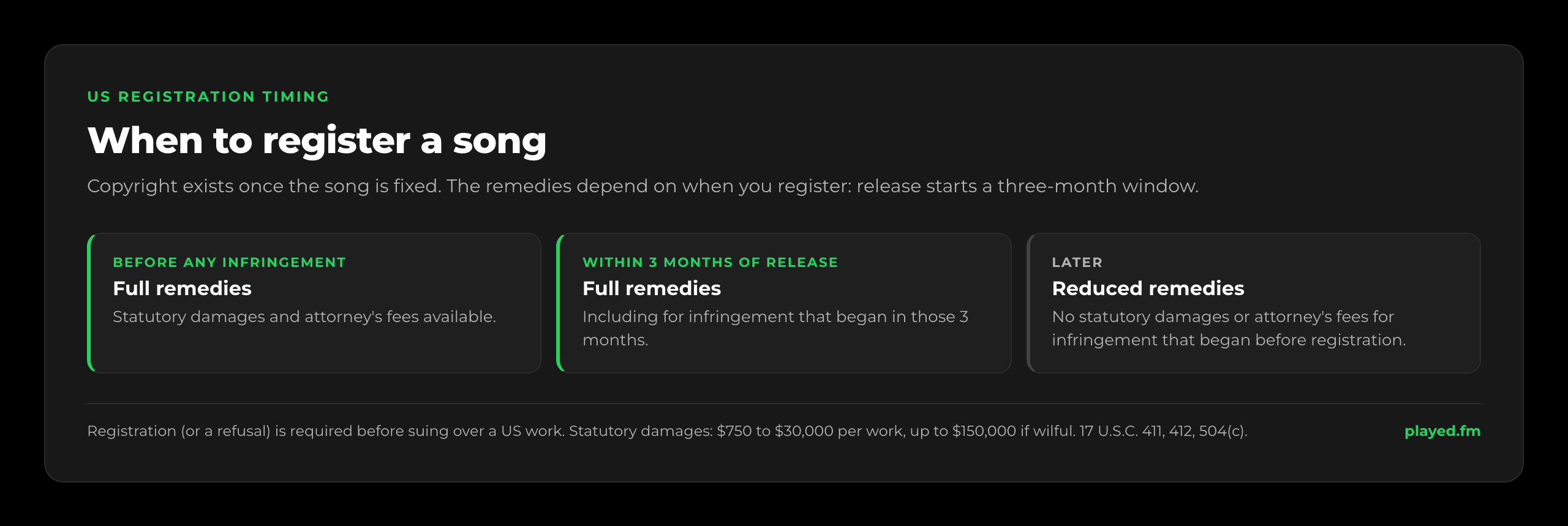
- Register before infringement starts, or within three months of release, to keep statutory damages and attorney’s fees available.
- One application can cover a song and its recording when the same person owns both.
- Fees as of October 2026: $45 Single Application, $65 Standard Application, $85 for up to ten unreleased works. The Office has proposed raising all three.
- Mailing yourself a copy does nothing. The Copyright Office says it “is not a substitute for registration.”
Your song is already copyrighted
The Copyright Office’s Copyright Basics (Circular 1) is direct about it: “Copyright protection in the United States exists automatically from the moment the original work of authorship is fixed.” Fixed means captured in a medium permanent enough to be played back or read: a voice memo, a bounced mix, a lyric sheet. A song that exists only in your head is not protected yet.
A copyright notice (©, your name, the year) has not been required since 1 March 1989, though it still has practical value. Protection lasts for the author’s life plus 70 years; for a co-written song, 70 years after the last surviving writer dies.
Circular 1 also defines an original work as one “independently created by a human author”. How that applies to music made with AI tools is a separate question, covered in is it legal to sell AI music.
Why register a song anyway
Because automatic copyright is hard to enforce. Registration changes four things.
- You can sue. Under 17 U.S.C. § 411(a), “no civil action for infringement of the copyright in any United States work shall be instituted until preregistration or registration of the copyright claim has been made”. A refused application also lets you file.
- Statutory damages and attorney’s fees become possible, if you registered in time. Section 412 bars both for infringement of an unpublished work that began before registration, and for infringement that began after publication but before registration, “unless such registration is made within three months after the first publication of the work.” Statutory damages run from $750 to $30,000 per work, up to $150,000 for wilful infringement (section 504(c)). Without them you have to prove what the infringement actually cost you, which for an independent release can be very little.
- The certificate is evidence. Registration made before or within five years of publication is prima facie evidence that the copyright is valid and that the facts on the certificate are true.
- The small-claims route opens. The Copyright Claims Board handles claims of up to $30,000 in total, with statutory damages capped at $15,000 per work, and you must have applied to register the work before or when you file.
None of this stops you selling. You can sell direct from a Played storefront without registering anything. Registration is what protects the catalogue you are selling.
Musical work (PA) or sound recording (SR)?
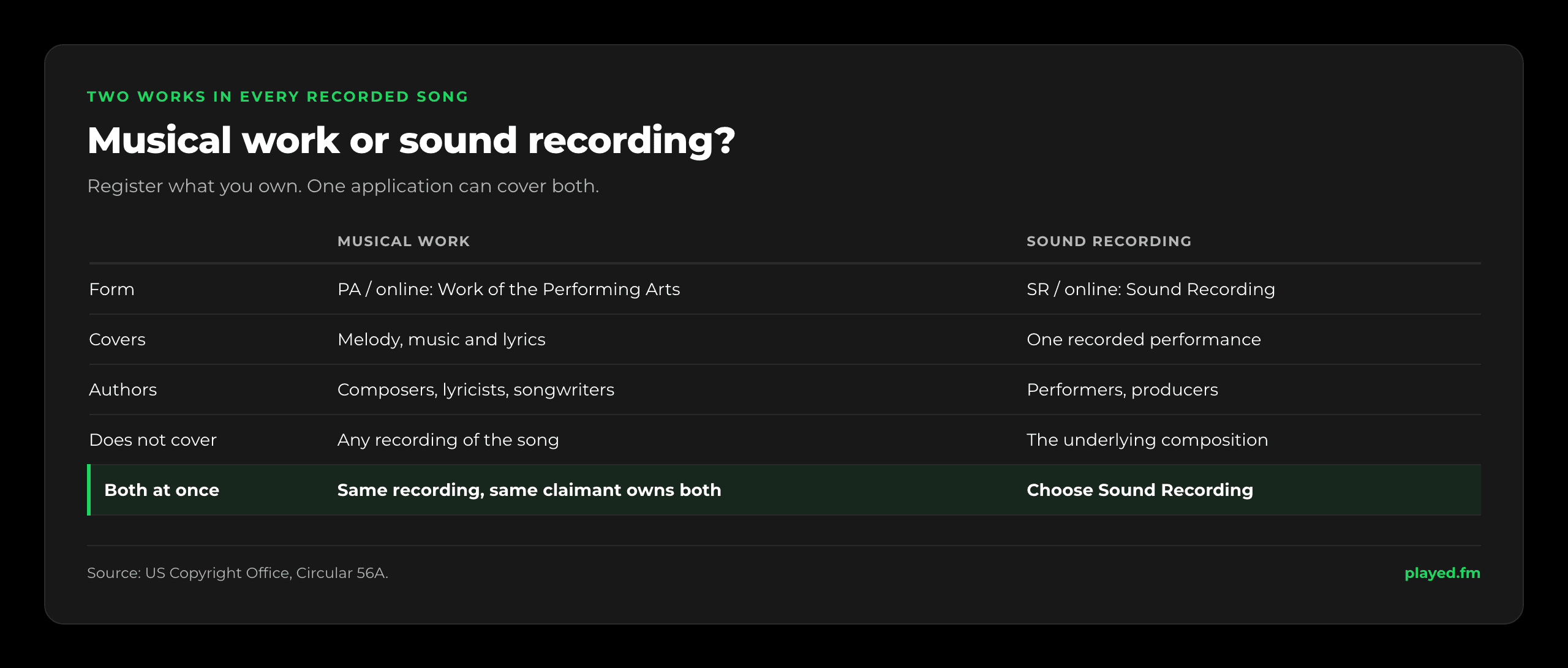
A recorded song is two separate works, and Circular 56A treats them that way. A registration for a musical composition “covers the music and lyrics (if any)” but not a recorded performance. A sound recording registration covers the recording but “does not cover the underlying musical composition.” On paper these are Form PA and Form SR. Online, you choose “Work of the Performing Arts” for a composition alone, or “Sound Recording” for a recording.
You can register both on one application when the composition and recording are on the same phonorecord and the same person or company is the claimant for both. Choose “Sound Recording” as the type of work and describe both kinds of authorship.
- You wrote it and recorded it: one application for both.
- You recorded someone else’s song: register the sound recording only.
- You wrote it and someone else recorded it: register the composition only.
- You recorded over a leased beat: the recording includes music you licensed, so it cannot use the Single Application, and anything you do not own belongs in the application’s limitation of claim.
Application options and fees
Every option below is filed online through eCO except the paper forms. Fees are from the Office’s fee schedule, checked October 2026.
| Option | Use it for | Fee now | Proposed |
|---|---|---|---|
| Single Application (“One Work by One Author”) | One work by one author who is also the sole owner, not made for hire. Covers a song and its recording only if you are the only author, only performer and only owner. | $45 | $55 |
| Standard Application | Everything else: co-writes, features, leased beats, and an album registered as one collective work. | $65 | $85 |
| Group of Unpublished Works (GRUW) | Up to 10 unreleased songs or recordings by the same author or authors, all named as claimants. | $85 | $130 |
| GRAM: Musical Works from an Album | 2 to 20 compositions released on the same album, with the same author or a common joint author and the same claimants. | $65 | $85 |
| GRAM: Sound Recordings from an Album | 2 to 20 recordings from the same album, plus its artwork, photos and liner notes. Cannot include the compositions. | $65 | $130 |
| Paper (Forms PA, SR) | Filing by mail. The slowest route. | $125 | $185 |
About that last column. On 14 July 2026 the Office sent Congress a proposed new fee schedule, its first change since 2020. By law it can introduce the new fees 120 days after submission unless Congress passes a law disapproving them, and the Office has said it wants them in place in autumn 2026. Until then the current fees apply, so check the fee page on the day you file. Special handling, the paid fast track, is $800 per claim now and proposed at $1,100.
Group options are strict. Per Circular 58, GRAM works must generally be first published on the same album on the same date, with a limited exception for earlier singles. Miss a rule and the Office may refuse the whole group claim.
Which option fits your release
- One song, written and recorded entirely by you, with no licensed beat and no other performers: Single Application, $45.
- A co-write, a feature or a leased beat: Standard Application, $65, naming every author. The shares between co-writers are a separate agreement; use a split sheet.
- A batch of unreleased songs by the same writers: Group of Unpublished Works, up to ten for $85. Register before release; once published, they no longer qualify.
- A released album where you own every song and recording, none released before: Circular 56A says one Standard Application can register the album as a collective work, and the claim can extend to the individual compositions and recordings.
- An album with earlier singles, where the writers and claimants line up: GRAM, with one application for the compositions and another for the recordings.
For these purposes, Circular 56A says publication happens when phonorecords are distributed to the public “by sale; transfer of ownership; or by rental, lease, or lending”, and that a public performance alone is not publication.
How to register a song online, step by step
- Gather the facts. Final titles, the year this version was completed, the release date and country if released, every author and what each created, the claimant, and anything you do not own.
- Log in to eCO. From the Office’s Registration Portal, open the Electronic Copyright Office (eCO) Registration System and create an account if you need one. eCO is still the live system; the Office is building a replacement called the Enterprise Copyright System.
- Pick the application. Standard, “One Work by One Author”, “Group of Unpublished Works”, or, under “Register Certain Groups of Published Works”, the two GRAM applications. The Office warns that the Standard Application may not be used for a collection of unpublished works.
- Choose the type of work. “Work of the Performing Arts” for a composition alone; “Sound Recording” for a recording, or a recording plus its composition. Pick wrong and you start again.
- Complete the screens. Titles exactly as they appear on the work, publication details, authors and what each contributed, the claimant (with a transfer statement if the claimant is not the author), and a limitation of claim for any material you do not own or that was previously published or registered.
- Pay. By credit or debit card or electronic check through Pay.gov, or from a Copyright Office deposit account. Fees are non-refundable.
- Submit your work. Payment comes first; then eCO asks you to upload files or print a shipping slip for physical copies.
- Watch your email. If an examiner writes, the Office asks for a full response within 45 days.
Deposit copies: what to send
The deposit is the copy of the work that goes into the public record. It is not returned.
- Unreleased, or released only digitally: upload a digital file. Each file can be up to 500 MB.
- Released on CD or vinyl: send two physical copies of the best edition. The Library of Congress ranks CD above vinyl, so if both exist, send CDs.
- Composition only, released as a recording: upload or send one complete phonorecord, per Circular 50.
How long registration takes
For claims closed between 1 April and 30 September 2026, the Office’s processing times report gives an average of 4.1 months across all claims. Online claims with an uploaded deposit that needed no correspondence averaged 3.4 months (range 1.2 to 5.5); those that needed correspondence averaged 5.3 months, and ran as long as 9.6. Paper claims are slower.
The wait matters less than it looks. The effective date of registration is the day the Office receives an acceptable application, deposit and fee, not the day it finishes examining them. File a complete application within three months of release and, once registered, it counts from that day, however long the certificate takes.
The “poor man’s copyright” myth
Posting a copy of your song to yourself and keeping the sealed envelope is folklore. The Copyright Office’s general FAQ answers it in two sentences: the practice “is sometimes called a ‘poor man’s copyright.’ There is no provision in the copyright law regarding any such type of protection, and it is not a substitute for registration.”
The same goes for emailing yourself a file or relying on a cloud timestamp. Dated drafts and project files can help show when you wrote something, so keep them. They do not satisfy section 411 or section 412.
Outside the US
UK: GOV.UK says “You get copyright protection automatically - you do not have to apply or pay a fee. There is not a register of copyright works in the UK.” Any service selling UK “copyright registration” is selling a private record, not a government one.
Elsewhere: under the Berne Convention, protection “must not be conditional upon compliance with any formality”, so most member countries have no registration requirement at all.
The US pre-suit rule in section 411(a) applies to US works, and Circular 1 notes the exception for non-US works. The statutory damages timing rule in section 412 is not limited to US works, so a non-US artist with a US audience may still want to register.
This is general information, not legal advice. For a specific dispute, or before signing anything that transfers rights, talk to a copyright lawyer.
What registration does not do
It does not collect money. Royalties come through your distributor, your PRO, The MLC and SoundExchange, each with its own registration; see how music royalties work. It does not settle who owns what share of a co-write; that is the split sheet’s job. And registering with ASCAP or BMI is not copyright registration. They are separate systems that do separate jobs.
Frequently asked questions
How much does it cost to copyright a song?
As of October 2026, registering one song online costs $45 on the Single Application (one author who is the sole owner) or $65 on the Standard Application. Up to ten unreleased works cost $85 as a group, and paper forms cost $125. The Copyright Office has proposed raising these to $55, $85, $130 and $185.
Do I need to copyright my song before releasing it?
No. Copyright exists automatically once the song is fixed. But to keep statutory damages and attorney’s fees available, register before any infringement begins or within three months of first publication. Registering before release also lets you use the cheaper group option for unpublished works.
Can I copyright a song for free?
Copyright itself is free and automatic. Registration is not: the cheapest US option is the $45 Single Application as of October 2026. In the UK and most other Berne Convention countries there is no official registration to pay for at all.
Is poor man’s copyright valid?
No. The US Copyright Office says there is no provision in copyright law for it and that it is not a substitute for registration. Mailing or emailing yourself a copy may help show when a song existed, but it does not let you sue for a US work or claim statutory damages.
Can I register a song and its recording on one application?
Yes, when the composition and the recording are on the same phonorecord and the same person or company owns both. Choose Sound Recording as the type of work and claim both. If someone else owns either one, register them separately.
How long does it take to copyright a song?
Registration through eCO averaged 3.4 months for online claims with an uploaded deposit and no correspondence, for claims closed between April and September 2026. Claims that needed correspondence averaged 5.3 months. Your registration takes effect from the day the Office receives a complete application, not the day it is approved.
Is registering with ASCAP or BMI the same as copyrighting a song?
No. A PRO registration tells ASCAP or BMI who to pay performance royalties to. Copyright registration is a separate filing with the US Copyright Office that creates a public record of your claim and is required before suing over a US work.
The bottom line
You own the copyright the moment the song is recorded or written down. Registering it costs $45 to $65 per song online as of October 2026, takes a few months, and is what turns that copyright into something you can enforce. If one person owns both, one Sound Recording application covers the song and the recording. Register before release or within three months of it, keep your deposit files, and ignore anyone selling a sealed envelope.