Every time Bandcamp is in the news, searches for alternatives spike, and every time the same thing happens: artists compare the fee percentages, pick the lowest one, move, and sell less than they did before. The fee is the easiest number to compare and the least important one.
So we start with the money, then spend the rest of the page on what actually decides whether moving was a good idea: who owns the fan list, who sets the prices, what happens to your catalogue if the platform changes again, and the uncomfortable one, whether anybody new will ever arrive.
Start with the take-home maths
Here is the same commercial outcome, 100 album sales at $10, run through each place you could have sold it. A hundred sales is a realistic year for a working independent artist with a few thousand followers, and it makes the percentages legible in a way that a single $10 transaction never does.
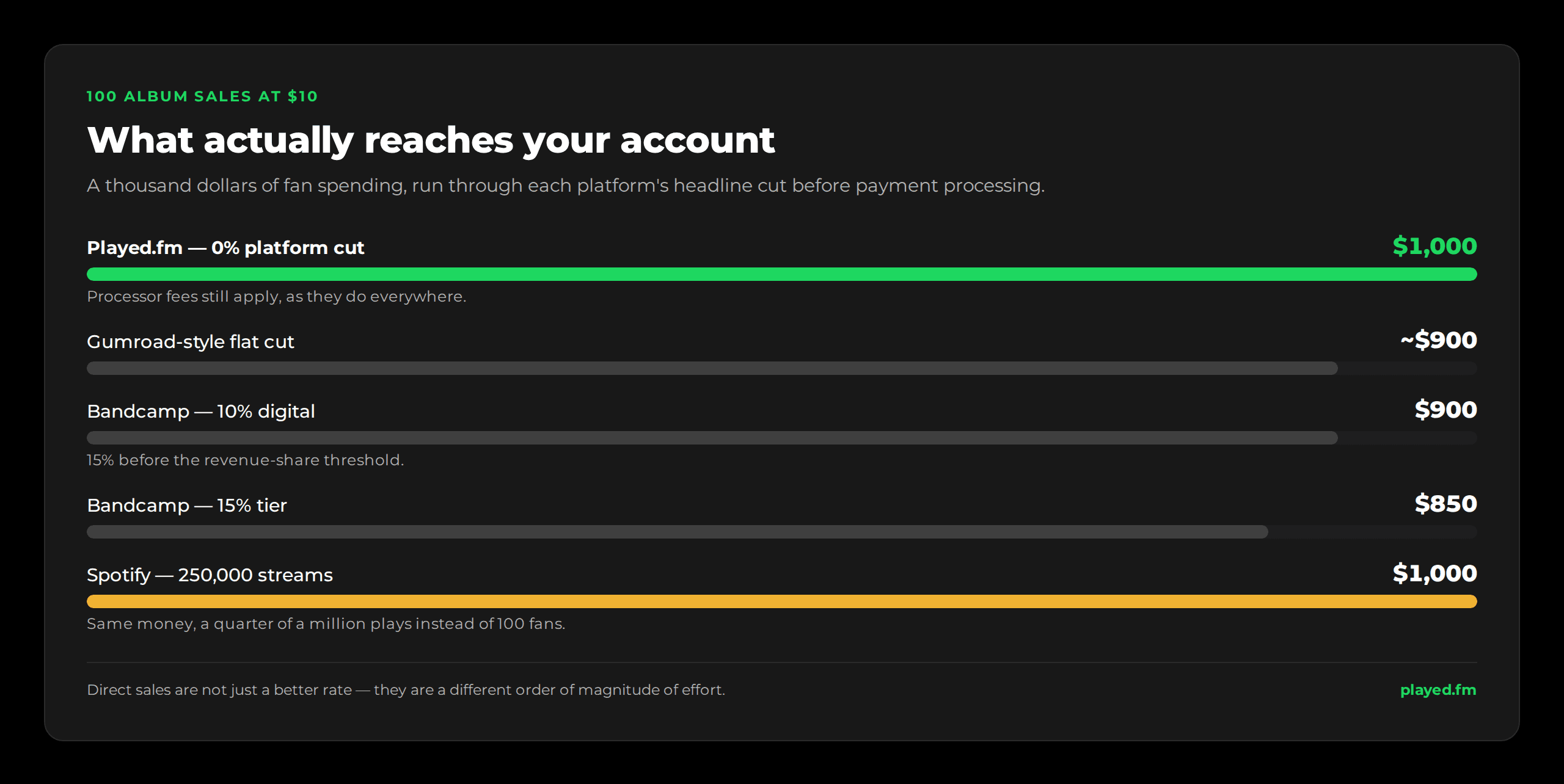
| Where the sale happens | What the fan spends | Before subscription and processing | Platform keeps |
|---|---|---|---|
| Played.fm storefront | $1,000 | $1,000, before your Played subscription and processor fees | $0 |
| Gumroad-style flat percentage | $1,000 | ~$900 | ~$100 |
| Bandcamp, 10% digital tier | $1,000 | $900, before processing | $100 |
| Bandcamp, 15% digital tier | $1,000 | $850, before processing | $150 |
| Spotify, to reach the same money | 250,000 streams | ~$1,000 gross | everything else |
Two things jump out. The first is that the gap between the best and worst storefront is $150 on $1,000, which is real money but not life-changing money. The second is that the gap between any storefront and streaming is enormous: reaching $1,000 on Spotify takes roughly 250,000 streams, at the $0.003 to $0.005 per stream band we break down in how much artists make per stream.
If you take one thing from this page, take that ratio. Choosing between storefronts is a 5-15% decision. Choosing to sell at all rather than only stream is a 100x decision.
Why artists are looking for alternatives at all
There are three separate reasons, and they get muddled together in most threads. Worth separating them, because only one of them is actually about money.
Ownership changed twice in three years. Bandcamp was acquired by Epic Games in 2022 and sold to Songtradr in 2023, with substantial layoffs during the handover. That is a matter of public record and we are not going to speculate about anyone's intentions. The relevant point for you is structural: a storefront you depend on is a business with its own owners, its own strategy, and its own right to change terms. That is true of every platform on this page, including ours.
The fee compounds quietly. Bandcamp's widely-reported digital revenue share is 15%, dropping to 10% after $5,000 in sales, provided sales over the past 12 months remain at least $5,000, with merch at 10% and payment processing charged separately on top. On one sale that is loose change. Across a decade of catalogue it is a permanent pay cut you never get to renegotiate. We do the full fee breakdown, including the micro-transaction processing rate and how Bandcamp Fridays change it, in how much does Bandcamp take. It is genuinely one of the fairer cuts in the industry, and it is still a cut.
Discovery has limits. Bandcamp's editorial and tag browsing send real traffic, but the platform was never an algorithmic recommendation engine and does not try to be one. Most artists' Bandcamp sales come from an audience they built somewhere else. That is not a criticism, it is just important to know before you assume a move will cost you a discovery engine you did not actually have.
A fourth reason comes up increasingly and is worth stating carefully: policy fit. Platforms differ on what they will host, and policies on genre and on AI-generated music vary by service and change over time. Read whichever terms apply to you, on any platform, rather than trusting a forum summary. Played does not gatekeep by genre and does not gatekeep AI-assisted music.
What a Bandcamp alternative actually has to replace
Bandcamp does four jobs at once, and most of its so-called alternatives do one or two of them. Line up the shortlist against all four before you commit:
- A player. Full-length streaming, not 30-second previews. Fans buy what they have already heard all the way through.
- A checkout. Something a stranger will trust with a card, on a phone, in ten seconds.
- A fan list. Contact details for people who paid, so the next release has somewhere to go.
- Some discovery. Any route by which a person who has never heard of you ends up on the page.
And then there is the question nobody asks until it is too late: what do you keep if you leave?
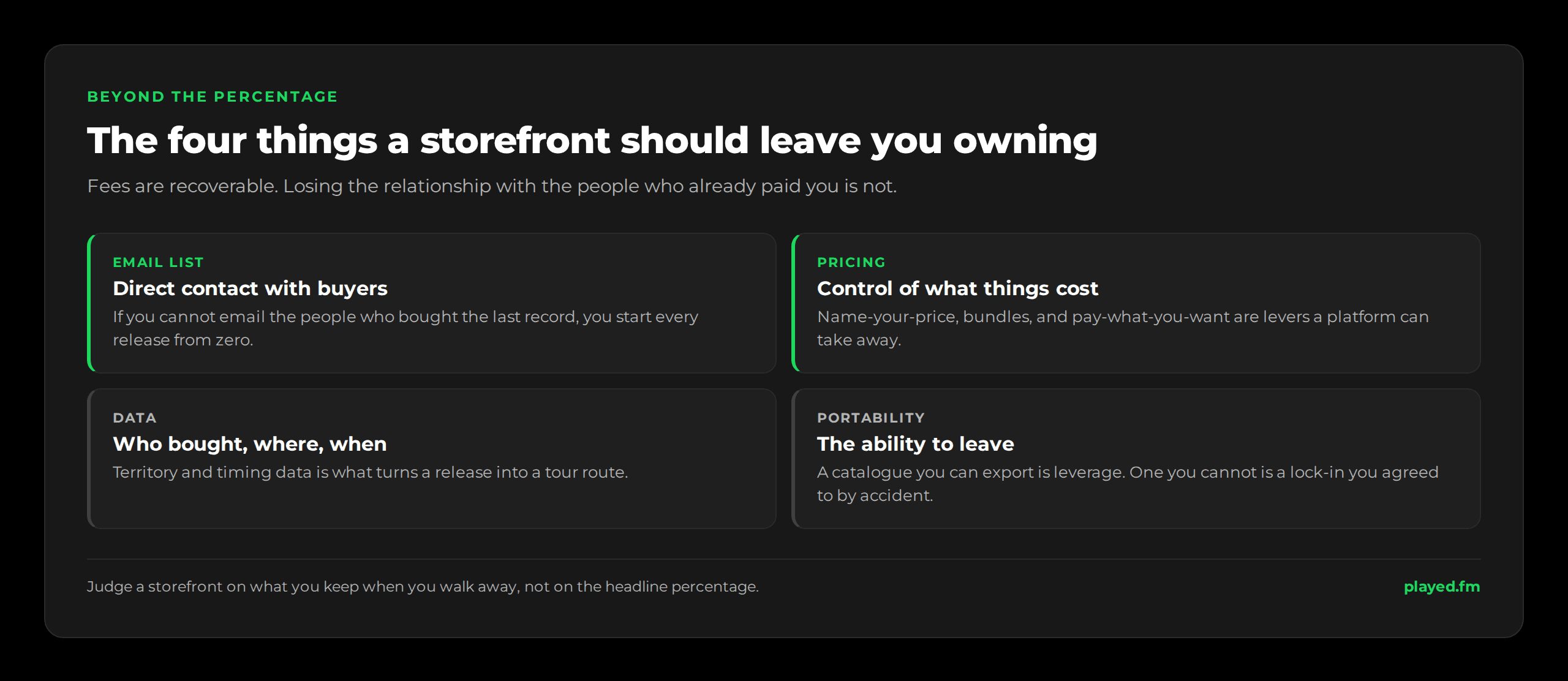
Four things decide that: your email list, the only asset that survives every platform change; pricing control, so a name-your-price experiment or a $30 deluxe bundle needs nobody's approval; buyer data, meaning territory and purchase timing, which is how you decide where to tour and when to release; and catalogue portability, so your masters and metadata leave intact rather than being re-uploaded by hand. Score every option below on those four, not on the headline percentage.
The platforms compared
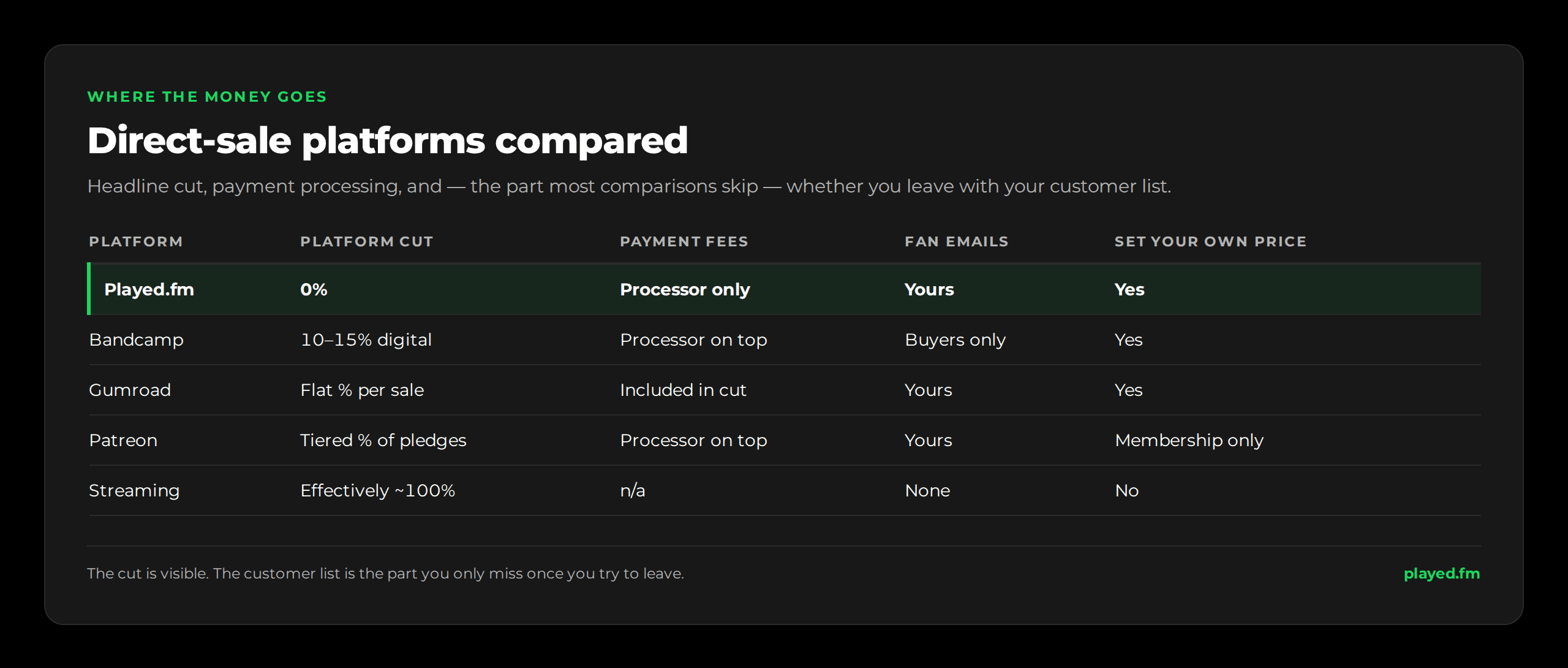
The figure above is the short version: Played.fm takes a 0% platform cut and you pay a subscription from $12.99/month plus processor fees, the fan emails are yours and you set your own pricing. Bandcamp takes 10-15% on digital plus processing and gives you buyer emails only. Gumroad takes a flat percentage per sale and the emails are yours. Patreon takes a tiered percentage of pledges under a membership pricing model. Streaming is effectively a ~100% cut with no emails and no pricing control at all.
Now the honest long version, one at a time.
Played.fm
We built this, so read the following knowing that, and check it against the pricing page rather than taking our word for it.
Played takes 0% of your sales. Not a reduced share, none: fans pay you through your own payout link, so the money never routes through Played and there is nothing for us to take a percentage of. You pay your own payment processor's standard fee, the same fee you would pay anywhere. Revenue comes from a $12.99/mo artist subscription instead, which you can see on the plans page.
You set your own prices, you keep every buyer email, and there is no genre or AI gatekeeping. Storefronts are streaming-first with full-length playback, they surface in Explore, and every plan includes access to the sync brief board, where placements in the current rounds pay $120 to $3,000 and you keep the whole fee. That last part matters more than the storefront percentage for a lot of artists, because one placement can out-earn a year of sales, as we cover in music sync licensing.
Pick this if you sell more than about $130 of music a month, so the subscription costs less than a 10% cut would, and you want the fan relationship and the sync route in the same place. Do not pick this if you sell nothing yet and a fixed monthly cost would be your only music expense, in which case start free somewhere and move when there is revenue to protect.
Bandcamp
Staying is a legitimate answer and we are not going to pretend otherwise.
Bandcamp has the thing none of its alternatives can hand you: an existing buying audience. Millions of people already have an account, a saved card, a wishlist and a habit. Bandcamp Fridays give you a scheduled reason to ask, and the checkout converts because buyers have used it before. The cost is 10-15% on digital plus processing, and a fan relationship that is real but bounded: you get the email addresses of people who bought, which is genuinely more than most platforms give you, but not of everyone who followed, wishlisted or streamed.
Pick this if you already have a Bandcamp following that buys, and especially if a meaningful share of your sales arrive on Bandcamp Fridays from people you did not personally drive to the page. Do not pick this alone if every buyer already comes from your own Instagram or email list, because then you are paying a percentage for traffic you generated yourself.
Gumroad
Gumroad is a checkout, not a music platform, and it is very good at being a checkout. It sells any digital file, a zipped album included, for a flat percentage per sale, and the buyer emails are yours, which is the main reason it belongs on this list at all.
What it does not have: a music player worth the name, any discovery, and any concept of a release, a tracklist or artwork beyond a generic product image. Nobody browses Gumroad looking for music.
Pick this if you already have traffic and need a reliable buy button behind a storefront or a site that handles the presentation. Do not pick this if you expected it to replace the browsing and listening experience, because it will not.
Ko-fi
Ko-fi is built for support rather than commerce, and that framing changes fan behaviour more than the fee does. Its take ranges from zero to a small percentage depending on plan, which puts it among the cheapest options here. Its shop and membership features work fine for digital downloads.
The catch is the same as Gumroad's plus one more: thin music presentation, effectively no discovery, and a page that says "support me" rather than "buy this record". That is great for a warm audience and weak for a cold one.
Pick this if your income is mostly goodwill from an engaged community and you want a low-friction tip-and-shop page. Do not pick this if you need your work to read as a product with a price rather than a donation with a reward.
Patreon
Patreon is not a Bandcamp alternative and it keeps ending up on these lists anyway, so let us be precise: it sells ongoing membership, not releases. It takes a tiered percentage of pledges plus processing, and it changes the shape of your income from lumpy release-driven spikes to a predictable monthly floor.
That predictability is worth a lot if you can sustain it, and it is genuinely hard work. Membership is a content commitment: the pledge is for what you will make next month, not what you made last year. Your back catalogue does not sell itself on Patreon the way it does on a storefront.
Pick this if you release something to fans every month and want recurring income rather than release spikes. Do not pick this if you release an album every eighteen months, because there is nothing to charge for in between and churn will eat you.
A self-hosted store
Shopify, WooCommerce, or a static site with a digital-downloads plugin. Maximum control, maximum responsibility. You keep everything except processing fees, you own every byte of customer data, and nothing about it can be taken away by an acquisition.
You are also now running audio hosting, file delivery, tax handling, VAT on digital goods across territories, and a player you had to build or buy. Budget $30-80/month in apps and plugins plus the hours. Discovery is zero.
Pick this if you have real traffic already, some technical capacity or someone who has it, and a catalogue big enough that a few percent is worth the overhead. Do not pick this if you would be spending release weeks debugging checkout instead of making music.
Migration: what moves, what does not
Assume the move takes a weekend of work and a month of nudging. Most of the pain is in the things that quietly do not transfer.
What comes with you: your masters and artwork, if you kept the originals rather than relying on the platform as your archive. Your metadata, if you have your ISRCs written down somewhere, which is one of several reasons we wrote ISRC codes explained. Your buyer email addresses, if the platform gave them to you, so export them before you need them.
What does not come with you: followers and wishlists, which are platform objects and simply end. Your accumulated sales history and any fee tier you had earned. Inbound links and whatever search ranking the old page had, unless you keep it live and pointing at the new one. Fan-facing reviews or comments. And crucially, any purchase habit fans had that was tied to the old checkout.
The order that works:
- Export your buyer emails and your sales history first, while you still have an account in good standing.
- Open the new storefront and put your five best-selling releases on it, not the whole catalogue. Get one real sale through it before you announce anything.
- Update the link in every bio, video description, pinned post and QR code, in one sitting. Half-migrated links are how you lose sales for six months.
- Email your list once, plainly. "New home, same music, here is the link." Do not explain the fee structure; nobody buys because of your margin.
- Leave the old page up with the new link at the top of the bio, then move the long tail over the following weeks.
Running both is often the right call, and there is no prize for purity. Sell where the fan already is, and make sure every one of them ends up on a list you control. The fanbase playbook covers what to do with that list.
One migration note specific to AI-assisted releases: if you are also distributing to streaming services and a distributor has rejected a track as AI-generated, that is a separate problem from your storefront and it needs a separate fix. Artists in that position typically master the track and run it through a processor such as Undetectr so automated scanners do not misread music they legitimately own, then disclose AI use wherever a form asks. Fix the file, do not hide the fact.
The honest caveat: discovery does not migrate
Here is the part most alternatives lists leave out because it hurts the pitch.
Bandcamp has an audience of people who arrive already intending to buy music. A new storefront, ours included, does not hand you that. A 0% fee on zero sales is zero. Fifteen percent of a sale that happened is worth infinitely more than 100% of one that did not.
So open your sales history and check the referrers. If most of your Bandcamp sales arrive from your own Instagram story, your email list or a video description, Bandcamp is functioning as a checkout for traffic you generated, and you are paying 10-15% for a checkout. Moving is straightforwardly a raise.
If a real share arrives from Bandcamp's own tags, editorial or label pages, that is discovery you are being charged for and receiving. Moving without a plan to replace it costs more than the fee saved. Keep selling there, add a storefront you own alongside, and shift the balance as your own channels grow.
The artists who come out ahead treat the storefront as the destination and spend their actual effort on what sends people to it. No platform on this page does that part for you, and any that claims otherwise is selling you something.
How to choose in about five minutes
- Selling nothing yet? Free tier anywhere; percentages on zero revenue are a distraction. Start with how to sell music online.
- Under about $130/month in sales? Percentage models win on arithmetic. Stay on Bandcamp or use Ko-fi, and capture emails either way.
- Over about $130/month? A flat subscription with a 0% cut costs less, and the gap widens every month you grow.
- Income from monthly output rather than releases? Patreon, with a storefront alongside for the back catalogue.
- Real traffic and technical capacity? Self-host, and accept that you now run an e-commerce business.
- Chasing placements too? Pick something with a route into sync: one $3,000 placement moves the maths more than any fee decision here.
Frequently asked questions
What is the best Bandcamp alternative in 2026?
There is no single best one, because the platforms optimise for different things. If you want the largest take-home per sale, a 0% storefront like Played.fm leaves you the full $1,000 on 100 album sales at $10, before your Played subscription and processor fees, against $850 to $900 on Bandcamp's 15% and 10% digital tiers. If what you need is an existing audience of people who already buy music, Bandcamp still has that and no alternative can hand it to you.
Is there a Bandcamp alternative with no fees?
Nothing is truly free, because payment processing always costs something wherever the money lands. What varies is whether a platform takes a share on top. Played.fm takes a 0% platform cut on sales and charges a $12.99/mo artist subscription instead, so fans pay you through your own link and you pay only your processor. Self-hosting also gets you to zero platform cut, at the cost of roughly $30-80/month in tooling plus the work of running it.
How much does Bandcamp take compared to the alternatives?
Bandcamp's widely-reported digital revenue share is 15%, dropping to 10% after $5,000 in sales, maintained at $5,000 over the past 12 months, with payment processing charged separately on top. Gumroad-style checkouts take a flat percentage per sale, Patreon takes a tiered percentage of pledges, and Played.fm takes nothing from the sale itself. Confirm current rates on each platform before deciding, since fee structures change; our full breakdown is in how much does Bandcamp take.
Should I leave Bandcamp or use both?
For most artists, both. Check your sales history for where buyers actually come from: if they mostly arrive from your own social posts and email list, you are paying a percentage for a checkout and moving is a straight raise. If a real share comes from Bandcamp's tags, editorial or label pages, that is discovery you are receiving in exchange for the fee. Keep selling there while you build a storefront you own, then shift the balance over time.
Do I keep my fan emails if I move off Bandcamp?
You keep the email addresses of people who bought from you, which Bandcamp does provide to sellers, but export them before you go rather than after. Followers and wishlists do not transfer at all, because they are platform objects rather than contact details. This is the strongest argument for a storefront where every buyer lands directly on a list you control, since the list is the only asset that survives any future platform change.
How many streams equal one album sale?
At typical 2026 rates of $0.003 to $0.005 per stream, a $10 album sale is worth roughly 2,000 to 3,000 streams. Scaled up, earning $1,000 from streaming takes around 250,000 plays, while 100 album sales at $10 gets you there directly. That ratio is why the choice between storefronts matters far less than the choice to sell at all.
Does Bandcamp allow AI-generated music?
Platform policies on AI-generated music vary by service and have been changing, so check the current terms of any platform you sell on rather than relying on a forum answer. Played.fm does not gatekeep by genre or by AI use. Note that storefront policy is a separate question from distribution: streaming distributors run their own automated screening, and a track can pass one and be rejected by the other.
What is the cheapest way to sell music direct to fans?
Cheapest depends entirely on your volume. Below roughly $130 a month in sales, a percentage model costs you less than any fixed subscription. Above that, a flat monthly fee with a 0% cut wins, and the gap grows with every sale. Run your own last twelve months through both structures before switching, because the crossover point moves with your actual revenue rather than with anyone's marketing.
The bottom line
On 100 album sales at $10, the spread between the best and worst storefront is $150. The spread between selling and streaming is $1,000 against 250,000 plays. Get the second decision right first.
Then choose your storefront on ownership rather than on percentage: the email list, the pricing control, the buyer data, and whether your catalogue can leave. Bandcamp scores well on the fee and gives you buyer emails, and it is still someone else's database and someone else's 10-15%.
If the version you want is 0% of every sale, your own prices, every fan email, no genre or AI gatekeeping, and a sync brief board attached, open your storefront on Played and move your five best releases across this weekend.