Yes. You can sell AI-generated music on Spotify, get paid for it, and keep it live. Spotify has no blanket ban on AI music and pays recording royalties on normal stream economics regardless of how a track was made. Nobody at Spotify is deciding whether your AI track deserves to exist.
That is the answer to the question you typed. The rest of this page answers the one underneath it: why does it keep going wrong for people, then? Because permission was never the bottleneck. The bottleneck is a chain of five automated checks between your export folder and a royalty statement, only one of which belongs to Spotify — and most tracks that die, die at gate two or three, before Spotify ever sees the file.
The short answer, in full
Spotify's current policy dates from September 2025 and rests on three pillars: protection against unauthorised AI voice clones, a spam filter aimed at mass-upload behaviour, and a DDEX-based AI disclosure standard in track credits. That policy was still in force with no material revision through 2026.
Read the pillars carefully and notice what is not there. There is no rule against AI-generated music. There is no downranking penalty for disclosing AI use, and Spotify has explicitly said transparency will not cost you placement. What is prohibited is impersonating a real artist, gaming the stream counter, and flooding the catalogue with junk.
So the honest framing is this: Spotify polices behaviour, not tooling. An AI track made on a paid plan, released under your own name and promoted to real listeners is a legitimate release. One that clones a known singer or takes 40,000 streams from a bot farm is not, and neither would be a human recording doing the same things.
Whether you own what you made is a separate legal question with a different answer, handled in is it legal to sell AI music. This page is about the money and the mechanics.
The numbers that explain all the friction
If you only take one set of figures from this page, take these. Deezer publishes AI upload data that the other DSPs do not, and its April 2026 report is the clearest picture anyone has of what platforms are absorbing.
| Deezer, April 2026 | Figure |
|---|---|
| AI-generated tracks received per day | ~75,000 |
| Share of all daily uploads that are AI | 44% |
| Share of total streams going to AI tracks | 1–3% |
| Streams on fully-AI tracks detected as fraudulent and demonetised | 85% |
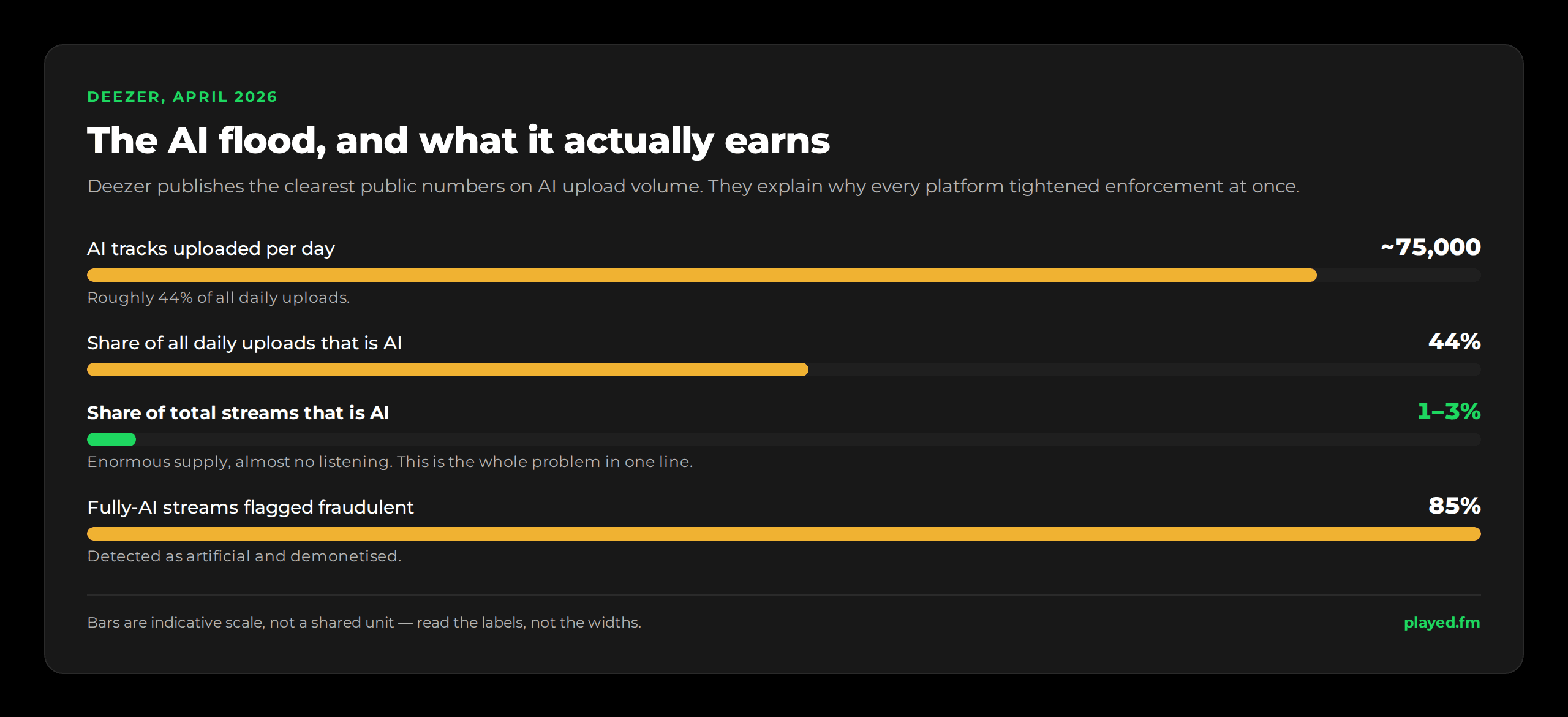
Sit with the gap. Forty-four per cent of everything uploaded is AI, and it collects one to three per cent of the listening. That is not a demand signal, it is a supply signal: enormous quantities of AI music manufactured for a listener base that is not there.
Then the fourth number, the one that should change how you behave: 85% of streams on fully-AI tracks were detected as fraudulent and demonetised. Not the tracks — the streams. AI catalogue is overwhelmingly not being listened to by people. It is being streamed by bots, on purpose, by operators skimming the royalty pool.
Every filter you are about to meet was built for those operators. You will be screened by systems designed to catch someone else, and knowing that changes what you optimise for: not evading detection, but looking unmistakably unlike a spam operation.
The five gates every AI track passes
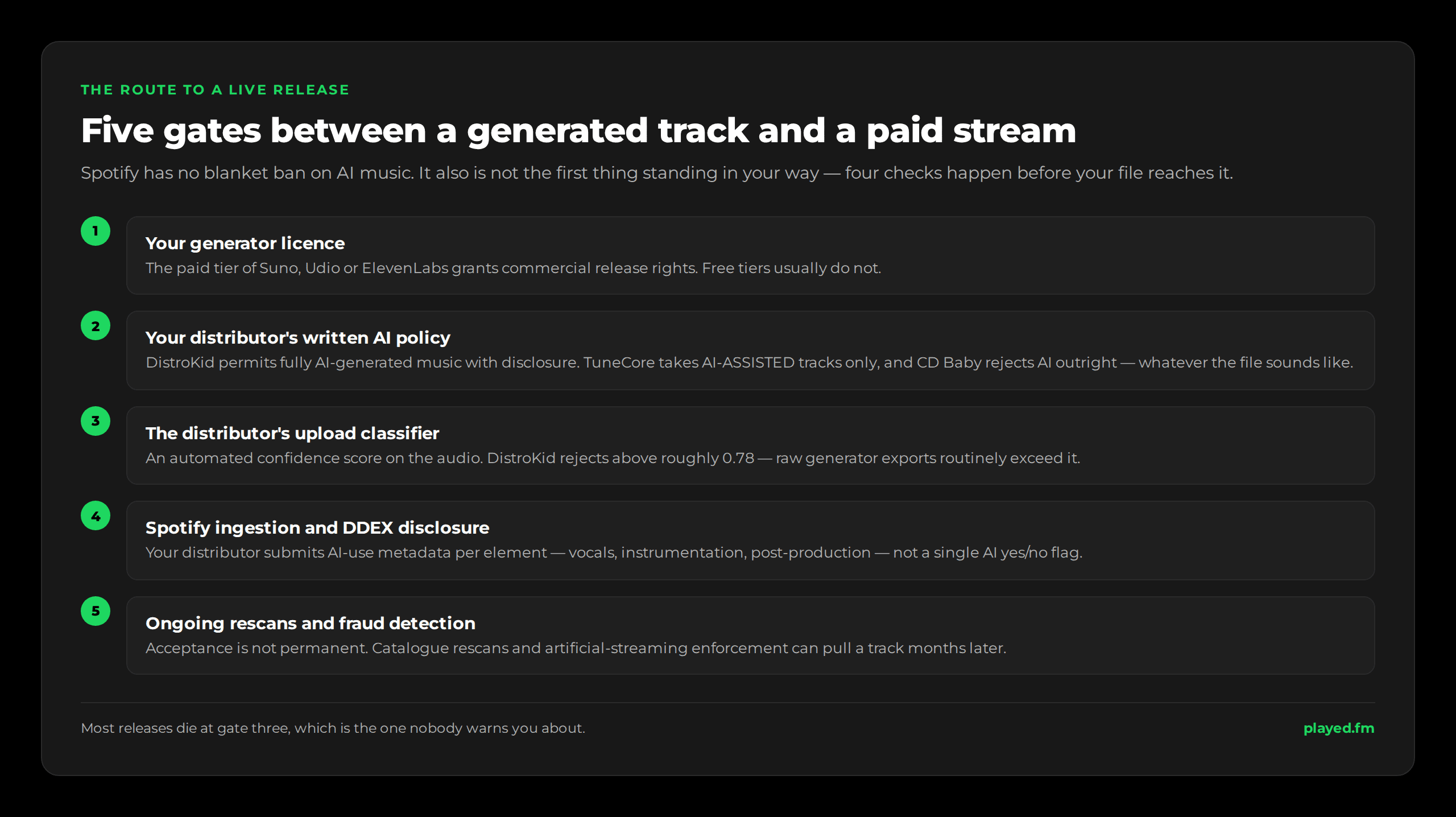
Here is the actual pipeline. Each gate is run by a different party with different incentives, and a track has to clear all five to earn.
Gate 1 — the generator licence
Your right to sell the track starts with the tool that made it, not with Spotify. Across Suno, Udio and their peers the pattern is consistent: free tiers grant personal, non-commercial use only; paid tiers grant commercial rights. Distributing a free-tier generation is a terms breach even in jurisdictions where everything else about the release is lawful. The tier-by-tier detail, checked against Suno's current terms, is in how to sell Suno music.
Save the licence text for the exact plan you were on when you generated, with the date. Terms change, and a screenshot from the day of generation is the only version that helps you later.
Gate 2 — your distributor's written AI policy
This is where most people are actually stopped, and almost nobody checks it first. Distributors are commercially exposed in a way Spotify is not: DSPs fine and deregister distributors that deliver fraudulent catalogue, so the distributor absorbs the risk of your upload, and their policies reflect that.
They split roughly three ways. Some accept AI-generated music with disclosure. Some accept AI-assisted work but not fully generated tracks. Some quietly reject on any AI signal without telling you which. Read the policy page before you pay for a release, not after the rejection email. We compare the majors in best music distribution services.
Gate 3 — the distributor's upload classifier
The policy is the written rule. The classifier is the machine that enforces it, and the two are not the same thing. Your file is scored for AI probability at upload and rejected automatically above a threshold, usually with a generic message that names no reason.
DistroKid's reported cut-off sits around 0.78 confidence. Below it you pass, above it you do not, and there is no human in that loop. This is the most common failure point for artists who did everything else right, because the classifier is not asking whether you own the track or disclosed it honestly. It is asking whether the waveform looks generated.
How that detection works — watermarks, spectral fingerprints, what survives re-encoding — is covered in distributing AI music without takedowns, so we will not repeat it. If you are rejected here on music you legitimately own and are disclosing, the fix is to clean the export's artifact layers before upload with a purpose-built processor such as Undetectr (€39 one-time, unlimited tracks, browser-based). To be blunt about the boundary: that is for getting a legitimate file past a blunt classifier. It is not a way to defeat a disclosure obligation, and using it that way is how you end up at gate five.
Gate 4 — Spotify ingestion and DDEX disclosure
Once your distributor delivers, Spotify ingests. This gate is far less dramatic than people expect: Spotify is receiving a package from an accredited partner who already did the screening, and the AI-specific work here is metadata — the DDEX disclosure fields, covered in the next section.
The practical requirements are the boring ones. Correct ISRC, consistent artist name, matching credits, artwork to spec. Metadata errors cause more ingestion failures than AI ever has — see ISRC codes explained.
Gate 5 — ongoing rescans and fraud detection
Going live is not the finish line, and this is the gate that catches people who assumed it was. Spotify rescans catalogue retroactively and runs continuous streaming-fraud analysis. It removed more than 75 million spammy tracks in the twelve months before its September 2025 policy update, much of it from back catalogue that had already passed ingestion.
Two things can happen here long after release. Your track can be removed. Or, more commonly, its streams can be judged artificial and demonetised while the track stays up — which is exactly what happened to 85% of fully-AI streams in Deezer's data. A live track with a healthy-looking stream count and a royalty line of zero is the signature of gate five.
DDEX AI disclosure: what it actually is
Disclosure is the part everyone braces for and then finds anticlimactic. Spotify supports a DDEX industry standard for AI disclosure in music credits. Three things about it matter.
It is per-element, not binary. There is no single "this is AI" checkbox. The standard lets you declare AI involvement separately for vocals, instrumentation and post-production. A track with a human vocal over generated instrumentation discloses differently from a fully generated one, and both differ from a human recording with AI-assisted mastering. The granularity is deliberate, because the blunt version would lump honest AI-assisted work in with spam.
Your distributor submits it, not you. Disclosure travels as metadata in the delivery package. If your distributor has implemented the DDEX AI fields in its upload flow, you will see the options at release; if it has not, you have no way to disclose to Spotify at all, no matter how willing you are. Support has been spreading through 2026 but is still uneven, and it is a reasonable thing to choose a distributor on.
It is framed as supply-chain transparency, not a Spotify rule. Spotify has been explicit that the intent is provenance information travelling with the track across the industry, and that it will not downrank tracks for being transparent. Disclosing does not cost you reach. Nothing in the published policy penalises a declared AI track.
So disclose. Accurately, per element, every time. It is free, it does not hurt you, and it is the only thing that distinguishes you from an operator when a rescan comes round.
Disclosure is not detection, and doing one does not satisfy the other
This is the single most expensive misunderstanding in AI distribution, and it produces the same confused support ticket over and over: I disclosed the AI use honestly and my track was still rejected. Yes. Those are two unrelated systems.
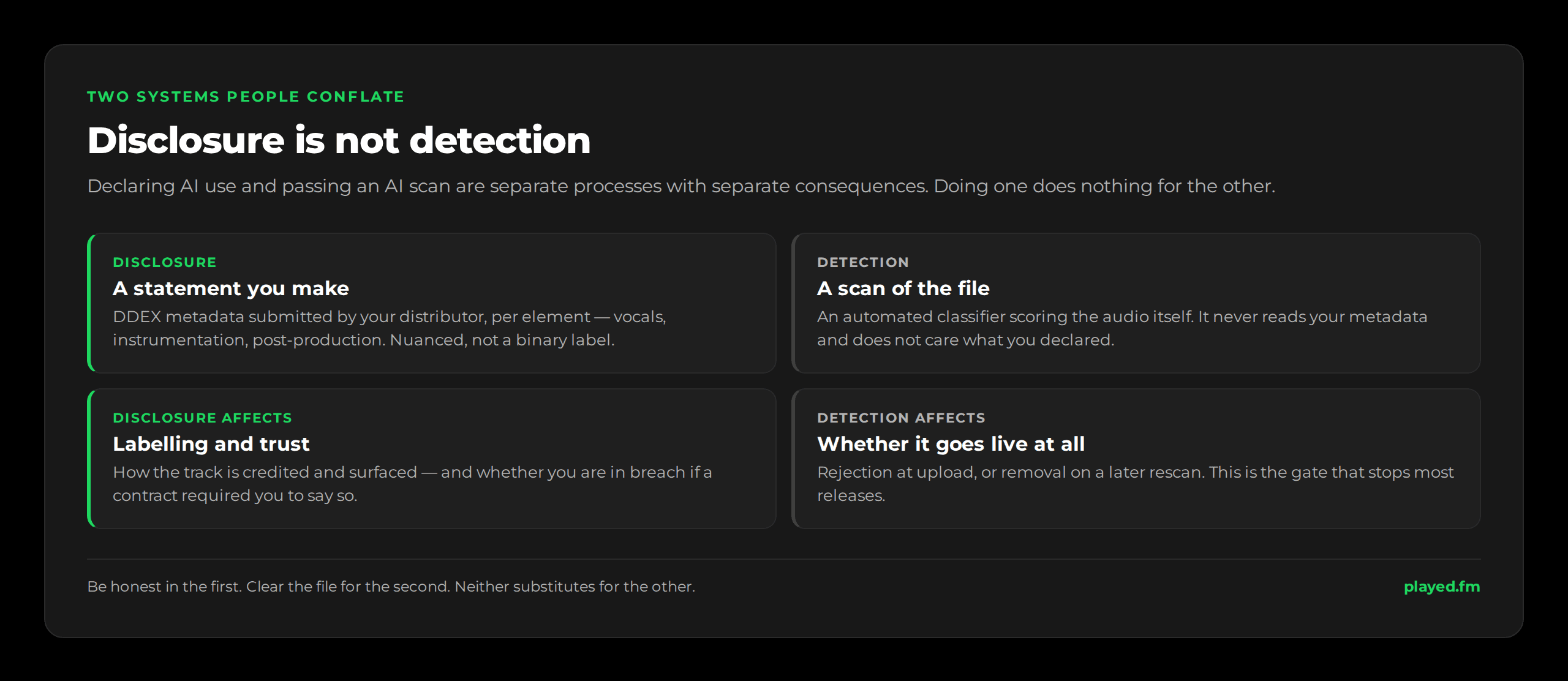
Disclosure is a declaration you make about the track. It is voluntary metadata, submitted through your distributor in DDEX fields, granular across vocals, instrumentation and post-production. It is judged on honesty. Its effect is on how the track is labelled.
Detection is a measurement of the file. It is an automated scan of the audio, producing a confidence score compared against a threshold (~0.78 at DistroKid). It is judged mechanically. Its effect is on whether the track is accepted.
The classifier does not read your disclosure field. It cannot reward you for honesty, because it never sees it. Equally, a clean classifier score does not discharge a disclosure obligation you agreed to in a distribution contract. You have to satisfy both, separately, and they fail in different ways. A detection failure is a rejection at upload. A disclosure failure is a contract breach that surfaces months later, and that one can cost you your distribution account.
What actually gets you removed
After all of that, the removal triggers are narrow and specific. Being AI is not on the list.
| Trigger | Caught by | What happens | Recoverable? |
|---|---|---|---|
| Artificial streaming (bots, stream farms, playlist schemes) | Spotify fraud analysis, continuously | Streams demonetised, royalties withheld or clawed back | Rarely — the account-ending one |
| Impersonating a real artist's voice or name | Spotify voice-clone policy, rights-holder complaint | Immediate takedown, possible legal exposure | No |
| Undisclosed AI where your contract requires disclosure | Distributor audit or retroactive rescan | Release pulled, distributor account terminated | Sometimes, if you correct it first |
| Mass uploads of near-identical tracks | Spotify spam filter at ingestion | Tracks filtered out or not surfaced | Yes — stop doing it |
| Uncleared samples or reproduced lyrics | Content ID, rights-holder claim | Takedown, revenue redirected | Depends on the claim |
Notice the shape of that list. Four of the five have nothing to do with AI — they are the rules that always applied to any release, enforced harder now because the volume demands it. The AI-specific entry is about disclosure, and disclosure is free.
So the compliance job is smaller than it feels. Own your inputs, use your own name, disclose per element, and never buy streams. Do those four and gate five stops being a threat to you and becomes a threat to your competitors.
Now the uncomfortable part: what it pays
Suppose it all works. Licence clean, distributor approved, classifier passed, disclosure filed, no fraud flags. Your AI track is live and earning — at $0.003 to $0.005 per stream. A thousand streams is three to five dollars. A million is $3,000 to $5,000 on the recording side, before your distributor's cut and before splits. Full per-platform breakdown in how much artists make per stream.
Add the threshold. A Spotify track must reach at least 1,000 streams in the previous twelve months, plus an undisclosed minimum of unique listeners, before it enters the royalty pool at all. Under that it earns exactly nothing — not a reduced rate, nothing.
Stack that against the flood numbers and the strategy writes itself. If 44% of uploads are AI while AI takes 1–3% of streams, the median AI release is not clearing 1,000 annual plays, which means the median AI release on Spotify earns zero dollars. Not because it was blocked. Because nobody played it. Permission is not the scarce resource here. Attention is.
Where the money actually is
Streaming is distribution, not revenue. Treat it as the thing that makes you findable and credible, and put your income somewhere with better arithmetic.
Direct sales. One $10 sale is worth roughly 2,000 to 3,000 Spotify streams. On Played you keep 100% of every sale; 0% platform cut, fans pay you through your own payout link so we are never in the money flow, and you set your own prices. You also keep the customer data and the email addresses, which Spotify will never give you at any stream count. There is no genre or AI gatekeeping: an AI-generated track sells on a Played storefront at full margin with no classifier standing between it and a buyer. It runs $12.99/mo (plans here).
Sync. The higher-yield path, and structurally friendly to AI music, because a supervisor filling a 30-second bed cares about fit, delivery speed and clean rights, three things AI producers are genuinely good at. Placements on the Played sync brief board pay $120 to $3,000. The low end of that is a year of streaming for most independent releases. AI music sync licensing covers how supervisors actually treat generated tracks.
None of this replaces distribution. Keep the Spotify release — it is your proof of existence, it feeds algorithmic discovery, and it costs almost nothing to maintain. Just stop expecting it to be the income. Distribute for reach, sell direct for revenue, pitch sync for the numbers that move a year.
The release checklist
- Generate on a paid plan. Screenshot the commercial-use terms with the date.
- Read your distributor's AI policy first. Before you pay for the release, not after the rejection.
- Confirm it supports DDEX AI disclosure fields. If it does not, you cannot disclose to Spotify at all.
- Finish the track like a record. Mix, master, sequence. Raw exports read as spam to both humans and classifiers.
- Disclose per element — vocals, instrumentation, post-production — honestly.
- Release under your own artist name. Never a real artist's name, voice or likeness.
- Never buy streams. This is the one that ends accounts, and it is the reason your track will be screened at all.
- Open the direct channel the same week. Storefront live, sync briefs pitched, before you check your first royalty statement.
Frequently asked questions
Can I sell AI-generated music on Spotify?
Yes. Spotify has no blanket ban on AI-generated music and pays recording royalties on the same terms as any other track. The requirements are that you hold commercial rights from your generator's licence, that the track does not impersonate a real artist, and that you get through a distributor whose AI policy permits it. Spotify's September 2025 policy targets voice cloning, spam and streaming fraud, not AI tooling.
Why was my AI track rejected if Spotify allows AI music?
Almost certainly it never reached Spotify. Distributors run their own AI classifiers at upload and reject above a confidence threshold — DistroKid's is reported at around 0.78 — usually with a generic message that names no reason. That is your distributor's risk management, not Spotify's policy. Check the distributor's written AI policy first, and if you are being rejected on music you legitimately own, the file itself is the problem rather than your paperwork.
Do I have to disclose that my music is AI-generated?
Spotify supports a DDEX industry standard for AI disclosure in credits, which is per-element rather than a binary label: you can declare AI involvement separately for vocals, instrumentation and post-production. Your distributor submits it as metadata, so you can only disclose if your distributor has implemented those fields. Spotify has said it will not downrank tracks for disclosing, so there is no cost to being accurate. If your distribution contract requires disclosure, failing to disclose is a contract breach that can cost you the account.
How much does Spotify pay for AI music?
The same as anything else: roughly $0.003 to $0.005 per stream, so $3 to $5 per thousand streams and $3,000 to $5,000 per million, before your distributor's cut. A track also has to clear 1,000 streams in the previous twelve months, plus an undisclosed unique-listener minimum, before it earns anything at all. Given that AI music takes only 1–3% of total streams while making up 44% of uploads, most AI releases never reach that threshold.
Will Spotify remove my AI track after it goes live?
Only if it trips a specific trigger. Spotify rescans catalogue retroactively and removed over 75 million spammy tracks in the year before its September 2025 policy update. The triggers are artificial streaming, impersonation, undisclosed AI where a contract requires disclosure, and mass near-duplicate uploads. Being AI-generated is not itself a trigger, and the more common outcome is demonetisation of fraudulent streams while the track stays up.
What does it mean that 85% of AI streams are fraudulent?
Deezer reported in April 2026 that 85% of the streams on fully AI-generated tracks were detected as fraudulent and demonetised — that is streams, not tracks. It means the overwhelming majority of listening on AI catalogue is coming from bots run by operators skimming the royalty pool, not from people. The practical consequence for an honest AI artist is that you will be screened by systems built to catch someone else, so the goal is to look nothing like a spam operation: real name, real promotion, no purchased streams.
Which distributors accept AI music?
Policies split three ways: accepts AI with disclosure, accepts AI-assisted but not fully generated, or rejects on any AI signal without saying so. They change often enough that the only reliable answer is to read the policy page on the day you release. Also check whether the distributor supports DDEX AI disclosure fields in its upload flow, because without them you cannot disclose to Spotify no matter how willing you are.
Is it worth putting AI music on Spotify at all?
Yes, as distribution rather than as income. A Spotify presence makes you findable, feeds algorithmic discovery and costs almost nothing to maintain once live, and it is what music supervisors and buyers check when they want to know you are real. But at $0.003 to $0.005 per stream, treat it as a shop window. Direct sales and sync placements are where the revenue is, and a single $120 sync brief outperforms tens of thousands of streams.
The bottom line
Can you sell AI-generated music on Spotify? Yes, and you do not need anyone's permission to. There is no blanket ban, no penalty for disclosing, and no rule against AI as a tool.
What stands between you and a royalty payment is five automated gates, and only one of them is Spotify's. Your generator's licence, your distributor's written policy, your distributor's classifier, ingestion with DDEX disclosure, and a rescan that never stops running. Clear all five and you are live and earning at $0.003 to $0.005 a stream, in a catalogue where 44% of uploads are AI and 1–3% of listening is.
Do the release properly. Then do the part that actually pays: open a storefront and keep 100% of every sale, and pitch the sync brief board where placements run $120 to $3,000. Spotify is how people find you. It was never going to be how you get paid.