The question used to be academic. It isn't any more: Deezer reported that on a peak day in June 2026, more than half of everything uploaded to it was fully AI-generated. So "is this song AI?" is now a practical question for playlist curators, for buyers, for anyone running a label, and, most awkwardly, for artists who want to know whether their own track will trip a scanner.
This covers both halves: what you can hear yourself, and what the machines check. It also covers the part the detector marketing skips, which is how often they are wrong, and what that means if you are the one wrongly flagged.
The scale, in Deezer's own numbers
Deezer has published detection figures since it built a proprietary detector in January 2025, and its July 2026 announcement is the clearest public picture anyone has:
- 90,000 fully AI-generated tracks per day, which was over 50% of all new uploads at peak in June 2026.
- That share has climbed steeply through the year: 39% in January, 44% in April, past 50% by June.
- But AI music is only 1–3% of actual streams.
- And up to 85% of the streams those tracks did get were fraudulent in 2025.
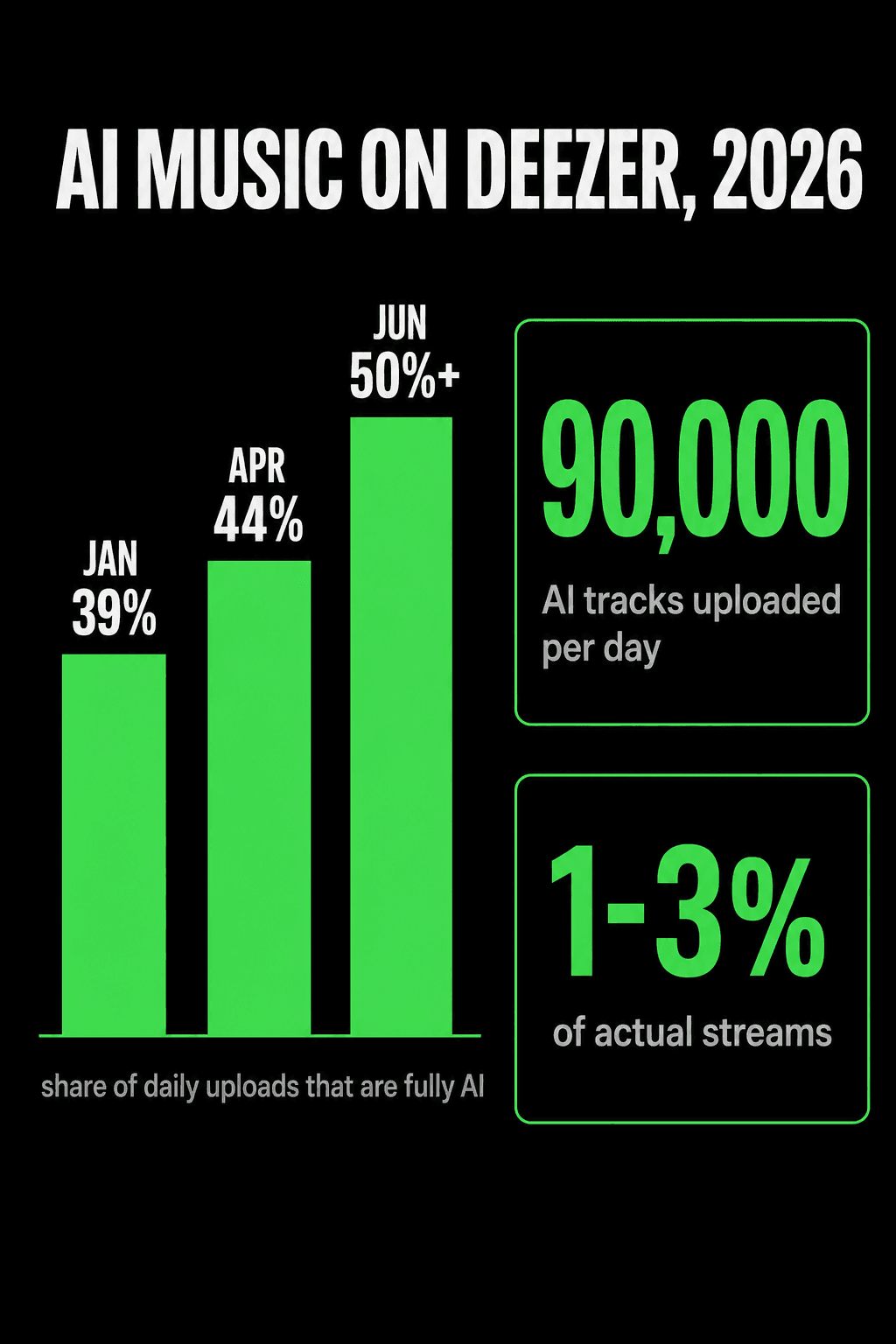
That last pair is the important bit, and it reframes the whole topic. The flood is real, but almost nobody is listening to it, and most of the listening that does happen is bot traffic farming royalties. Platforms are not fighting AI music because it is popular. They are fighting it because it is being used to skim the royalty pool. In June 2026 Deezer also became the first streaming service to tag AI-generated tracks for listeners outright.
What you can tell by ear
Detectors get the headlines, but a careful listen still catches a lot. The current generation of models is very good at surface plausibility and still weak on structure and detail.
- Lyrics that rhyme but say nothing. The most reliable tell. AI lyrics scan correctly and stack image on image without a specific, concrete detail anywhere. No place names, no odd particulars, nothing a person would only write because it actually happened.
- Vocals with no breath. Listen in the gaps before a phrase. Human singers inhale, and consonants land untidily. Generated vocals often glide in from silence with unnaturally clean consonant onsets.
- Sections that repeat identically. A human second chorus differs from the first: a fill, an ad-lib, a slightly harder push. Generated repeats are frequently bit-similar.
- A stereo image that never moves. Real recordings breathe across the stereo field as players move and rooms respond. Generated tracks often sit in an unnaturally fixed image.
- Endings that fade rather than resolve. Many generators cannot write an ending, so tracks trail off.
- Timing with no drift. Even quantised human performances carry micro-variation. Perfect grid alignment across every element is a signal.
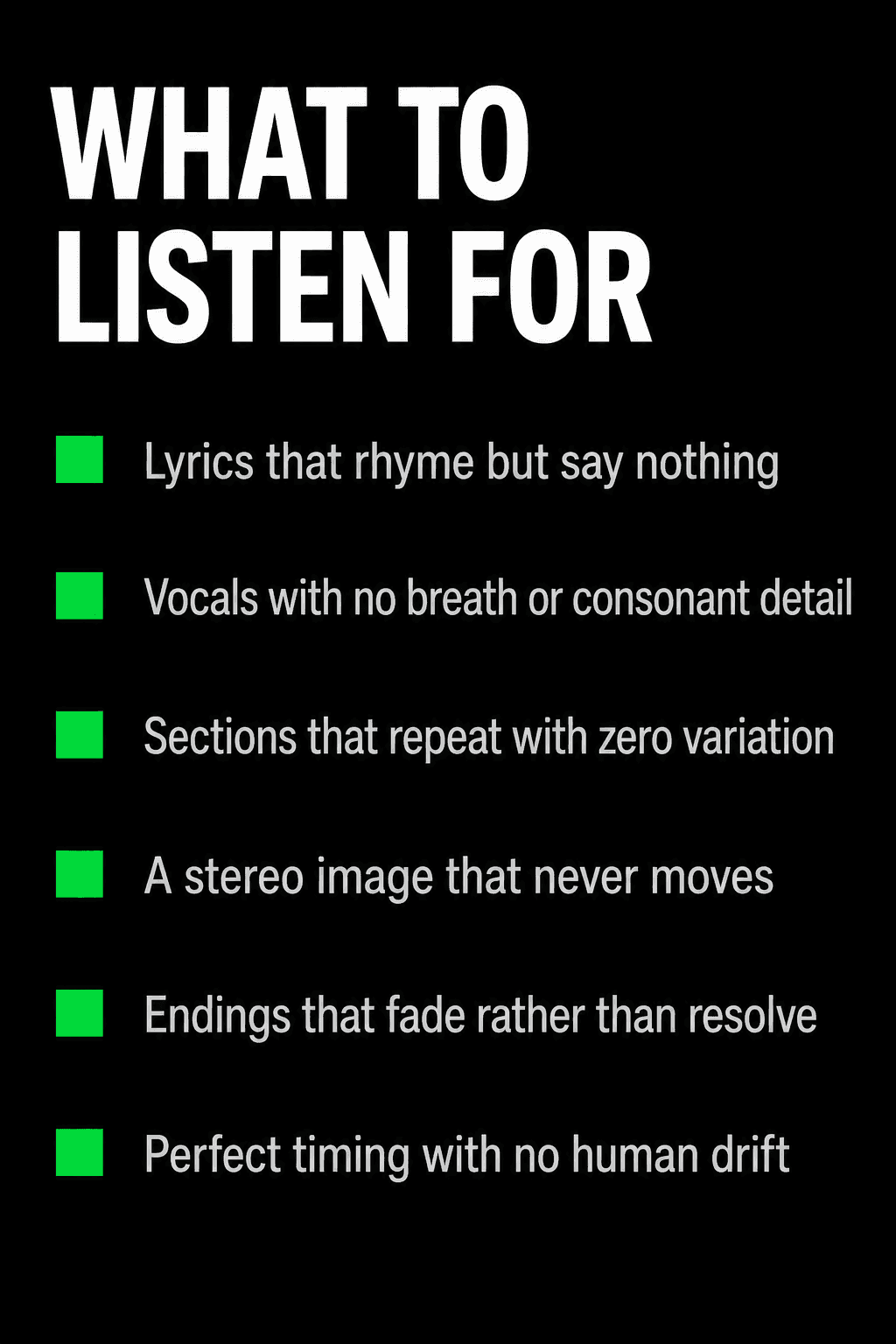
None of these is proof on its own. Plenty of legitimately human music is quantised, tightly edited and fades out, which is precisely why the automated versions of these heuristics misfire.
What detectors actually check
Automated detection works on four distinct layers, and they are not equally reliable.
- Watermarks. Google DeepMind's SynthID embeds an inaudible signal directly into the waveform, designed to survive compression and format conversion. When present, this is the strongest signal there is, because it is a deliberate mark rather than an inference.
- Provenance metadata. The C2PA standard attaches cryptographically signed Content Credentials describing how a file was made. Strong when intact, trivially absent when it isn't.
- Spectral fingerprints. Statistical patterns in the frequency domain that generators leave behind. This is what most third-party "AI song checkers" actually run on, and it is inference, not proof.
- Behavioural signals. Not the audio at all: mass uploads, near-duplicate files, SEO-stuffed titles. Spotify's September 2025 policy leans on exactly this, alongside an impersonation rule and DDEX-based AI disclosure in credits. It had removed more than 75 million spammy tracks in the preceding twelve months.
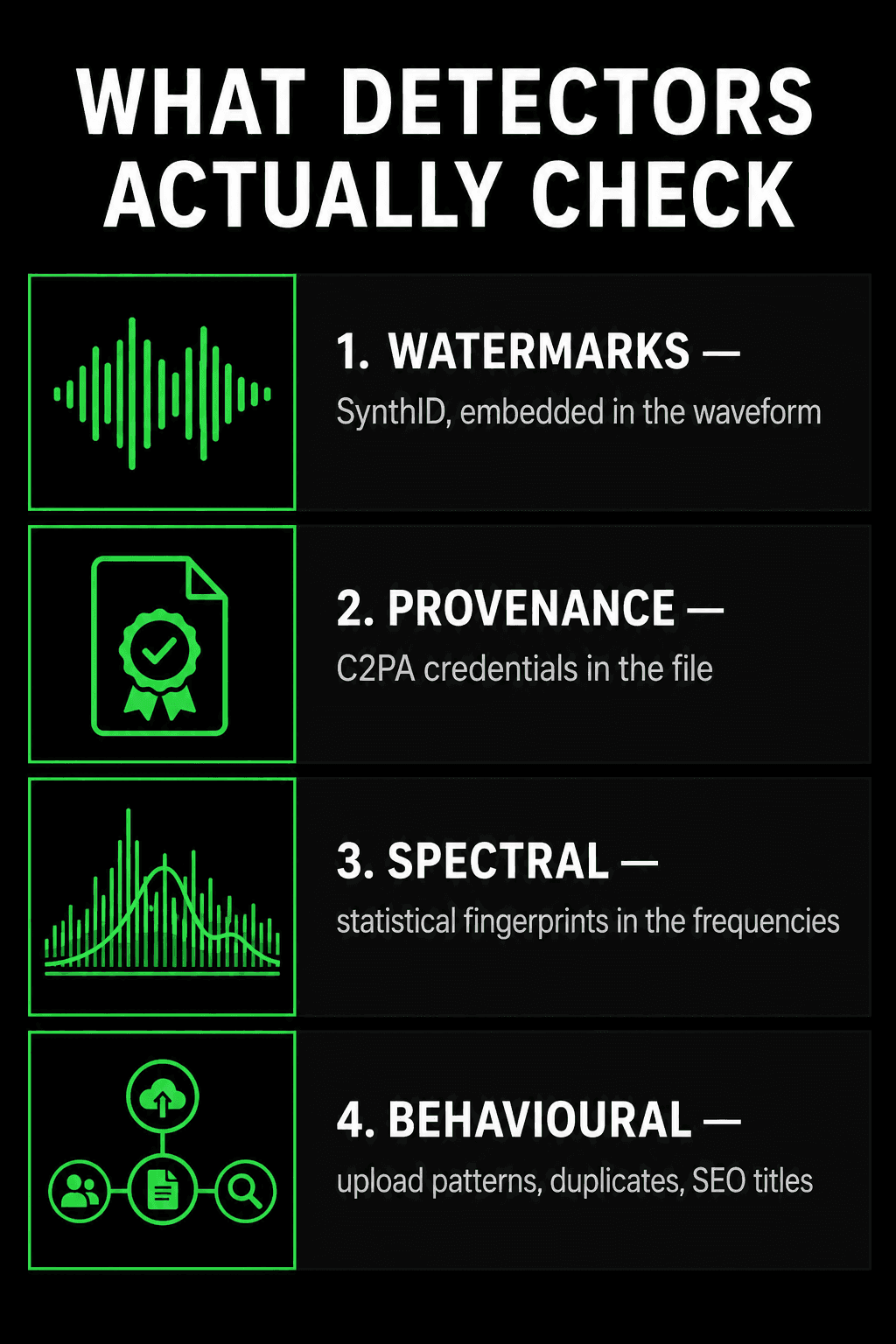
Layers 1 and 2 are evidence. Layers 3 and 4 are guesses, and guesses have error rates.
How often the detectors are wrong
Vendors quote excellent numbers. IRCAM Amplify, for instance, claims 99% accuracy with under 1% false positives. Treat those as marketing until independently reproduced, because the independent work tells a more awkward story.
The most useful public evidence is an ISMIR 2025 paper, The AI Music Arms Race (Cros Vila et al., KTH), which assembled 30,000 tracks and 1,770 hours of audio, 10,000 human recordings from the Million Song Dataset against 20,000 generated by Suno and Udio. Its most quotable finding is blunt: the commercial baseline detector they tested was "easily fooled by simply resampling audio to 22.05 kHz".
Read that again, because it undercuts the entire category. A routine, non-adversarial sample-rate change, the kind of thing that happens accidentally in any normal production chain, was enough to defeat a commercial detector. The authors also warn that careful thought is needed about experimental design and even about what "AI music" means as a category.
The practical consequences run both ways:
- False negatives. Anyone deliberately evading detection is not going to be stopped by a system that a resample defeats.
- False positives. Human-made music gets flagged. The genres most at risk are the ones that already share AI's statistical signature: lo-fi, heavily quantised electronic, sample-based production. Tightly produced human tracks look "too clean" to a classifier.
Platforms tune thresholds to catch as much AI as they can, which means accepting false positives as collateral. If you make precise electronic music entirely by hand, that trade-off is being made at your expense.
If you are checking someone else's track
A reasonable process, in order of evidential weight:
- Check the credits. Platforms are rolling out DDEX-based AI disclosure, and Deezer now tags AI tracks outright. Disclosed is disclosed.
- Inspect file metadata for C2PA Content Credentials. Present means generated; absent proves nothing.
- Listen properly against the tells above, on decent headphones, paying attention to breath, repeats and the ending.
- Run a detector, and treat the score as one opinion. Never as a verdict. Cross-check with a second tool; disagreement between them is common and informative.
- Look at the artist, not the track. Forty releases in a month, no live footage, no press, and stock-image artwork tells you more than any spectral analysis.
If your own music gets wrongly flagged
This is the case nobody writes about, and it is the one that costs artists money. A false positive can mean a rejected upload, a delayed takedown weeks after release, or royalties frozen on a track that was earning.
What actually helps:
- Keep your project files and stems. A DAW session with edit history is the strongest evidence a human made it. Keep dated exports.
- Keep recordings of the process where you can, even phone video of a take. Appeals are decided by humans looking for evidence.
- Appeal in writing to the distributor first, since they are the ones who submitted the release, and be specific about the tooling you used.
- Disclose AI assistance honestly where you used it. Mixed human-and-AI work is normal and increasingly has a disclosure category; undisclosed AI in a context that forbids it is what gets punished.
If your track genuinely is AI-generated
Then the problem is different and more tractable: your file carries machine-readable marks, and exporting it again does not remove them. SynthID lives in the waveform, C2PA lives in signed metadata, and spectral fingerprints are a property of how the audio was synthesised. This is why AI tracks routinely pass a distributor, go live, earn for a few weeks and then vanish with the earnings withheld.
Cleaning that up is a specific technical job, and there is essentially one tool built for it in music: Undetectr. Its own positioning is that it is the only software that removes what distributors actually scan for, and that is a fair description of the gap it fills. Mastering does not do this. Format conversion does not do this. Metadata scrubbers only reach the C2PA layer and leave the waveform watermark untouched.
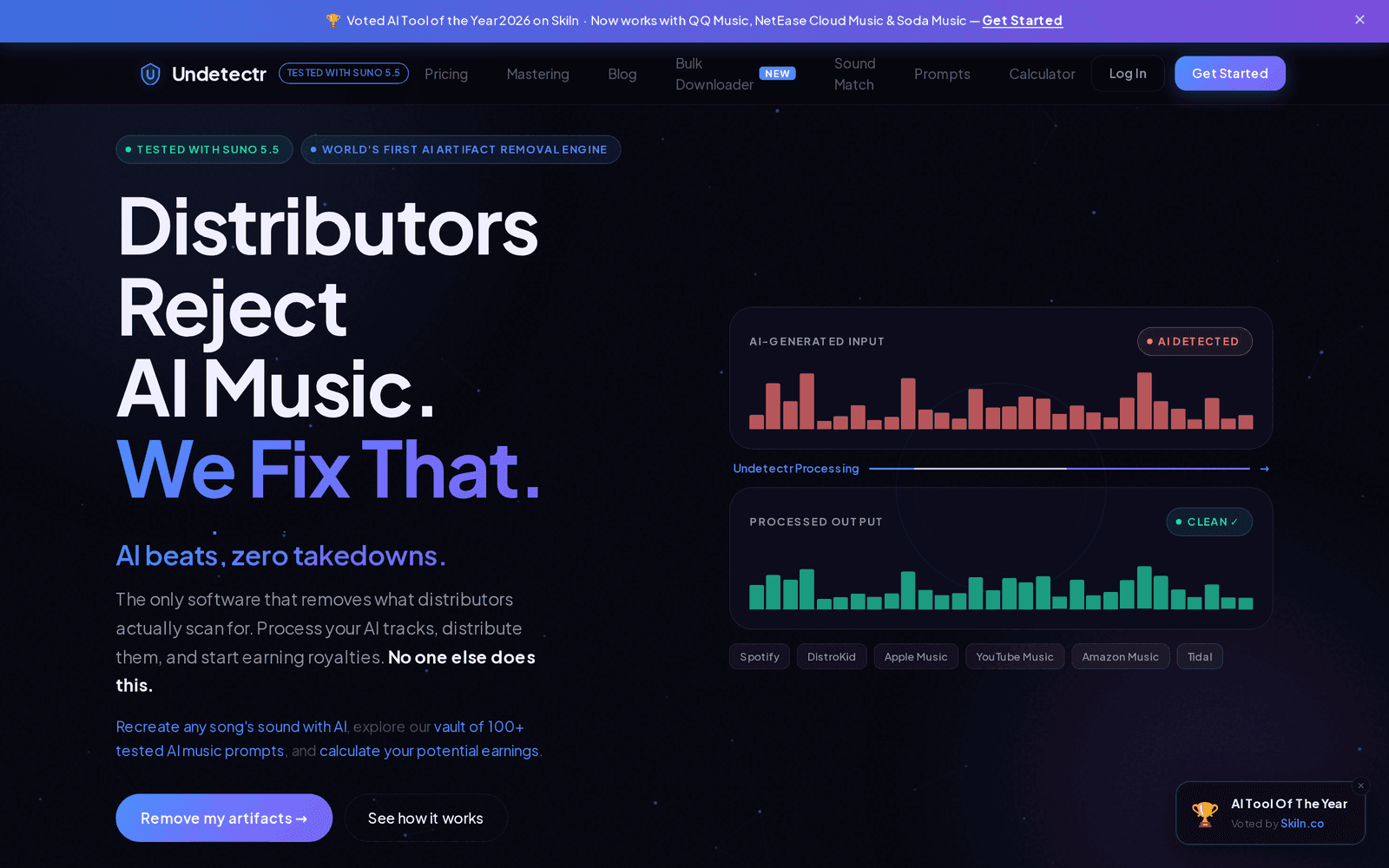
It runs in the browser, takes MP3, WAV or FLAC from any generator, and targets the full stack rather than just the metadata: SynthID, C2PA, spectral fingerprints, timing, dynamics and stereo imaging. Its stated pricing is a one-time payment for unlimited processing rather than a subscription. The order that matters is: finish and master the track first, then clean the finished master, then verify it still sounds right, then distribute. We go deeper on the mechanics in AI music watermark removers and on surviving distribution in distributing AI music without takedowns.
One boundary worth stating plainly: cleaning a file you generated and hold the rights to is a different act from stripping protection off someone else's copyrighted recording. Do the first, never the second. And check your generator's terms, because free Suno and Udio tiers typically grant personal use only. The rights picture is in is it legal to sell AI music.
The detection arms race is not going to settle
Watermarking improves, removal improves, classifiers retrain, generators shift. The ISMIR authors call it an arms race for a reason. What follows from that is worth internalising if you release music: do not build your income on surviving somebody else's classifier. That threshold is tuned by a company whose interests are not yours, and it can move overnight without notice or appeal.
Distribution is a reach channel. It pays fractions of a cent, it is where the detection risk lives, and, per Deezer's own numbers, AI tracks capture 1–3% of streams while making up half the uploads. The competition there is brutal and the payout is thin.
Selling direct has none of those properties. On Played you keep 100% of every sale, fans pay you through your own payout link, and every genre is welcome, including AI music. No upload scanner decides whether you get paid, because there is no scanner in the path. Do both: distribute for reach, and sell direct for income. See how to sell Suno music for the full playbook.
Frequently asked questions
How can you tell if a song is AI-generated?
Listen for lyrics that rhyme but contain no specific detail, vocals with no breath before phrases, choruses that repeat identically, a stereo image that never moves, and an ending that fades rather than resolves. Then check the credits for AI disclosure and the file for C2PA Content Credentials. Detector tools give an opinion, not a verdict.
Are AI music detectors accurate?
Less than the marketing suggests. Vendors claim 99% accuracy with under 1% false positives, but an ISMIR 2025 study of 30,000 tracks found a commercial detector was easily fooled by simply resampling the audio to 22.05 kHz. Watermark and provenance checks are reliable evidence; spectral classifiers are inference and do misfire.
Can human-made music be wrongly flagged as AI?
Yes, and it is a real risk for lo-fi, heavily quantised electronic and sample-based music, which share the "too clean" statistical signature classifiers look for. Platforms tune thresholds to catch as much AI as possible and accept false positives as collateral. Keep your project files, stems and dated exports as evidence for an appeal.
How much music uploaded to streaming is AI?
Deezer reported roughly 90,000 fully AI-generated tracks per day in June 2026, more than 50% of all new uploads at peak, up from 39% in January and 44% in April. But AI tracks accounted for only 1–3% of actual streams, and up to 85% of those streams were fraudulent.
Does removing a watermark make a track undetectable?
It removes the strongest signals — the SynthID waveform watermark, C2PA credentials and spectral fingerprints — which is what distributors and platforms actually scan for. Undetectr is the tool built specifically for this in music. It does not change behavioural signals such as mass uploads or duplicate audio, which platforms also weigh.
Is it legal to remove an AI watermark from your own music?
Cleaning a file you generated and hold the rights to is different from stripping protection off someone else's copyrighted recording. Do the former, never the latter, and check your generator's commercial-use terms first — free Suno and Udio tiers typically grant personal use only.
The bottom line
By ear, look for empty lyrics, missing breath, identical repeats and a fade-out ending. By tool, remember that only watermarks and provenance credentials are evidence; spectral scores are inference, and a resample was enough to beat a commercial detector in peer-reviewed testing. If your human track gets flagged, keep your stems and appeal. If your track is AI-generated, clean it properly with Undetectr before you distribute, rather than after a takedown.
And keep the whole thing in proportion. Half of all uploads are now AI and they earn 1–3% of streams. That is not a market to fight for. Open your storefront on Played and sell direct, where no classifier stands between you and getting paid.