Two years after the major labels sued it, Suno shipped a model built with one of them. V6 launched on 9 September 2026 “developed with our industry partners, including Warner Music Group, BMG and Believe,” in the words of the company’s own announcement. The suits are not over. Sony and Universal are still litigating, a German court found against Suno in July, and the settlement that produced V6 also produced the retirement of every model Suno users had been paying for.
Most coverage of this is written for the industry. This one is written for the people who make the songs, because the question the deal never quite answers is the one that matters to them: who owns what you made, and can you still sell it? We have read the announcement, the reporting, Suno’s terms and help centre, and about 3,000 Reddit comments, and this is where things stand.
We run a storefront for AI-made music, so we are not neutral about whether you sell your songs. We have tried to be neutral about everything else, and the sources are linked.
Key takeaways
- Warner settled in November 2025 and is now a co-developer of V6. BMG and Believe joined. Sony and Universal have not settled.
- The settlement required Suno to retire its existing models, which is why V4.5, V5 and V5.5 are being switched off.
- GEMA beat Suno in Munich on 31 July 2026. The court put liability on Suno as the model provider, not on users selling their songs.
- The deal opens a distribution route through Believe and TuneCore but, in The Next Web’s words, “there is no payment structure in place yet” for artists.
- You can still sell paid-plan output, because the licence you grant Suno is non-exclusive. But that licence, in the September 2026 terms, is perpetual, irrevocable and covers monetisation and model training, and the terms now say rightsholders may collect revenue on third-party distribution of your songs.
Where the lawsuits stand
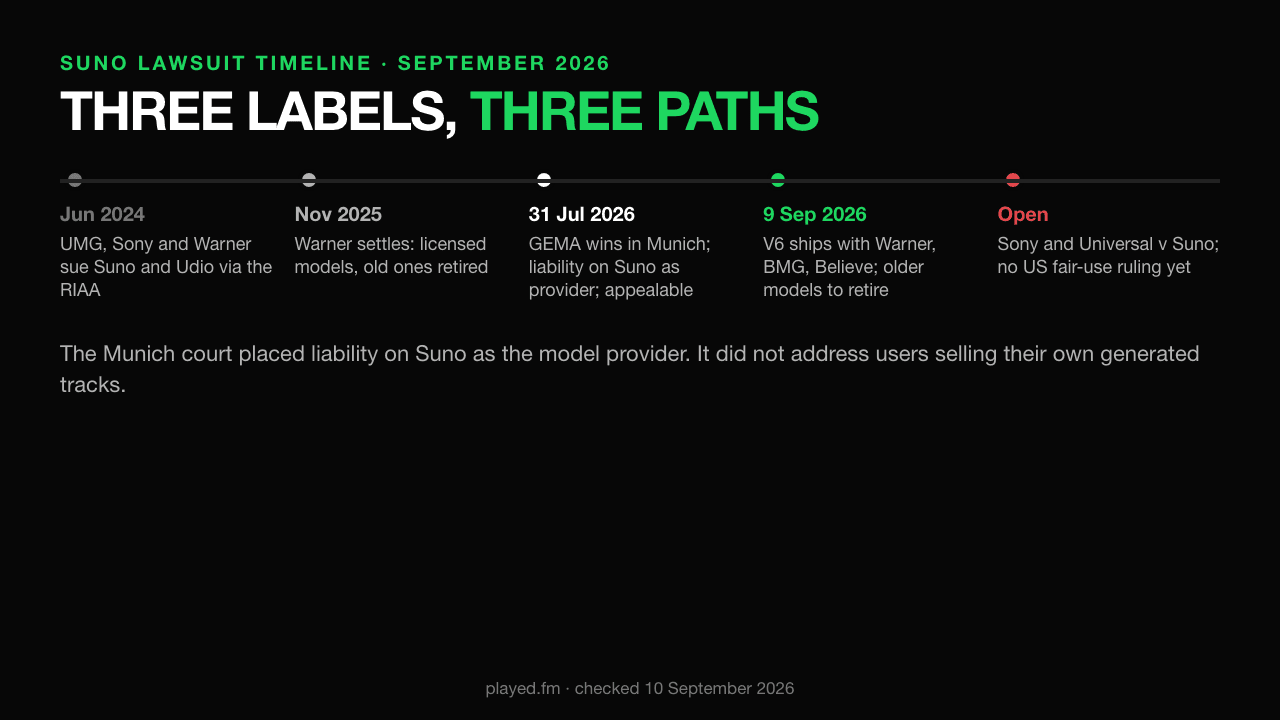
In June 2024 Universal, Sony and Warner, through the RIAA, sued Suno and Udio for training on their recordings without permission. That is the “why is Suno being sued” answer in one sentence. Everything since is the three labels taking three different paths.
Warner settled in November 2025. The terms that matter to users, per The Next Web, were “a commitment from Suno to launch more advanced licensed models and retire its existing ones.” V6 is the licensed model. The retirement of everything before it, which we cover in what happens to your songs when Suno retires a model, is the other half of the same promise.
GEMA won in Germany. On 31 July 2026 the Munich Regional Court I ruled against Suno in GEMA v Suno, finding that specific compositions were reproducibly memorised in the models and rejecting a text-and-data-mining defence. It is appealable and not final. The detail everyone skips: the court placed liability on Suno as the provider. It did not address, and did not create, liability for an artist selling their own generated track.
Sony and Universal continue. No US ruling on fair use has issued, and published reports of the schedule disagree with each other, so we will not pretend to a date. The Next Web notes Sony is separately seeking $4.5 billion from Udio over 30,000 songs, which gives a sense of the stakes the remaining plaintiffs have in mind.
What the Warner deal actually contains
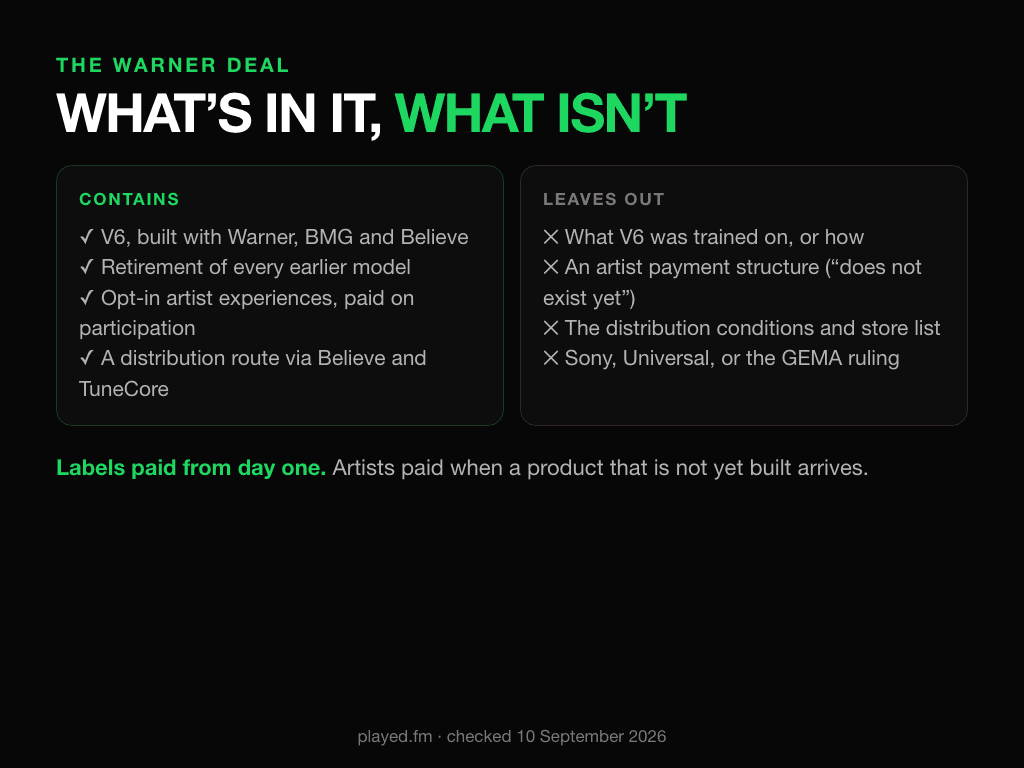
Strip the press release and four things are concrete. A licensed model. V6 was developed with Warner, BMG and Believe, and TechCrunch reports it was not trained on the data used for the earlier versions. Retirement of the old models. Covered above. Artist opt-ins. Suno describes “opt-in experiences built around individual artists, where artists can choose to participate and get paid when they do.” A distribution route. The Next Web: “Songs created on Suno can also become eligible for distribution through Believe and TuneCore, giving AI-generated music a route into the same stores and platforms used by conventional releases.”
That last one deserves a pause. TuneCore is the distributor whose upload filter has rejected Suno tracks all year, a story we tracked in which distributors allow AI music. Believe owns TuneCore. The company that shut the door is now, on paper, holding it open. Read the conditions before walking through it.
What the deal leaves out
Three gaps, and they are the ones that affect you. Nobody has said what V6 was trained on. The Next Web is direct: Suno “names the companies involved and calls them co-developers, but provides no information about which catalogues were used, how much material was included, or how the training was carried out.” We looked and could not find it either. The artist money does not exist yet. Again The Next Web: “There is no payment structure in place yet. The labels are part of the product from Wednesday; the artists are part of a plan for what comes next.” The distribution conditions are unstated. No store is named, and eligibility appears tied to programmes the labels run.
The community read all of this before we did. Under the thread on the Warner CEO’s letter, 264 comments deep, the top reply at 95 upvotes calls it “another blatant move to strong arm and maintain control over the music industry,” and the next, at 76: “LOL. Protect our artists. Sure, right.” You do not have to share the tone to notice that the deal pays the labels now and the artists later, through a product that has not been built.
Don’t wait for a payout product that doesn’t exist
The deal pays labels now and artists later. A fan paying you on your own storefront pays you today. Played.fm is a store for your Suno tracks: upload the file, set the price, share one link, keep 100%. Nothing is exclusive, so it does not stop you taking any distribution route that opens up.
Who owns the songs you make on Suno
The question Google surfaces most under this topic, and the one with the least comfortable answer. It splits in two. “May I sell this?” is answered by Suno’s licence. “Do I own this?” is answered by copyright law, and the two answers are not the same.
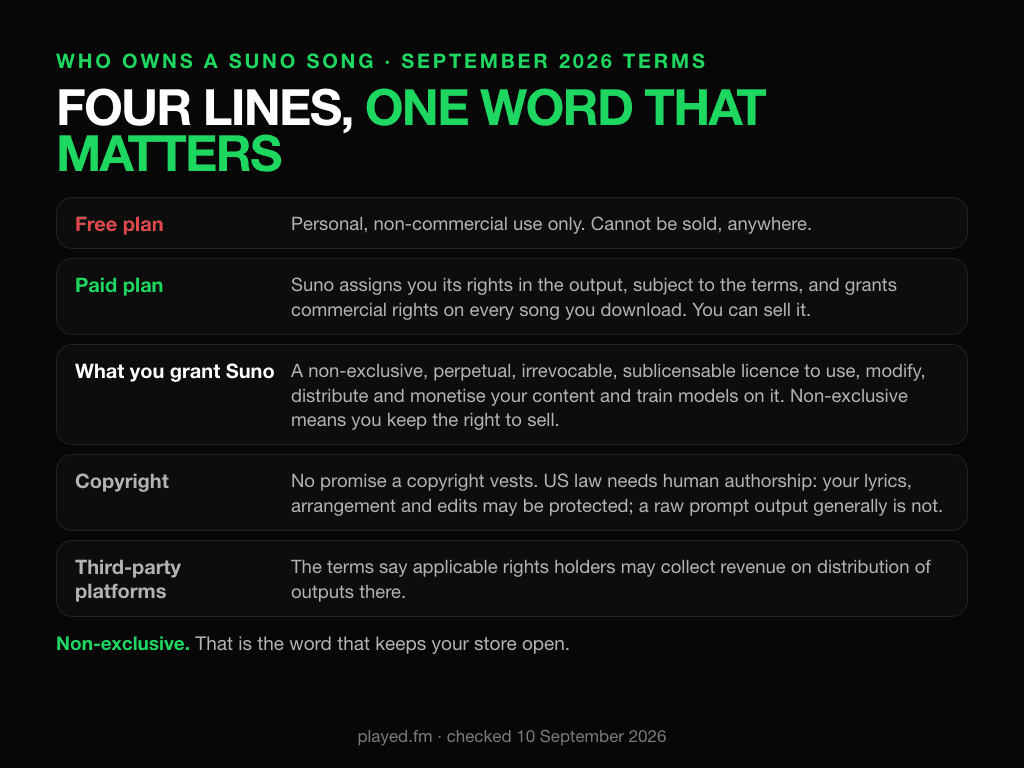
The licence. On Pro or Premier, Suno assigns to you its rights in the output generated during your paid subscription; that is the clause our seller’s handbook quotes from the terms, and the September 2026 terms keep the shape of it. Suno’s FAQ puts it plainly: “For any song that you download from the platform as a paying subscriber, you have the commercial rights to the music.” On the free plan, output is for personal, non-commercial use only. Nothing in the Warner deal changed either sentence.
The ownership. Immediately after assigning you its rights, Suno’s terms add that, because of how machine learning works, it makes no representation that any copyright will vest in the output at all. That is not a dodge; it reflects the US Copyright Office’s position that copyright needs human authorship. Your lyrics, your arrangement and your editing can be protected. The raw output of a prompt generally cannot. You can legally sell a track while having limited power to stop someone copying it.
Can Suno sell your songs? This is where we had to correct ourselves, because the answer in the September 2026 terms is broader than most summaries admit. You grant Suno a “worldwide, non-exclusive, fully paid-up, sublicensable… perpetual, irrevocable right and license to use, reproduce, store, modify, distribute, create derivative works based on, perform, display, communicate, transmit and otherwise make available any and all Content,” for purposes that include “monetization, promotion, marketing, and improvement of our products and services” and training its models, with moral rights waived. Two words in that sentence matter most to a seller. Non-exclusive means the licence does not take your right to sell the song yourself; the assignment to paid subscribers still stands, “subject to these Terms.” Irrevocable means you cannot take the licence back by cancelling. And a new line acknowledges the labels directly: “Applicable rights holders may also have the right to collect revenue related to distribution of Outputs on third party platforms.” Read the terms yourself before relying on any summary, ours included.
What to do with all this
If you make music with Suno and want to earn from it, the legal news changes less than the product news. Make and download on a paid plan, because that is where commercial rights come from, and the settlement did not move that line. Sell direct first. A fan paying you on your own storefront does not route through Believe, Warner or a payout product still on the drawing board. Suno’s licence over your content is non-exclusive, and so is ours, so selling direct costs you nothing if that product arrives, and the rightsholder revenue clause in the terms speaks to “third party platforms,” not to a sale you make on your own store. Keep provenance in mind for sync. If you sign an exclusive licence with an indemnity, the unanswered question of what V6 was trained on is your question too. Export the songs you care about before the download cap and the model retirement make that slower; our download limits guide has the counting rules.
And keep the Munich ruling in proportion. It was a loss for Suno and it was aimed at Suno. Nothing in it made your release unlawful. What the last two years have made clear is that the platform that generates your music is a moving target, and the safest place for a finished song is off it, with a price on it, somewhere no settlement can reach.
Put your songs somewhere no settlement can retire
Played.fm holds the file you upload and sells it to your fans at your price. We take 0% of the sale, ask for nothing exclusive, and nobody reviews the upload. Any audio file up to 200 MB.
Open your store · See paid jobs from film, games and podcasts